Wednesday, March 26, 2014

Lost in Translation...meaning what you say in the 18th century

Doctor Johnson in the Ante-Room of the Lord Chesterfield Waiting for an Audience, 1748
by Edward Matthew Ward, 1845
So, having reached Part II of my work-in-progress, Through the Hourglass, my young heroine time travels back to 1718. As a sixteen-year-old from the year 2014, one of her immediate adjustments is that of language. Even though she is in her hometown of Edenton, North Carolina (known at the time as the Town on Queen Anne's Creek,) and even though the inhabitants are speaking her own native English, she finds the meanings of many words have changed, causing much room for misunderstandings!

In researching the changes in word usage, I came across the dictionary authored by
Samuel Johnson's 1755 Dictionary of the English Language
Samuel Johnson in 1755. (Another 18th century book with a loooong sub-title:)

A DICTIONARY OF THE ENGLISH LANGUAGE: 
IN WHICH The WORDS are deduced from their ORIGINALS, 
AND ILLUSTRATED in their DIFFERENT SIGNIFICATIONS 
BY EXAMPLES from the best WRITERS. 
TO WHICH ARE PREFIXED, A HISTORY of the LANGUAGE, 
AND An ENGLISH GRAMMAR, 
By SAMUEL JOHNSON, A. M. 
In TWO VOLUMES.  

Thanks to the wonders of the Internet, you can peruse Mr. Johnson's work at: 
 www.johnsonsdictionaryonline.com 
(You can see photos of the actual original pages by clicking "Page View.")

Here is a list of examples, one for each letter of the alphabet, to give you some idea of the misunderstandings a time traveler might encounter:

AWFUL—Not rotten but awe-inspiring, as in “awful majesty.”
BAGGAGE—An insulting term for a woman, like “hussy.”
CLOWN—A rustic or bumpkin, not a circus performer.
DESERT—Any deserted or uninhabited place—a wilderness, not necessarily a place filled with sand. 18th century author Daniel Defoe placed his Robinson Crusoe on a desert island filled with lush vegetation.
ENTHUSIASM—Fanaticism, especially in religious matters. Not a positive attribute.
FOND—Foolish, naive, innocent.
GENEVA—Gin. The word and its shortened form come not from the Swiss city, but from genever, Dutch for juniper, the plant which provided the flavor for the original Dutch variety.
HOTHOUSE—Brothel.
INTERVIEW—Any sort of meeting. Not just to see about getting hired for a job.
JADE—Could refer to the green stone we think of today but also as an abusive term applied to women; something like slut.
KID—Young goat. To kid meant to bring forth young goats. (Nothing at all to do with teasing!)
LEECH—Johnson’s first meaning is: physician (and not derogatory at all) and second meaning is: the critter that sucks blood. The norm for medical treatment was bleeding the patient.
MAKE LOVE—Johnson lists 59 entries under "to make___" and this is number 39: To court, to woo (with no sexual connotation.)
NICKNAME—A name given in contempt with great derision.
OUCH—An ornament of gold or jewels, unless referring to the ouch of a boar in which it means a blow from a boar’s tusk, (Ouch!)
PECULIAR—Particular (not odd or unusual.)
SNACK—A share of something often by a compact or agreement.
TOILET—A dressing table (no indoor plumbing, remember?)
UPHOLSTERER—One who furnishes houses (not limited to one who makes or repairs upholstered furniture.)
VINE—The plant that bears the grape (apparently all vines were assumed to be those that produced vino.)
WOMANIZE—To make a man more like a woman, effeminate, emasculate (something done TO a man not BY a man.)
X—“No words in English language begin with this letter” according to Samuel Johnson.
YUCK—Itch
ZONE—Girdle (which meant anything that surrounded one’s middle not just the suck-you-in undergarment of your grandmother’s day. )
Sophia Drake, by Ralph Earl, 1784

As you can see, a young time traveler could get herself into a lot of hot water if she misspoke or misunderstood. Let's hope she doesn't go for an interview as a hothouse worker!

Have a good week, dear Reader. Thanks for stopping by...Y'all come back now! 

Kate


Wednesday, March 19, 2014

The Luck of the Irish...was NOT with Poor John Lawson

Portrait thought to be of John Lawson, 1700, artist unknown
I write this on the eve of St Patrick's Day to be first read on March 19 while I trust visions of all things green and lucky are still dancing in your head (and perhaps a bit of maniacal step dancing by some leaping leprechauns, as well!) At any rate, for some unknown and mysterious reason, my thoughts have turned to that most unlucky of eighteenth century fellows, John Lawson. Oh, poor John. Truly.
Title Page of John Lawson's Book


Last week's blog post featured John Lawson's glowing account of the qualities of women he discovered on his journey throughout the Carolinas in the first decade of the 1700s, published in 1709 as A New Voyage to Carolina; Containing the Exact Description and Natural History of That Country: Together with the Present State Thereof. And a Journal of a Thousand Miles, Travel'd Thro' Several Nations of Indians. Giving a Particular Account of Their Customs, Manners, &c 
See: https://archive.org/details/newvoyagetocarol00laws to view a copy of his book.

Before delving into the awful manner of Mr. 
Carolina Wildlife from John Lawson's Book
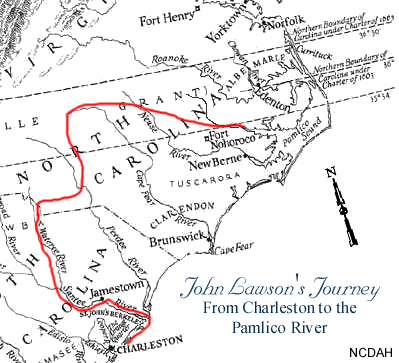
Map of John Lawson's Journey from
Lawson's demise, let me tell you a little of this remarkable man's accomplishments. In addition to exploring, what was then, a land of rough and tumble people, a land filled not only with the natural beauty and grace of its gentler inhabitants, but also with poisonous snakes, savage biting insects, and an air of lawlessness we usually attribute to the Wild West frontier days of America, John Lawson was responsible for the layout and establishment of North Carolina's oldest town, Bath, as well as for that of the town of New Bern, North Carolina. John Lawson traveled on foot and by canoe as he witnessed and recorded the amazing diversity of flora and fauna as well as the people, both native and immigrant. Note--I use the term, "Indian," here as that is how Lawson described them as opposed to today's preferred term, "Native American."--  On December 28, 1700, he, along with a crew of five Englishmen, three Indian men and one Indian woman, set out on a fifty-nine day journey snaking along rivers and trading paths beginning at what is now Charleston, South Carolina, moving in a crescent out to the piedmont region of both South and North Carolina and ending near present day Bath, on the coastal plain. Although probably about five hundred miles as flies the proverbial crow, his trip took such a circuitous route, his claim of a thousand miles is not unwarranted. His descriptions of the many Indian tribes he encountered (often a different one for each river) were, though sometimes colored with his bemusement, most often respectful, sometimes comparing them favorably to his fellow countrymen (and women.) To quote Lawson, with modern spelling:

Amongst (Indian) women, it seems impossible to find a Scold: if they are provoked, or affronted, by their Husbands, or some other, they resent the Indignity offered them in silent tears, or by refusing their Meat. Would some of our European Daughters of Thunder set these Indians for a pattern, there might be more quiet Families found amongst them, occasioned by that unruly Member, the Tongue.

Lawson did not limit his praise to the fairer sex, however, and although he referred to the native people as savages, he often remarked they were less savage in some ways than their Old World counterparts. His praise of the native peoples is all the more ironic in that his death was at the hands of the Tuscarora, whom he acknowledged with sympathy and respect in his book.
Tuscarora Warrior, artist unknown

in 1711, on the verge of war against the colonists, some of the Tuscarora looked upon Lawson as an agent representing people who were the source of terrible injustice and mistreatment of the natives. Not only had Indian lands been confiscated but many Indian women and children had been taken as slaves. Lawson, for all his close interaction with the Indians, appeared unaware of their belief that he was actually working against them. In mid-September, during a time simmering with hostility, John Lawson placed himself in the heart of Indian country as he took an expedition trip along the Neuse River to find a quicker route through North Carolina to the Virginia border. He was captured by Tuscarora warriors and subsequently killed. Baron Christoph Von Graffenried and his slave who accompanied Lawson on that fateful trip were eventually released by their captors and the baron's own illustration of the event is included in today's post. For those with a weak stomach or prone to nightmares, I seriously suggest you stop reading the remainder of this post. I am not being humorous and I certainly want the Reader to understand the grave and graphic nature of the description passed down to us from centuries past. Although it may have been embellished for reasons of propaganda, the methods described match those Lawson, himself, recorded during his time among the Tuscarora. So, here goes:
The Death of John Lawson, 1711, by Baron Christoph Von Graffenried

Splinters made from pitch pine were stuck into Lawson's skin covering his entire body. The horrible pain this caused was then increased a thousand fold when the splinters were set ablaze and the unfortunate man was burned alive. To quote Marjorie Hudson in her article, "Among the Tuscarora: The strange and mysterious death of John Lawson, gentleman, explorer, and writer," reprinted at http://www.learnnc.org/lp/pages/1645  from its original publication in North Carolina Literary Review, Vol. 1, No. 1, Summer 1992: 

His bleeding skin numbed by pitch pine, he begins to feel the heat on the skin of his legs and feet, the rush upward, the death dance now frenzied in his limbs, the last sight of this world framed in fire, and, finally, the soul escaping into a heavenly place like Eden, like the New World when it was still young, belonging to itself alone, a land that fulfills all expectations of balance, of beauty, of perfect enmity.

This terrible event preceded a war between the Tuscarora and the colonists which after two dreadful years ended with all of that tribe either killed, taken as slaves, or fled northward out of the Carolinas.

Have a good week, dear Reader. Thanks for stopping by...Y'all come back now! (And may we learn from the past.)

Kate


Wednesday, March 12, 2014

Brisk Charming Eyes...Carolina Girls of the 18th century

Portrait of an Unknown Lady of South Carolina, 1708-1709, by Henrietta Johnston

In 1709, British Surveyor General John Lawson, wrote an extensive description of the Carolinas which served as an enticement for men of England to brave the seas and help colonize the land. The title for this work certainly boasts one of the longest sub-titles this author has ever seen:

A New Voyage to Carolina; Containing the Exact Description and Natural History of That Country: Together with the Present State Thereof. And a Journal of a Thousand Miles, Travel'd Thro' Several Nations of Indians. Giving a Particular Account of Their Customs, Manners, &c


One of the most entertaining sections of his treatise is his description of the amazing virtues of the region's women. Not only were they "often very fair" and "very fruitful," they were, apparently, not afraid of heavy, outdoor labor and "very handy in Canoes!" Read on to see Lawson's own words regarding these remarkable women: 


"The Women are the most industrious Sex in that Place, and, by their good Houswifry,
A Girl Sewing, 1750, by Philip Mercier 
make a great deal of Cloath of their own Cotton, Wool and Flax; some of them keeping their Families (though large) very decently apparel’d, both with Linnens and Woollens, so that they have no occasion to run into the Merchant's Debt, or lay their Money out on Stores for Cloathing.

As for those Women, that do not expose themselves to the Weather, they are often very fair, and generally as well featurd, as you will see any where, and have very brisk charming Eyes, which sets them off to Advantage. They marry very young; some at Thirteen or Fourteen; and She that stays till Twenty is reckon’d a stale Maid; which is a very indifferent Character in that warm Country.

The Women are very fruitful; most Houses being full of Little Ones. They have very ­­easy Travail in their Child-bearing, in which they are so happy, as seldom to miscarry It has been observ’d that Women long marry’d, and without Children, in other Places, have remov’d to Carolina, and become joyful Mothers.
Louisa Balfour, 1751, by Phillip Mercier


Many of the Women are very handy in Canoes, and will manage them with great Dexterity and Skill, which they become accustomed to in this watry Country. They are ready to help their Husbands in any servile Work, as Planting, when the Season of the Weather requires Expedition; Pride seldom banishing good Houswifry. The Girls are not bred up to the Wheel, and Sewing only; but the Dairy and Affairs of the House they are very well acquainted withal; so that you shall see them, whilst very young, manage their Business with a great deal of Conduct and Alacrity."

Perhaps the Beach Boys should have been singing, "I wish they all could be Carolina girls!"

Have a good week, dear Reader. Thanks for stopping by...Y'all come back now!

Wednesday, March 5, 2014

That's Entertainment...18th century American style

    
The movie award season was capped Sunday night by the 86th Annual Academy Awards ceremony and it made me ponder just what our 18th century American ancestors did for entertainment. Well, the answer is quite a lot, actually. For those wishing to sit back and be entertained there was the precursor to film, live theater, and for the more adventurous, there were circuses. Much of 18th century entertainment was, of course, the do-it-yourself variety and included board and card games, sing-alongs, dancing, and books of jokes and instructions in fortune-telling. We'll get to those later but, this week, let's take a look at the spectator-based entertainments, theater and circus. 
The Laughing Audience, mid 1700s, by William Hogarth

Live theater was determined unsuitable for the mores of the American colonies until the mid-1700s. The Library Company of Philadelphia tells us that in the first half of the century, "religious reformers believed that plays encouraged licentiousness, promoted effeminacy and homosexuality among men, encouraged treachery and hypocrisy (as acting was a form of lying), competed with religious worship, and often challenged religious doctrine."  It wasn't until 1752 that theater was considered somewhat respectable, with the first advertised play being a performance of Shakespeare's Merchant of Venice by a theater troupe from Great Britain called the American Company. This production was held in that hotbed of questionable morals, Virginia. It wasn't until 1792 when the anti-theater act of 1767 was finally repealed that New Englanders were free to see such spectacle. Even then, religious purists of that region preached the dangers of the theater and prospective drama devotees had to travel to large cities such as New York to get a taste of such entertainments. 
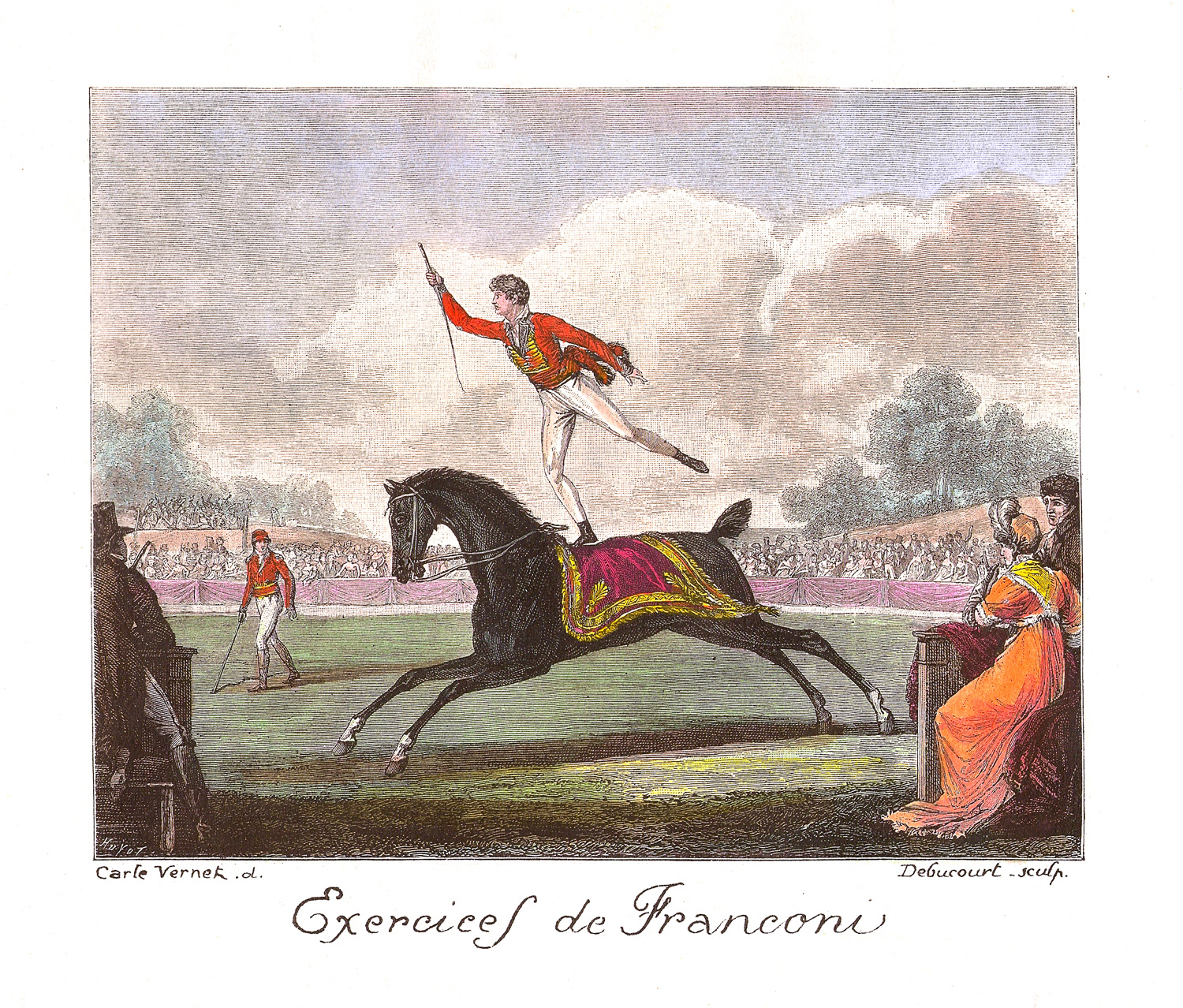
Laurent Franconi, 1800,  by Carle Vernet 

Now, for the circus. As might be expected, some religious leaders of the time were dead set against such exotic entertainment, primarily because it drew together crowds of people of all socio-economic levels, age and gender and heaven knows what that could lead to! It was also considered a dubious distraction from religious duties. Puritanical objections aside, the first circuses were based on feats of equestrian prowess. Riders performed tricks on horseback that were best accomplished and seen when enclosed in a circle. Thus the term circus, as it relates to the modern circus, came into being. By the end of the century, circuses were extremely popular, drawing those crowds of disparate folks together. Over time, the trick-riding acts were interspersed with other entertainers in the way of clowns and acrobats. The first circuses were housed in buildings set aside for the purpose and in 1793 a British equestrian, John Bill Ricketts, opened the first American circus in the city of Philadelphia followed shortly by the circus of another British horseman, Philip Lailson. By then, the ultra-conservative element of the religious faithful were convinced America was surely going to hell in a brightly festooned hand basket.

Have a good week, dear Reader. Thanks for stopping by...Y'all come back now!

Thanks to the following for today's resource material:

http://www.librarycompany.org/zinman/entertainment.htm

http://www.circopedia.org/SHORT_HISTORY_OF_THE_CIRCUS


Wednesday, February 26, 2014

18th Century Man, Woman, and Child's Best Friend...going to the dogs

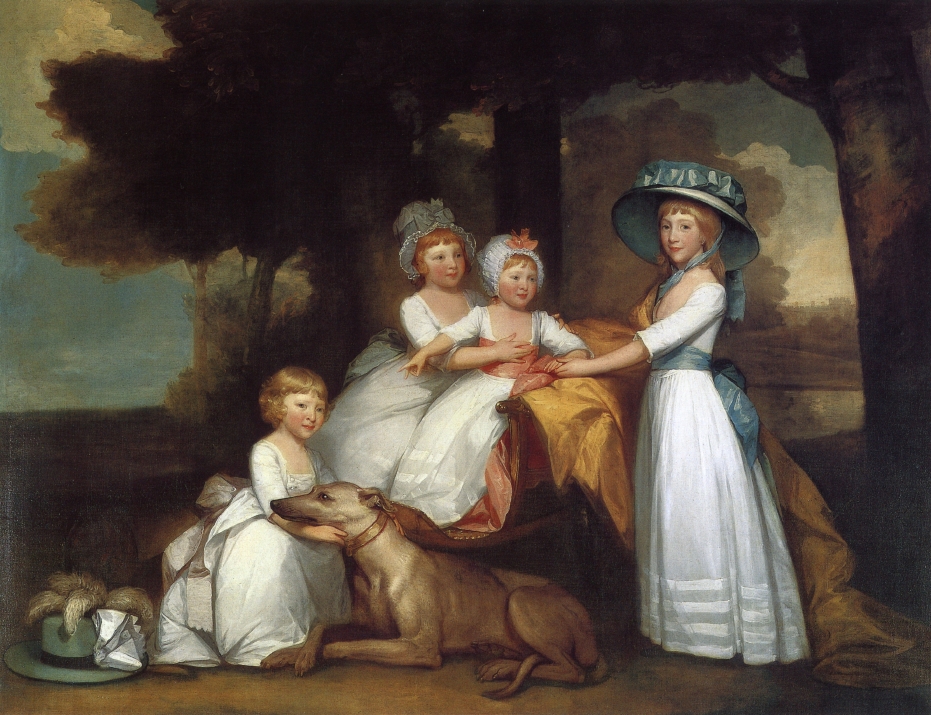
The Children of the Second Duke of Northumberland, 1787, Gilbert Stuart
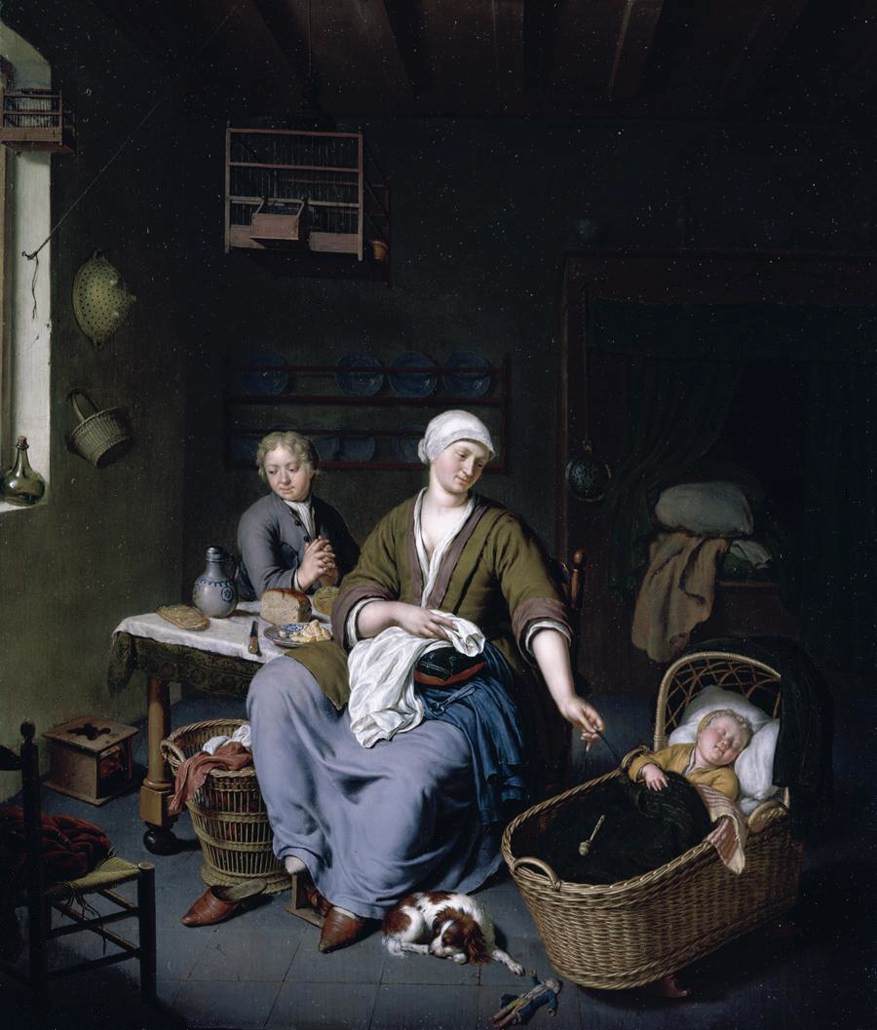
In 21st century America, our pets are often considered family members, be they dogs, cats, goldfish, ferrets, rabbits, pot-bellied pigs, horses, llamas, hamsters, what have you. Examining portraits from the 18th century, we see this is really nothing new at all. Many portraits included dogs, cats, and birds, as well as more exotic pets and, by virtue of them being painted with their people, we can easily surmise the importance they played in the family structure. Today I would like to salute the 18th century pet dog and show you several paintings that include man's (as in mankind's) best friend. As you can see, dogs were included in paintings depicting all
Louis XIV and His Family, 1710, by Unknown, formerly attributed to Nicolas de Largillierre
socioeconomic strata from the humblest peasant to the highest monarch. My novel-in-progress has a dog as an integral part of the story so I was interested in seeing the kinds of dogs who populate 18th century paintings.
Enjoy!


George Venebles Vernon, 1767, Thomas Gainsborough
Cottage Girl with Dog and Pitcher, 1785, by Thomas Gainsborough


Woodes Rogers and his family, 1729, by William Hogarth
The Children of King Charles I of England, 1637, Anthony van Dyck (17th century but just had to include it!)
Louis Philippe Joseph, Duc d'Orleans and Duc de Chartres
18th century, by Louis Tocque
Elisabeth Isabella Mniszech , 1797, by Marie Élisabeth Louise Vigée
 Interior with a Mother Attending her Children, 1728, by Willem van Mieris


e
Portrait of a Lady with a Dog and a Monkey, 1710, by Nicolas de Largillierre
Teresa Vandoni, Italian singer, 1797, Carl Frederick von Breda
Philip of Parma, 1765, by  Laurent Pécheux
I even found our Betsy in the portrait above! 

Kate and Betsy at Yellowstone National Park, 2011, by William F. Ahearn
Have a good week, dear Reader. Thanks for stopping by...Y'all come back now!

Wednesday, February 19, 2014

What's Love Got To Do With It?...18th century courtship and marriage


"The Judicious Lover" 18th century after Hubert Gravelot
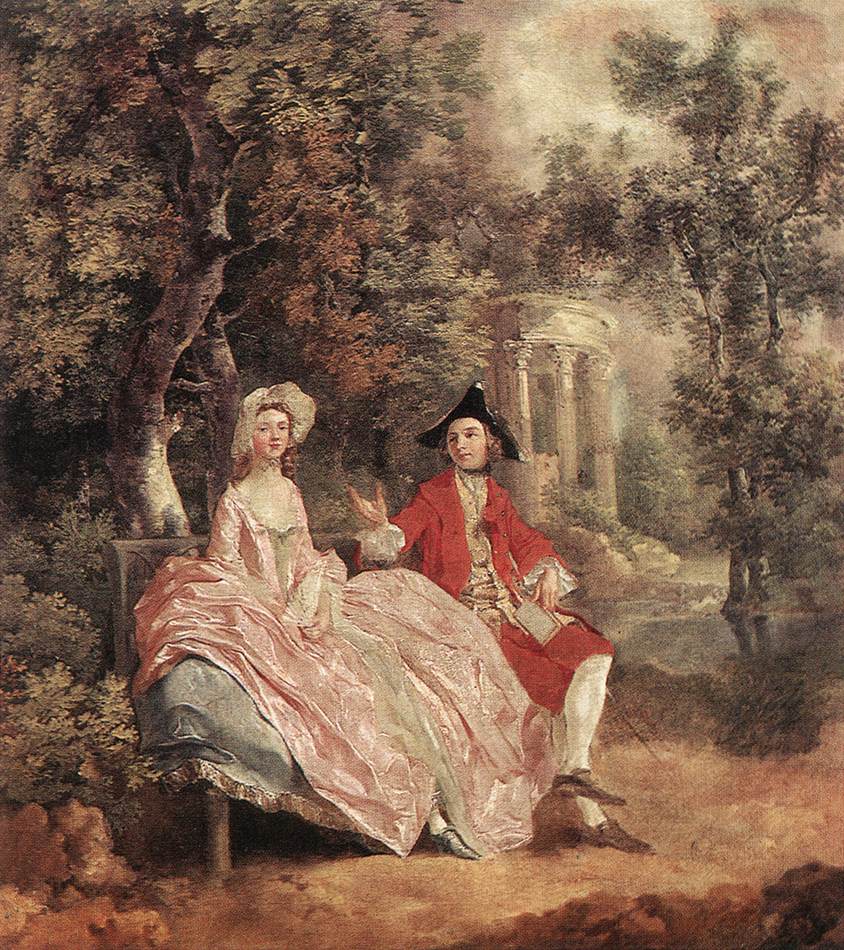
In the early 18th century, whether you married for love or money was often a matter of socioeconomic class. As in ladies’ fashions, the higher your social status, the lower your ability to do as you pleased. For the upper class, marriage was an arrangement made by parents seeking to cement the foundations of their wealth and power in the community. Any notions of romance were seen as secondary and, in truth, detrimental to such pairings. It was a thoughtful business decision set apart from the mercurial passions of the young people. Love, as such, was something one might grow into as the couple lived out their respectable, marriage contract. (Or…attained outside the bonds of marriage.) Young women, especially, had little to say in the matter and knew, once they were married, any small amount of independence they currently enjoyed was put to an end as their husbands would have complete legal control over them. If a young man’s attention was independently drawn to a particular lady, he would first have to receive the permission of his own father who, if he approved of the potential match, would send a formal request to the young lady’s father. The two patriarchs would meet and discuss the financial arrangements and if a 
"Conversation in a Park" (1768) Thomas Gainsborough
satisfactory deal was made, the son was given permission to court the object of his affections prior to the agreed-upon marriage (whether or not the young lady had any interest at all.) If a young couple fell in love without the approval of their fathers, their only choice was to dissolve all financial ties and rights from their families, losing any inheritance they may have expected, and set out on their own. In today’s world of modern love and independence, that choice may seem a no-brainer but it was a very difficult move in the early 1700s. In some areas, the unapproved suitor could be sued by the young woman’s father for inveigling her affections, gaining her love through trickery. It was not until the mid to late 18th century that parental control diminished and young people of the upper classes were freer to court and marry based on romantic love.
    
"Haymaker and Sleeping Girl" (1785) Thomas Gainsborough
Now of course, if you were born into a lower rung of the societal ladder, your choices for courtship and marriage were much broader since wealth and status were not part of the
equation. That did not mean, however, families felt no responsibility for their children's welfare. The practice of “bundling” in which a courting couple were allowed to sleep in the same bed, fully clothed with a bundling board or bolster between them in the young lady’s family home, served a dual purpose. In many lower income families, everyone slept in the same room, and it was a means in which not only the young lovers could get to know each other better but also as a way of proving the identity of the unborn baby’s father if things progressed, as they so often would, despite the physical barriers.

 In this more relaxed attitude toward courtship and marriage, there were varied forms of marriage agreements in the early 1700s, not all dependent upon a minister or magistrate. One of the more prevalent means was “handfasting” or “spousal” in which the young couple, with or without witnesses, simply held hands and promised love and loyalty, declaring themselves married. These personal ceremonies were held anywhere the couple chose and in Colonial America
"Young Girl Listening to Conversation Between Two Lovers"
(1789) by Michel Garnier
were often performed over an anvil in a blacksmith’s shop, symbolizing the strength of their bond. Some were held right in the bedroom just prior to conjugal bliss. Since a number of those husbands disappeared by morning’s light, the bride would sometimes hide her friends in the closet as witnesses to
the ceremony. For spousals that were sincere, the couple often gave each other the gift of a half a broken silver sixpence which each kept until death did them part. Another custom was called “spousal de futuro,” which was an announcement of engagement, but if a baby was conceived in the interim, the status was automatically elevated to “spousal.”

"The Joys of Motherhood" (1752) by Jean-Honore Fragonard
Remember this old chant from your childhood?  “First comes love, then comes marriage, then comes (insert name of choice) with a baby carriage.” As you can see, in the early 18th century, the order of events could take any number of variations and, come to think of it, that’s not so different from today, after all!


Have a good week, dear Reader. Thanks for stopping by...Y'all come back now!

Wednesday, February 12, 2014

Love is in the Air...18th Century Valentine Wishes

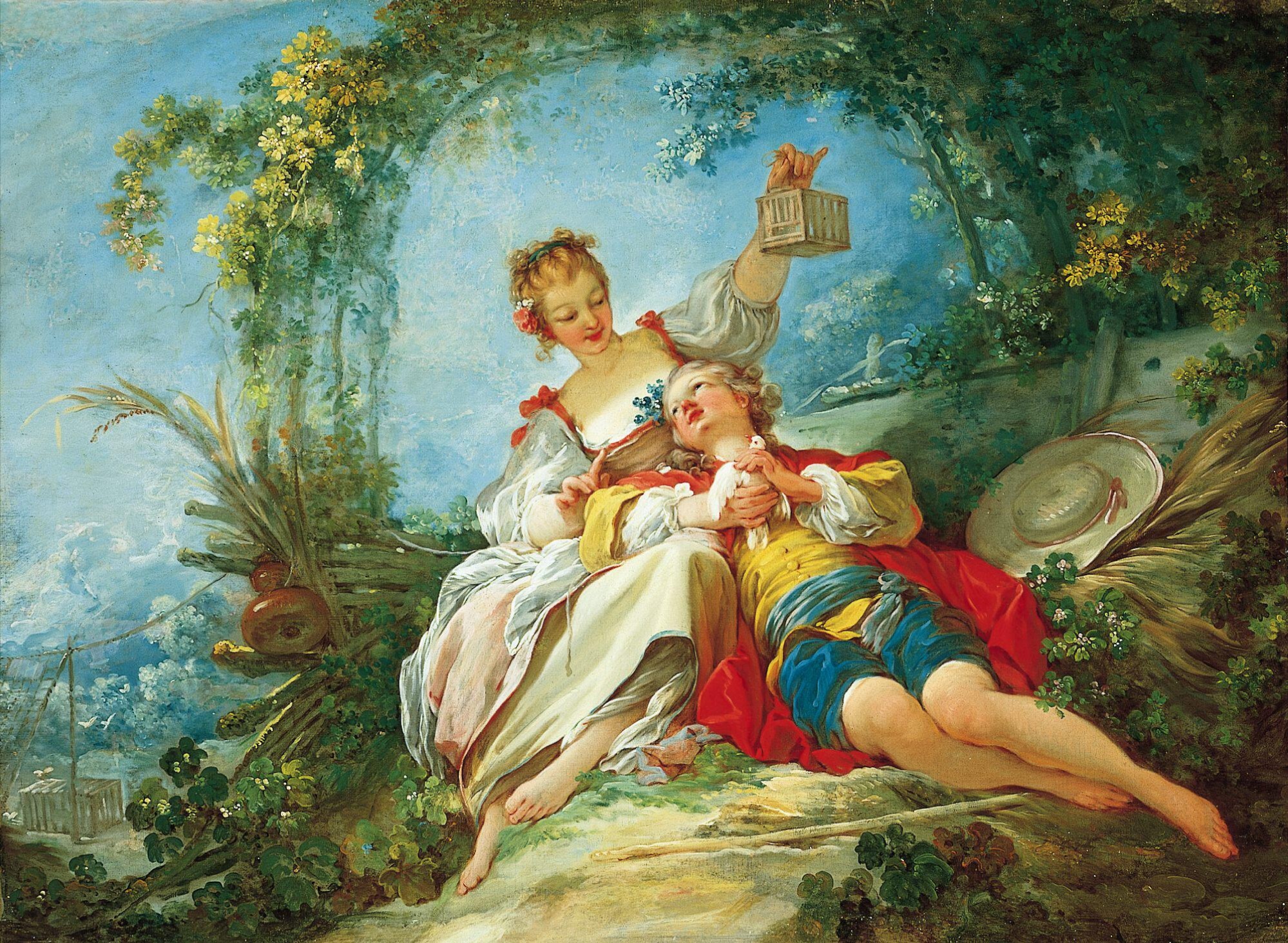
"Happy Lovers" (1760-1765) by Jean-Honore Fragonard


"St. Valentine Baptizing St. Lucilla" (1575) by Jacopo Bassano
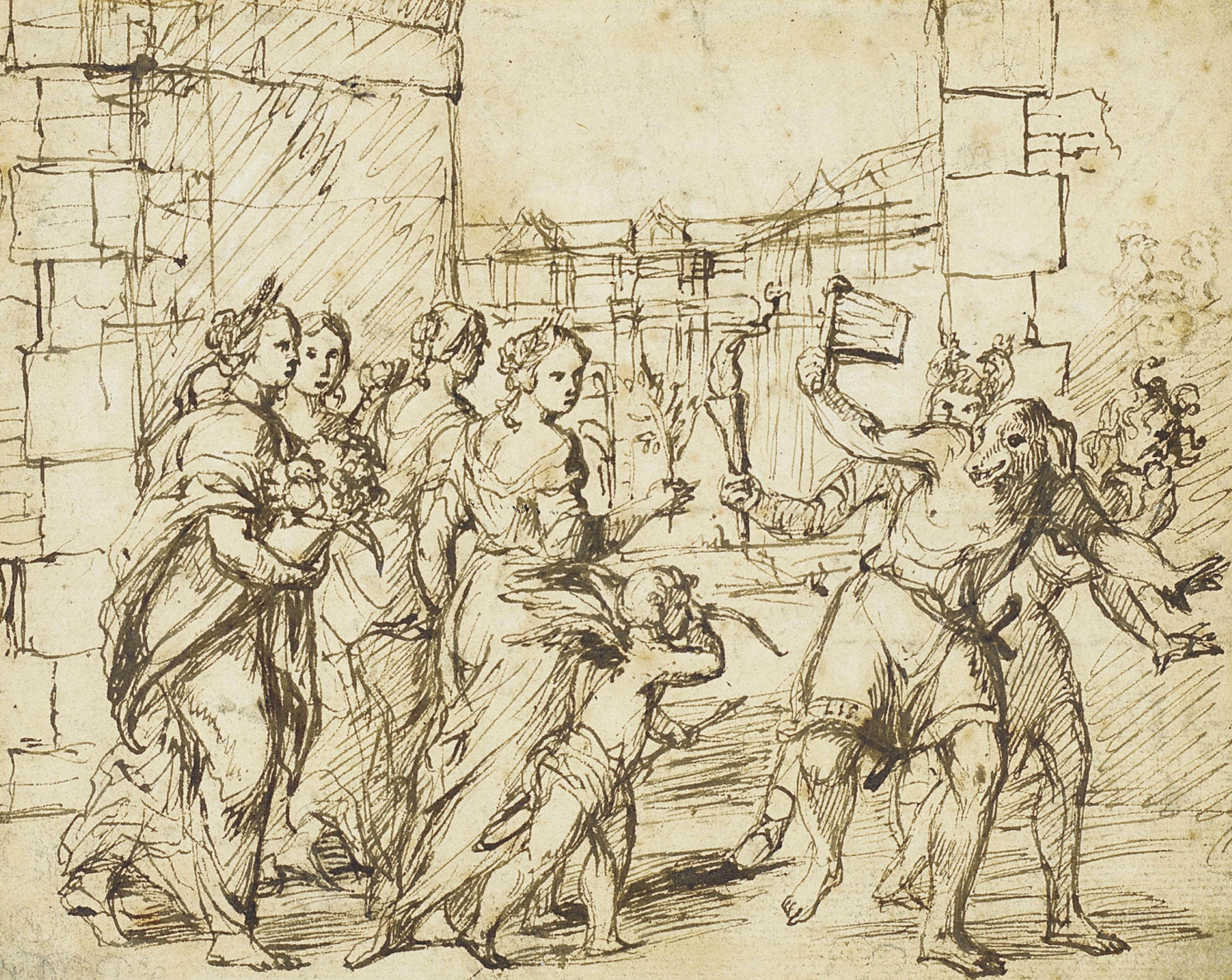
"The Lupercalian Festival in Rome" by the Circle of Adam Elsheimer (1578-1610)
Ah…’tis the week of love culminating in Valentine’s Day this Friday the 14th. Many’s the modern man who looks upon this day with disdain claiming it’s just a made-up day by the greeting card companies, a pernicious ploy to part the lover from his cash, to trap his heart in ransom until he buys his love a valentine. Oh, but he would be wrong, at least as far as the origins of the day are concerned. Celebrating February 14 as a day for proclamations of love goes waaaay back to ancient Roman times. Although more than one story exists as to how the saint, for which the day is named, became associated with romantic love, there are two likely scenarios. One, is that a priest named Valentine, who lived in 3rd century Rome, defied Emperor Claudius II’s orders and performed secret wedding ceremonies for soldiers. The emperor had outlawed the marriage of his soldiers, deeming them less useful if they had wives and children to think of. When Claudius II learned of the priest’s actions, he had him imprisoned and sentenced to death. Another story has it that while in prison, Valentine fell in love with the jailer’s daughter who was kind to him and, before his death, penned her a letter reading “From your Valentine.” 

Long before Valentine, however, the Romans celebrated the festival of Lupercalia, a day in mid- February dedicated to the god of fertility, Faunus. In the 5th century, in an effort to distract Christians from the pagan activities, the church deemed February 14 as
Saint Valentine’s Day, the day on which the saintly priest was martyred. In the middle ages, the good folk of England and France thought that February 14 was the day birds chose their mates for the season and in this mix of pagan fertility rites, loving saints, and love birds, the romantic notions of Saint Valentine’s Day came to full flower.


"Lovers in a Landscape" (1740) Pieter Jan van Reysschoot 
                    
" Helene Lambert de Thorigny" (1700) Portrait by Nicolas de Largillierre
Flowers by 
Jean-Baptiste Belin de Fontenay
Jumping ahead to the 18th century, we find many poems flowing from romantic hearts and hand-written messages of love being exchanged on February 14. And if a love-struck Romeo of the late 18th century found himself at a loss for words, he could refer to a book published in Great Britain in 1797 entitled, The Young Man’s Valentine Writer. Remember the old standard, “Roses are red, Violets are blue?” Well you will find the original is a Valentine message written in a collection of English nursery rhymes in 1784, 
Gammer Gurton’s Garland. 
Here, you see it in its original version:

The rose is red, the violet's blue,
The honey's sweet, and so are you.
Thou are my love and I am thine;
I drew thee to my Valentine:
The lot was cast and then I drew,
And Fortune said it shou'd be you.


"Mary Darby Robinson as 'Perdita' "(1782) by Joshua Reynolds 
For more adult verses, I give you a prolific female poet of the 18th century, Mary Darby Robinson, whose life was short on years but long on romantic intrigue (including a bout with the teenaged Prince of Wales, but that’s for another day!) Here, I present one of her many poems touting the sweet pain love can inflict upon us:

“Sonnet XVII: Love Steals Unheeded”

Love steals unheeded o'er the tranquil mind,
As Summer breezes fan the sleeping main,
Slow through each fibre creeps the subtle pain,
'Till closely round the yielding bosom twin'd.

Vain is the hope the magic to unbind,
The potent mischief riots in the brain,
Grasps ev'ry thought, and burns in ev'ry vein,
'Till in the heart the Tyrant lives enshrin'd.
Oh! Victor strong! bending the vanquish'd frame;
Sweet is the thraldom that thou bid'st us prove!
And sacred is the tear thy victims claim,
For blest are those whom sighs of sorrow move!
Then nymphs beware how ye profane my name,
Nor blame my weakness, till like me ye love.
    
"Robert Burns" by Alexander Naysmith (1758-1840)
Turning to that 18th century superstar of songs and poetry, I give you Scotland’s Robert Burns whose hundreds of verses are full of romantic notions. Here is one of his all-time favorites:

"A Red, Red Rose" 

O my Luve's like a red, red rose
That's newly sprung in June;
O my Luve's like the melodie
That's sweetly played in tune.

As fair art thou, my bonnie lass,
So deep in luve am I;
And I will luve thee still, my dear,
Till a' the seas gang dry:

Till a' the seas gang dry, my dear,
And the rocks melt wi' the sun;
I will luve thee still, my dear,
While the sands o' life shall run.

And fare thee weel, my only Luve,
And fare thee weel awhile!
And I will come again, my Luve,
Tho' it ware ten thousand mile.

Yes, just give Robbie a lass’s name and he’ll pen her tribute. Here is a list of names I pulled from his long list of poems and songs (perhaps you’ll find your lady’s name!)
Lesley
Mary
Mary Ann
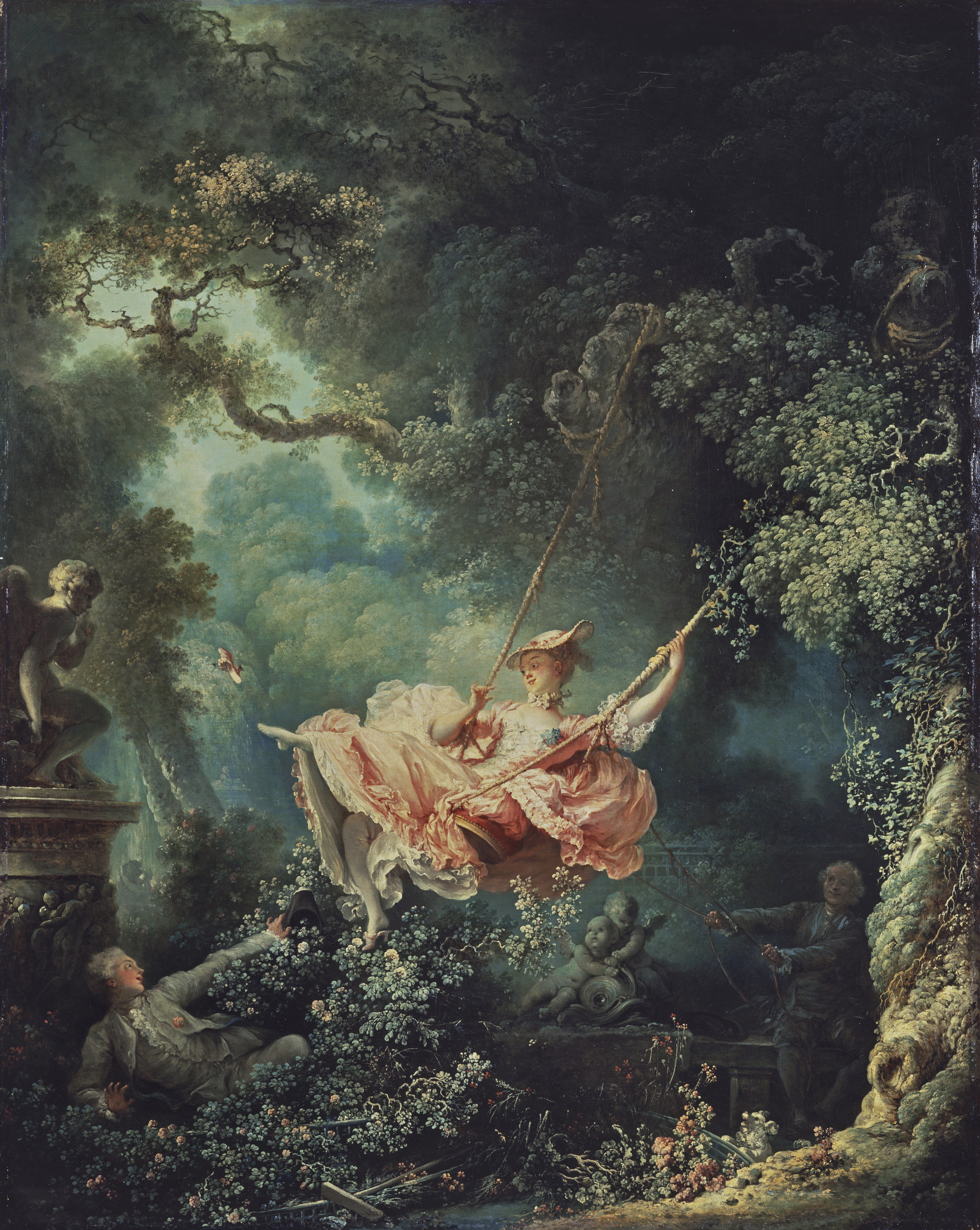
"The Swing" (1767) by Jean-Honore Fragonard
Bell
Nell
Eliza
Eppie
Nanie   
Polly
Sylvia
Bessie
Jessie
Meg
Peggy
Peg
Stella
Jean
Jeanie
Clarina
Clarinda
Ann
Anna
Phillis
Nancy
Jessie
Cholris
Philly
Leezie
Mally
Katie
"Lovers First Tiff" (1876 painting of an 18th century scene)
by Louis Haghe

A busy man was our Rrrobbie! Now, if you find a poem suitable for your love, you may want to do a little Scottish/modern English translation or you just might honor her with a line like this from one of his poetic ditties: “Johnie lad, cock up your beaver…”

Hmmm…well on that note, I think it’s time to draw this post to close!

Have a good week, dear Reader. Thanks for stopping by...Y'all come back now!  (And Happy Valentine's Day!)


Wednesday, February 5, 2014

How to Survive Winter...18th Century Style

The Four Seasons, Winter, 1755 by Francois Boucher
Brrrrrrr, it's been a cold winter, so far, even down here in Edenton, North Carolina where we're still recovering from our six inches of snow and two degree (F) wind chills a few days ago. (Yes, I know for some of you in more northern climes, that sounds down right balmy, but it's all relative!) Living in a drafty old house made me wonder how our 18th century ancestors managed without central heat and indoor plumbing. Chills me to the bone just thinking about it!

Comtesse Tessin, 1741, by Jean Marc Nattier
So, let's say you are a woman who has time traveled back to the 18th century in the dead of winter and you need to warm up...fast! First of all, let's be sure you are properly dressed. If you are a highly fashionable woman such as the young lovely pictured above in her swan-decorated, man-driven sleigh, your choices are fewer than if you are of the lower-classed variety. Your silk gowns are low-cut in the bodice and the sleeves end right around your elbows. You can achieve some relief by wearing woolen stockings and quilted petticoats beneath your skirt and perhaps a woolen waistcoat over your corset and beneath your gown. You may keep your hands warm by tucking them inside a fur muff. During the 18th century, the size of your fur muff increases dramatically and becomes a status symbol. The wealthier you are, the larger your muff. As a matter of fact, some French women were known to carry small dogs inside their huge muffs. I suppose that would add another layer of warmth as well! Now, if you are still cold and must cover your beautiful gown, you might wear an elbow-length, fur-lined cape. A light scarf can cover your head but if you arrive in the latter quarter of the century, your formal wigs double
A Winter Landscape with Figures Skating on a Frozen River, early 1700s, by Dirck Dalens III
as head warmers. Of course, the flipside to that is the undesired heat they capture come summertime, but that's for another, more sultry day... If you are a less fashionable lady you have more latitude and may wear skirts of heavier, courser, warmer fabric and cover your less-than-vogue dress with a longer, hooded cloak. Think you might get by wearing long underwear? Think again, dear lady, no matter your class, women did not wear underpants or drawers of any kind in the 18th century.

Traveling? Be sure you have plenty of warm woolen blankets or furs, if you can afford them, to cuddle beneath while riding in your carriage or... your swan-decorated, man-driven sleigh.

How about something to warm your insides? You may have your choice of hot broth, hot chocolate, hot tea, hot coffee, hot toddy, hot mulled wine or cider. You see the trend here. A nice hot bowl of Brunswick Stew would go a long way to warm you up on an icy day! (See my blog post for 11-20-13 for an authentic Brunswick Stew recipe.)
Bed Warmer--  Algont at nl.wikipedia

Your home is heated by fireplaces and if your abode is a humble one, the kitchen fireplace doubles as the place to cook and as the source for heat. A single fireplace kept stoked with embers will warm your small home. If your time machine drops you into a large mansion, your bedroom will have its own fireplace kept glowing by the household servants. The servants may also have warmed your bed with a warming pan before you retire (lucky you!) The warming pan consists of a large round or oval metal pan, often copper, attached to a long wooden pole. The pan is filled with hot coals or ash from the fireplace and closed with its hinged top. Not only does the pan warm the bed linens as it slides from end to end, it helps eliminate dampness often felt before the days of dry, central heat.

Woman at her Toilet, 1660, by Jan Hacvicksz Steen
So, now you've survived your day in the cold and tucked yourself into a bed made toasty by a warming pan, or perhaps by the companionship of other inhabitants of your home, and with a tummy warmed by a bowl of hot stew and a mug of hot, mulled cider. Oh dear, perhaps you had a little too much of that warming liquid and Nature calls. What to do? Nothing to do but haul yourself out of bed and head for the unheated, outdoor privy or, perhaps on second thought, make use of the indoor chamber pot. Just be sure you've located it before the candles are snuffed out. It's mighty dark at night in the 18th century and you wouldn't want to trip over it or, worse yet, knock it over!

Have a good week, dear Reader. Thanks for stopping by...Y'all come back now! (And stay warm!)

Portrait of Princess Daria Galitzine - "Winter", 1756 by Jean Samsois II
Kate