Showing posts with label love. Show all posts

Monday, February 28, 2022

Inspiration...the breath of life and fulfillment

Inspiration. From the Latin: inspiratus, to breathe into. The act of breathing pulls in life-giving, energizing oxygen, without which we cease to exist on a physical level. Over time, we have learned that we not only need to breathe in the air around us, but also the wisdom and love and support of others to live an inspired life. When I say "others," I refer to all things outside ourselves that we can pull inside ourselves to bring added joy and meaning to our work, our relationships, our very lives. We can find inspiration in the natural world as well as in the creations of other people. Of course, as human beings, we are also part of the natural world no matter how many barriers we often place between ourselves and other organic creations, flora and fauna, with which we share the Earth.

Today, I am focused on the inspiration I received from my dear Aunt Evelyn. Inspiration that overflowed itself into a poem that I recently wrote for her ninety-fifth birthday, just about a week before she passed away. Always a woman of strength, flexibility, good humor, and boundless love, Aunt Evelyn also lived life with a sense of curiosity and courage. As she began her transition from this life to the next, my cousin was witness to her mother's reporting of dreams, visions, and glimpses of the "other side." As with the rest of her life, my aunt faced her next phase with a sense of wonder and a deep foundation of faith. She was ready for the next grand adventure, knowing in her heart that other loved ones who had gone before her, especially her cherished husband, were ready to take her hand and lead her forward.

I learned from my cousin that her mother loved butterflies and that her favorite color was blue. Blue. The color of her beautiful eyes and that Carolina Blue sky beneath which she was born. And so, with Aunt Evelyn's spirit breathing life into my words, I wrote the following poem, shared here with my cousin's blessing. It is, perhaps, more "heart" than "art" but, I hope you may find a bit of inspiration from it as well.

Butterfly Soul

by Kathryn Louise Wood

A small butterfly came fluttering by

and caught the blue of Evelyn's eye. 

She softly raised her gentle hand,

offering haven for it to land.


Its tiny feet then tickled her palm,

sapphire wings folding down in calm.

She nearly felt its thrumming heart

and knew it played some larger part,

bigger than self in God's great plan.

"Please tell me now, however you can."


A shimmering voice now entered her mind,

more thought than words of any kind,

"Lean closer with your heart's own ear.

I'll tell you why God placed me here:

To remind you of things you already know,

down deep in your soul where all truths grow—


"Caterpillaring on, you do your best,

then cocoon for a moment of briefest rest.

And just when you think all of life is done,

you discover your wings, reflecting the sun.

Look in a mirror, and know what you see

veils your Butterfly Soul of Eternity."


Thanks for stopping by. Ya'll come back, now (and feel free to leave your own inspirations in the comments below.)

Kate

-photos from Pixabay.com-


Friday, February 8, 2019

Happy Valentine's Day, My Little Chicken...international terms of endearment

"Kissy Flamingos" photo by KLWood
While researching an appropriate pet name used by a Scottish character—a male selkie— in my current WIP (Work In Progress,) I began to wonder about the names people around the globe give to their dear ones. After all, it's February, that "Kissy" time of year, when Valentine's Day spurs lovers to wax poetic.

If "Let Me Call You Sweetheart" has lost its old fashioned charm, I've gathered a list of terms of endearment from around the world. As you will see, they fall roughly into categories of flora, fauna, food, body parts, and heavenly bodies. From the deep ("My Soul,") to the cute ("Little Chip,") may these global expressions of love inspire you. After all, it's been said (and sung) that "Love Makes the World Go 'Round."

And if you want to know how to pronounce these marvelous monikers, check out:

https://translate.google.com/

So, "Let Me Call You..."


Mouse (Mäuse)- Germany
"Mouse"

Little Bear (Ursolina)- Portugal

Little Elephant (Chang Noi)- Thailand

Froggy (Żabko)- Poland

Possum- Australia

My Little Chicken (Falloutsi)- Maghreb

My Little Bug (Bogárkám)- Hungary

My Little Sun (мое маленькое солнце) “moye malen'koye kolntse"-Russia
"Sky"

Star (Stella/Stellina)- Italy

Sky (Cielo)- Spain

Potato Flower (Blodyn Tatws)- Wales

My Cabbage (Mon Chou)- France

Fruit of My Heart (Buah Hatiku)- Indonesia

Most Honored Poison of my Heart (Nyingdu-la)- Tibet

My Pulse (Mo Chuisle) “mo khwish leh”- Ireland

"My Cabbage"
My Soul (Canim)- Turkey

Egg With Eyes (Tamago Gata No Kao)- Japan

Cute Nose (Sötnos)- Sweden

Little Chip (Patatje)- Holland

Breadcrumb (Muru)- Finland

Sugar Pie, Honey Pie, Sweetie Pie, Baby Cakes,
(We love our sweets!)
and one my Granddaddy reserved for me: Pie Crust!- North Carolina, USA
"Fruit of My Heart"

What do you call your Sweetie? Leave a Comment and let us know!

BTW- My Scottish character calls the object of his ardor,
"My Wee Dautie" ("My Little Darling.")

"Kate's Honey Pie" photo (and Pie) by KLWood
Thanks for stopping by, Honey Pie.
Y’all come back, now!


Kate


Thursday, February 9, 2017

Spectral Lovers...of the Great Dismal Swamp

"Lake Drummond in The Great Dismal Swamp
National Wildlife Refuge" photo by U.S. Fish and Wildlife Service
 Northeast Region via Wikimedia Commons
One of only two natural lakes in Virginia is surrounded by 100,000 acres of deep, dark wetlands straddling that state's southeastern border with its neighbor, North Carolina. Lake Drummond sits in the midst of the Great Dismal Swamp and, along with its mysterious swamplands, is the source of many ghostly tales. As this intriguing natural wonder is central to my latest work-in-progress (a middle-grade novel entitled Zephyr Stone, Ghost Charmer,) and as this is the romantic month of 
February, I am sharing one of the swamp's most famous stories.
"Thomas Moore" by Martin Archer Shee

One of the oldest tales of the Great Dismal Swamp is the enduring legend of the Lady of the Lake. The earliest people to populate the swamp were Native Americans who are thought to have first lived there 13,000 years into the past. It is not surprising, then, that this long-lived tale features those early inhabitants. It is said that a young Native American woman died just before her wedding day and her ghostly image can be seen paddling a white canoe through the dark waters of Lake Drummond. While visiting Norfolk, Virginia in 1803, Irish poet Thomas Moore immortalized the Lady and her distraught bridegroom in his poem, "A Ballad: The Lake of the Dismal Swamp." This was part of Moore's book, Epistles, Odes, and Other Poems, written in 1806 about his experiences and impressions during his visit to Bermuda and the eastern region of America. His introduction to the collection is a scathing criticism of the people he encountered in the young nation. His poem about the spectral lovers, however, is the height of romanticism.

From the Sheet Music Collection of
Samuel S. Levy at Johns Hopkins University
A Ballad: The Lake of the Dismal Swamp
by Thomas Moore

“They made her a grave, too cold and damp 
For a soul so warm and true; 
And she’s gone to the Lake of the Dismal Swamp, 
Where, all night long, by a fire-fly lamp, 
She paddles her white canoe. 

“And her fire-fly lamp I soon shall see, 
And her paddle I soon shall hear; 
Long and loving our life shall be, 
And I’ll hide the maid in a cypress tree,
When the footstep of death is near.” 

Away to the Dismal Swamp he speeds— 
His path was rugged and sore, 
Through tangled juniper, beds of reeds,
Through many a fen where the serpent feeds, 
And man never trod before. 

And when on the earth he sunk to sleep, 
If slumber his eyelids knew, 
He lay where the deadly vine doth weep 
"Stained Glass of Dismal Swamp" photo by KL Wood
Its venomous tear and nightly steep 
The flesh with blistering dew! 

And near him the she-wolf stirr’d the brake, 
And the copper-snake breath’d in his ear, 

Till he starting cried, from his dream awake, 
“Oh! when shall I see the dusky Lake, 
And the white canoe of my dear?” 

He saw the Lake, and a meteor bright 
Quick over its surface play’d— 
“Welcome,” he said, “my dear one’s light!” 
And the dim shore echoed for many a night 
The name of the death-cold maid. 
"Beaver Dam, Dismal Swamp" photo by KL Wood

Till he hollow’d a boat of the birchen bark, 
Which carried him off from shore; 
Far, far he follow’d the meteor spark, 
The wind was high and the clouds were dark, 
And the boat return’d no more. 

But oft, from the Indian hunter’s camp, 
This lover and maid so true 
Are seen at the hour of midnight damp 
To cross the Lake by a fire-fly lamp, 
And paddle their white canoe!

    My husband and I visited the Great Dismal Swamp National Wildlife Refuge, today, with
"Tree in Road, Dismal Swamp" photo by KL Wood
the intention of driving to Lake Drummond. Unfortunately, a victim of this morning's wind storm blocked our path half-way, its long branches stretching across the narrow road, its large root base upended over the canal leading to the lake. Oh well. Another day. Who knows, perhaps the Lady of the Lake did not wish to be disturbed today.


Thanks for stopping by...y'all come back now.  And Happy Valentine's Day!
Kate


Wednesday, March 30, 2016

Spring- when a young man's fancy lightly turns to...Ylang Ylang!

Cananga Flower (Ylang Ylang Flowers) by Ks.mini via Wikimedia Commons 
Back in 1835, Alfred Lord Tennyson pronounced, "In the Spring young man's fancy lightly turns to thoughts of love." One might add that the warmth and promise of Spring turns all our thoughts to love! And the essential oil to help encourage such thoughts to move into desired channels of attention or just keep our own minds and hearts focused on the emotion of the season? According to aromatherapists, that would be Ylang Ylang. From my own experience with this essential oil in aromatherapy blends, I heartily agree. It has the most luscious, sensual fragrance you can imagine. No wonder it is often used in perfumes. And its fragrance is so concentrated, just a little bit goes a long way. Too much is overpowering.

Ylang Ylang is utilized as an:
Ylang
Ylang Ylang (
Cananga odorata) Essential Oil in clear glass vial
by Iteneranttrader via Wikimedia Commons
Antidepressant- its fragrance has qualities that lift the spirit, ease stress, and relax the body and mind
Antiseborrhoeic- helps regulate the natural sebum production in the skin, aiding in relief of seborrhoeic eczema
Antiseptic- acts as a disinfectant and inhibits microbial growth in wounds
Aphrodisiac- used in many cultures to stimulate those thoughts and feelings that arise come Springtime! (Also attributed to balancing hormone levels)
Hypotensive- its stress-lowering qualities contribute to a lower blood pressure
Nervine- boosts the nervous system and reduces emotional strain on nerves
Sedative- its ability to lower stress levels and calm the mind helps induce a good night's sleep (of course, if you are thinking all those "love thoughts" it encourages, that might keep you awake at night!)
Cananga Odorata in Maui, Hawaii by Forest and Kim Starr
via Wikimedia Commons

The essential oil of Ylang Ylang is steam distillation extracted from the fresh flowers of the Ylang Ylang tree, (Cananga Odorata,) commonly found in the rain forests of Asian and South Pacific Islands like Indonesia, Philippines, Java, Sumatra, Comoro and Polynesia. Its chief components are benzyl acetate, benzyl benzoate linalool, caryophyllene, geranyl acetate, methyl benzoate, p-cresyl methyl ether and other components known as Sesquiterpenes, all of which contribute to its fragrance and medicinal properties.

So inhale it, soak in a bath infused with it, massage it in with your carrier oil of choice, or lightly dab it on your skin, and lose yourself in Ylang Ylang's sensual, joyous cloud of Springlike goodness. 

Have a good couple weeks, dear Reader. Thanks for stopping by...y'all come back now! (And inhale deeply...)

Kate
(As always: this post is for information only and does not replace medical advice. Тest out an oil first by placing a small diluted amount on your arm as a patch test. In particular, those who are or could be pregnant should always refer to their physicians before using any essential oils.) 


Wednesday, April 16, 2014

The Power of the Dog...a timely poem by Rudyard Kipling

Betsy
My dear readers, I beg your patience and your indulgence this week as I depart from my usual sharing of 18th century research and take time to mourn the loss of our beloved dog, Betsy, who passed away in my arms April 13, 2014, just a month shy of her twelfth birthday. I am including a poem written by Rudyard Kipling who spoke to our nature of giving dogs our deepest love knowing, full well, their time on earth is far too short. Yes, Betsy's passing has torn my heart in two but for such a loving companion, I gladly give it to her, for it is the least I can do for such a pure soul.  


The Power of the Dog by Rudyard Kipling
There is sorrow enough in the natural way
From men and women to fill our day;
And when we are certain of sorrow in store,
Why do we always arrange for more?
Brothers and Sisters, I bid you beware
Of giving your heart to a dog to tear.

Buy a pup and your money will buy
Love unflinching that cannot lie --
Perfect passion and worship fed
By a kick in the ribs or a pat on the head.
Nevertheless it is hardly fair
To risk your heart for a dog to tear.

When the fourteen years which Nature permits
Are closing in asthma, or tumour, or fits,
And the vet's unspoken prescription runs
To lethal chambers or loaded guns,
Then you will find -- it's your own affair --
But . . . you've given your heart to a dog to tear.

When the body that lived at your single will,
With its whimper of welcome, is stilled (how still!)
When the spirit that answered your every mood
Is gone -- wherever it goes -- for good,
You will discover how much you care,
And will give your heart to a dog to tear.

We've sorrow enough in the natural way,
When it comes to burying Christian clay.
Our loves are not given, but only lent,
At compound interest of cent per cent.
Though it is not always the case, I believe,
That the longer we've kept'em, the more do we grieve;

For, when debts are payable, right or wrong,
A short-time loan is as bad as a long --
So why in -- Heaven (before we are there)
Should we give our hearts to a dog to tear?
The Author and Betsy
Have a good week, dear Reader. Thanks for stopping by...


Kate

Wednesday, February 19, 2014

What's Love Got To Do With It?...18th century courtship and marriage


"The Judicious Lover" 18th century after Hubert Gravelot
In the early 18th century, whether you married for love or money was often a matter of socioeconomic class. As in ladies’ fashions, the higher your social status, the lower your ability to do as you pleased. For the upper class, marriage was an arrangement made by parents seeking to cement the foundations of their wealth and power in the community. Any notions of romance were seen as secondary and, in truth, detrimental to such pairings. It was a thoughtful business decision set apart from the mercurial passions of the young people. Love, as such, was something one might grow into as the couple lived out their respectable, marriage contract. (Or…attained outside the bonds of marriage.) Young women, especially, had little to say in the matter and knew, once they were married, any small amount of independence they currently enjoyed was put to an end as their husbands would have complete legal control over them. If a young man’s attention was independently drawn to a particular lady, he would first have to receive the permission of his own father who, if he approved of the potential match, would send a formal request to the young lady’s father. The two patriarchs would meet and discuss the financial arrangements and if a 
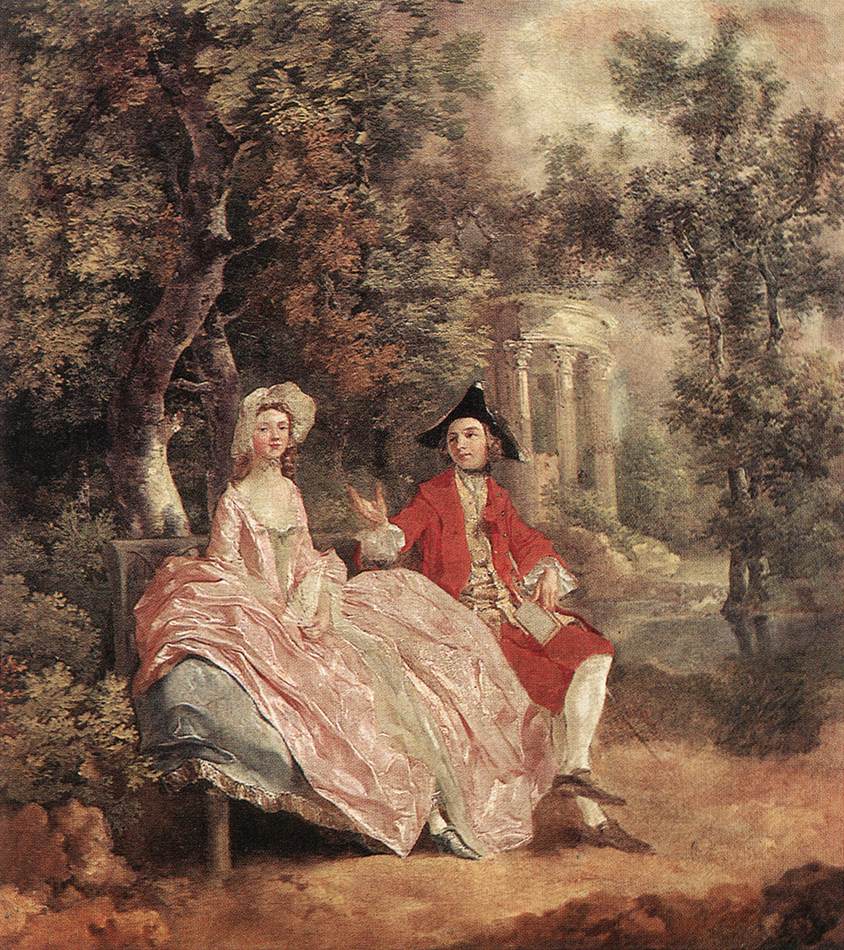
"Conversation in a Park" (1768) Thomas Gainsborough
satisfactory deal was made, the son was given permission to court the object of his affections prior to the agreed-upon marriage (whether or not the young lady had any interest at all.) If a young couple fell in love without the approval of their fathers, their only choice was to dissolve all financial ties and rights from their families, losing any inheritance they may have expected, and set out on their own. In today’s world of modern love and independence, that choice may seem a no-brainer but it was a very difficult move in the early 1700s. In some areas, the unapproved suitor could be sued by the young woman’s father for inveigling her affections, gaining her love through trickery. It was not until the mid to late 18th century that parental control diminished and young people of the upper classes were freer to court and marry based on romantic love.

    
"Haymaker and Sleeping Girl" (1785) Thomas Gainsborough
Now of course, if you were born into a lower rung of the societal ladder, your choices for courtship and marriage were much broader since wealth and status were not part of the
equation. That did not mean, however, families felt no responsibility for their children's welfare. The practice of “bundling” in which a courting couple were allowed to sleep in the same bed, fully clothed with a bundling board or bolster between them in the young lady’s family home, served a dual purpose. In many lower income families, everyone slept in the same room, and it was a means in which not only the young lovers could get to know each other better but also as a way of proving the identity of the unborn baby’s father if things progressed, as they so often would, despite the physical barriers.

 In this more relaxed attitude toward courtship and marriage, there were varied forms of marriage agreements in the early 1700s, not all dependent upon a minister or magistrate. One of the more prevalent means was “handfasting” or “spousal” in which the young couple, with or without witnesses, simply held hands and promised love and loyalty, declaring themselves married. These personal ceremonies were held anywhere the couple chose and in Colonial America
"Young Girl Listening to Conversation Between Two Lovers"
(1789) by Michel Garnier
were often performed over an anvil in a blacksmith’s shop, symbolizing the strength of their bond. Some were held right in the bedroom just prior to conjugal bliss. Since a number of those husbands disappeared by morning’s light, the bride would sometimes hide her friends in the closet as witnesses to
the ceremony. For spousals that were sincere, the couple often gave each other the gift of a half a broken silver sixpence which each kept until death did them part. Another custom was called “spousal de futuro,” which was an announcement of engagement, but if a baby was conceived in the interim, the status was automatically elevated to “spousal.”

"The Joys of Motherhood" (1752) by Jean-Honore Fragonard
Remember this old chant from your childhood?  “First comes love, then comes marriage, then comes (insert name of choice) with a baby carriage.” As you can see, in the early 18th century, the order of events could take any number of variations and, come to think of it, that’s not so different from today, after all!


Have a good week, dear Reader. Thanks for stopping by...Y'all come back now!

Wednesday, February 12, 2014

Love is in the Air...18th Century Valentine Wishes

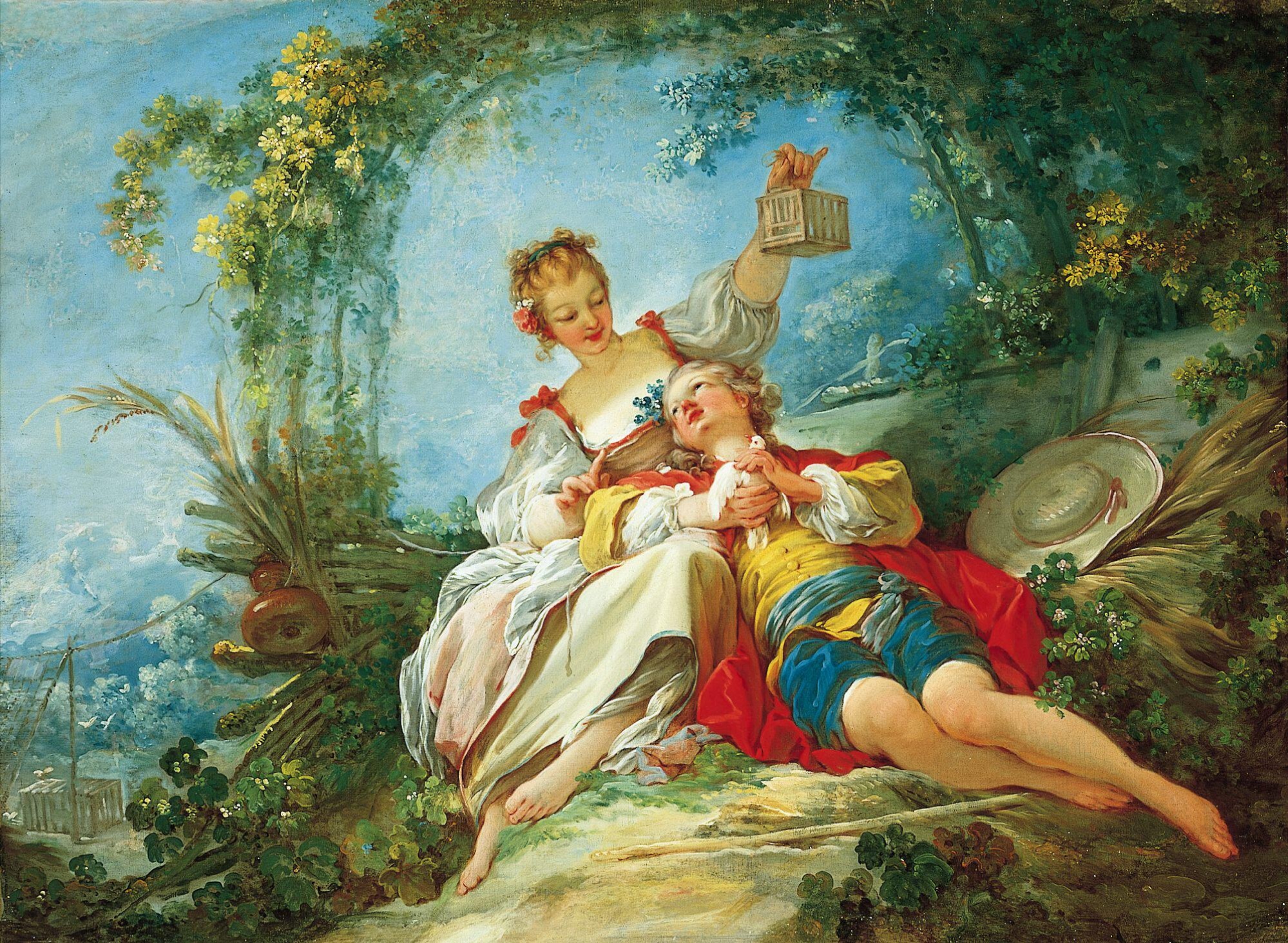
"Happy Lovers" (1760-1765) by Jean-Honore Fragonard


"St. Valentine Baptizing St. Lucilla" (1575) by Jacopo Bassano
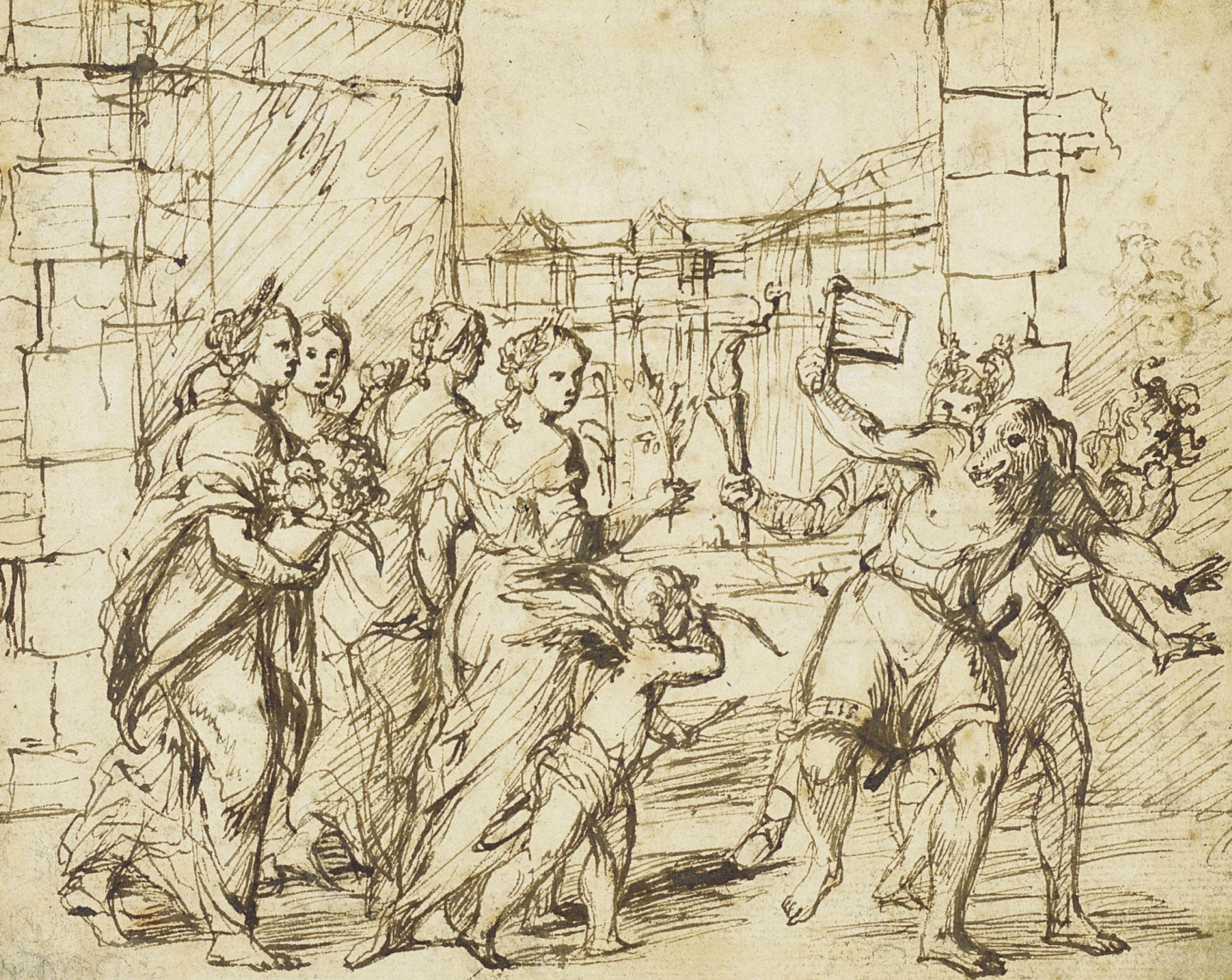
"The Lupercalian Festival in Rome" by the Circle of Adam Elsheimer (1578-1610)
Ah…’tis the week of love culminating in Valentine’s Day this Friday the 14th. Many’s the modern man who looks upon this day with disdain claiming it’s just a made-up day by the greeting card companies, a pernicious ploy to part the lover from his cash, to trap his heart in ransom until he buys his love a valentine. Oh, but he would be wrong, at least as far as the origins of the day are concerned. Celebrating February 14 as a day for proclamations of love goes waaaay back to ancient Roman times. Although more than one story exists as to how the saint, for which the day is named, became associated with romantic love, there are two likely scenarios. One, is that a priest named Valentine, who lived in 3rd century Rome, defied Emperor Claudius II’s orders and performed secret wedding ceremonies for soldiers. The emperor had outlawed the marriage of his soldiers, deeming them less useful if they had wives and children to think of. When Claudius II learned of the priest’s actions, he had him imprisoned and sentenced to death. Another story has it that while in prison, Valentine fell in love with the jailer’s daughter who was kind to him and, before his death, penned her a letter reading “From your Valentine.” 

Long before Valentine, however, the Romans celebrated the festival of Lupercalia, a day in mid- February dedicated to the god of fertility, Faunus. In the 5th century, in an effort to distract Christians from the pagan activities, the church deemed February 14 as
Saint Valentine’s Day, the day on which the saintly priest was martyred. In the middle ages, the good folk of England and France thought that February 14 was the day birds chose their mates for the season and in this mix of pagan fertility rites, loving saints, and love birds, the romantic notions of Saint Valentine’s Day came to full flower.


"Lovers in a Landscape" (1740) Pieter Jan van Reysschoot 
                    
Helene Lambert de Thorigny" (1700) Portrait by Nicolas de Largillierre
Flowers by 
Jean-Baptiste Belin de Fontenay
Jumping ahead to the 18th century, we find many poems flowing from romantic hearts and hand-written messages of love being exchanged on February 14. And if a love-struck Romeo of the late 18th century found himself at a loss for words, he could refer to a book published in Great Britain in 1797 entitled, The Young Man’s Valentine Writer. Remember the old standard, “Roses are red, Violets are blue?” Well you will find the original is a Valentine message written in a collection of English nursery rhymes in 1784, 
Gammer Gurton’s Garland
Here, you see it in its original version:

The rose is red, the violet's blue,
The honey's sweet, and so are you.
Thou are my love and I am thine;
I drew thee to my Valentine:
The lot was cast and then I drew,
And Fortune said it shou'd be you.


"Mary Darby Robinson as 'Perdita' "(1782) by Joshua Reynolds 
For more adult verses, I give you a prolific female poet of the 18th century, Mary Darby Robinson, whose life was short on years but long on romantic intrigue (including a bout with the teenaged Prince of Wales, but that’s for another day!) Here, I present one of her many poems touting the sweet pain love can inflict upon us:

“Sonnet XVII: Love Steals Unheeded”

Love steals unheeded o'er the tranquil mind,
As Summer breezes fan the sleeping main,
Slow through each fibre creeps the subtle pain,
'Till closely round the yielding bosom twin'd.

Vain is the hope the magic to unbind,
The potent mischief riots in the brain,
Grasps ev'ry thought, and burns in ev'ry vein,
'Till in the heart the Tyrant lives enshrin'd.
Oh! Victor strong! bending the vanquish'd frame;
Sweet is the thraldom that thou bid'st us prove!
And sacred is the tear thy victims claim,
For blest are those whom sighs of sorrow move!
Then nymphs beware how ye profane my name,
Nor blame my weakness, till like me ye love.
    
"Robert Burns" by Alexander Naysmith (1758-1840)
Turning to that 18th century superstar of songs and poetry, I give you Scotland’s Robert Burns whose hundreds of verses are full of romantic notions. Here is one of his all-time favorites:

"A Red, Red Rose" 

O my Luve's like a red, red rose
That's newly sprung in June;
O my Luve's like the melodie
That's sweetly played in tune.

As fair art thou, my bonnie lass,
So deep in luve am I;
And I will luve thee still, my dear,
Till a' the seas gang dry:

Till a' the seas gang dry, my dear,
And the rocks melt wi' the sun;
I will luve thee still, my dear,
While the sands o' life shall run.

And fare thee weel, my only Luve,
And fare thee weel awhile!
And I will come again, my Luve,
Tho' it ware ten thousand mile.

Yes, just give Robbie a lass’s name and he’ll pen her tribute. Here is a list of names I pulled from his long list of poems and songs (perhaps you’ll find your lady’s name!)
Lesley
Mary
Mary Ann
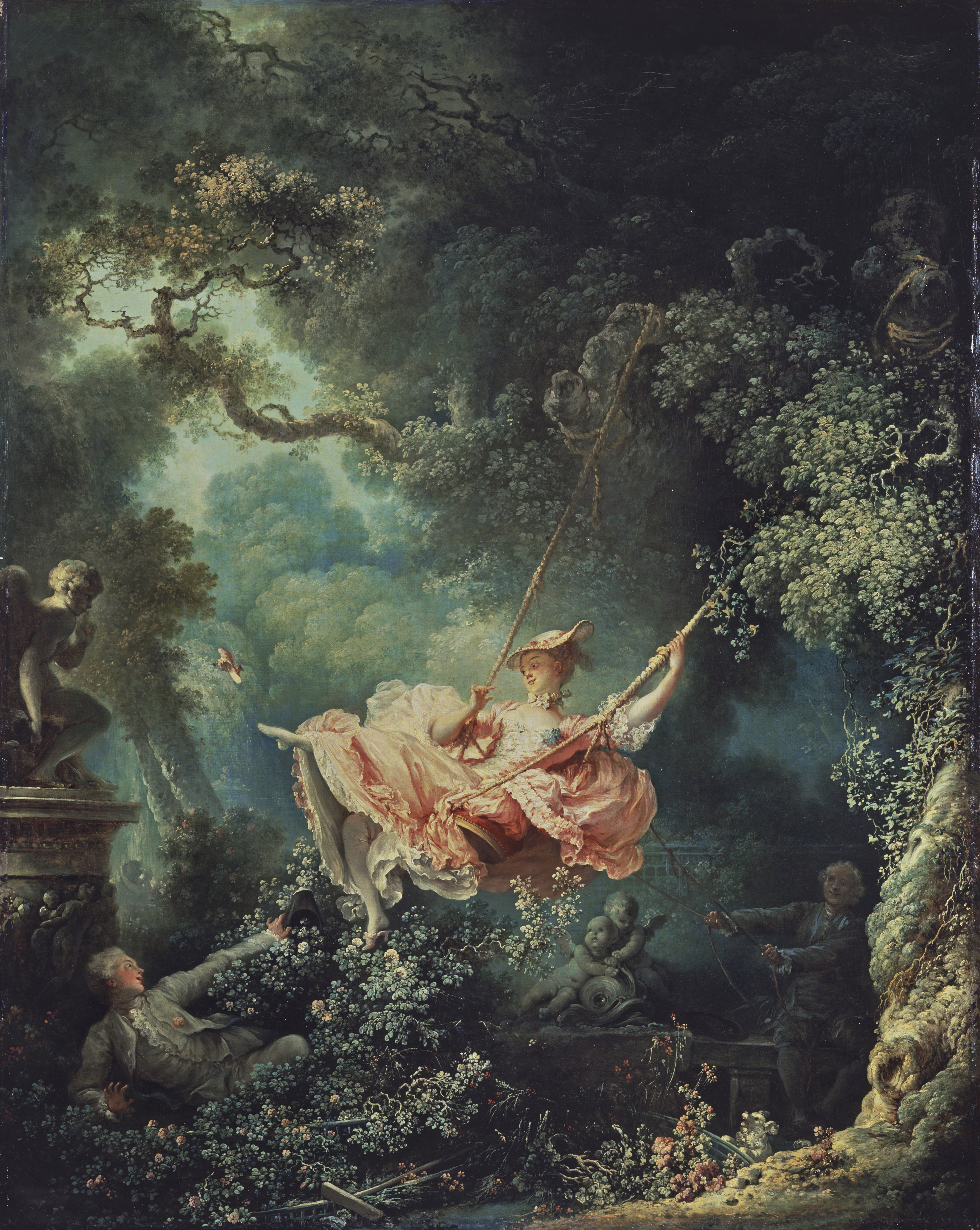
"The Swing" (1767) by Jean-Honore Fragonard
Bell
Nell
Eliza
Eppie
Nanie   
Polly
Sylvia
Bessie
Jessie
Meg
Peggy
Peg
Stella
Jean
Jeanie
Clarina
Clarinda
Ann
Anna
Phillis
Nancy
Jessie
Cholris
Philly
Leezie
Mally
Katie
"Lovers First Tiff" (1876 painting of an 18th century scene)
by Louis Haghe

A busy man was our Rrrobbie! Now, if you find a poem suitable for your love, you may want to do a little Scottish/modern English translation or you just might honor her with a line like this from one of his poetic ditties: “Johnie lad, cock up your beaver…”

Hmmm…well on that note, I think it’s time to draw this post to close!

Have a good week, dear Reader. Thanks for stopping by...Y'all come back now!  (And Happy Valentine's Day!)