Showing posts with label lovers. Show all posts

Thursday, February 9, 2017

Spectral Lovers...of the Great Dismal Swamp

"Lake Drummond in The Great Dismal Swamp
National Wildlife Refuge" photo by U.S. Fish and Wildlife Service
 Northeast Region via Wikimedia Commons
One of only two natural lakes in Virginia is surrounded by 100,000 acres of deep, dark wetlands straddling that state's southeastern border with its neighbor, North Carolina. Lake Drummond sits in the midst of the Great Dismal Swamp and, along with its mysterious swamplands, is the source of many ghostly tales. As this intriguing natural wonder is central to my latest work-in-progress (a middle-grade novel entitled Zephyr Stone, Ghost Charmer,) and as this is the romantic month of 
February, I am sharing one of the swamp's most famous stories.
"Thomas Moore" by Martin Archer Shee

One of the oldest tales of the Great Dismal Swamp is the enduring legend of the Lady of the Lake. The earliest people to populate the swamp were Native Americans who are thought to have first lived there 13,000 years into the past. It is not surprising, then, that this long-lived tale features those early inhabitants. It is said that a young Native American woman died just before her wedding day and her ghostly image can be seen paddling a white canoe through the dark waters of Lake Drummond. While visiting Norfolk, Virginia in 1803, Irish poet Thomas Moore immortalized the Lady and her distraught bridegroom in his poem, "A Ballad: The Lake of the Dismal Swamp." This was part of Moore's book, Epistles, Odes, and Other Poems, written in 1806 about his experiences and impressions during his visit to Bermuda and the eastern region of America. His introduction to the collection is a scathing criticism of the people he encountered in the young nation. His poem about the spectral lovers, however, is the height of romanticism.

From the Sheet Music Collection of
Samuel S. Levy at Johns Hopkins University
A Ballad: The Lake of the Dismal Swamp
by Thomas Moore

“They made her a grave, too cold and damp 
For a soul so warm and true; 
And she’s gone to the Lake of the Dismal Swamp, 
Where, all night long, by a fire-fly lamp, 
She paddles her white canoe. 

“And her fire-fly lamp I soon shall see, 
And her paddle I soon shall hear; 
Long and loving our life shall be, 
And I’ll hide the maid in a cypress tree,
When the footstep of death is near.” 

Away to the Dismal Swamp he speeds— 
His path was rugged and sore, 
Through tangled juniper, beds of reeds,
Through many a fen where the serpent feeds, 
And man never trod before. 

And when on the earth he sunk to sleep, 
If slumber his eyelids knew, 
He lay where the deadly vine doth weep 
"Stained Glass of Dismal Swamp" photo by KL Wood
Its venomous tear and nightly steep 
The flesh with blistering dew! 

And near him the she-wolf stirr’d the brake, 
And the copper-snake breath’d in his ear, 

Till he starting cried, from his dream awake, 
“Oh! when shall I see the dusky Lake, 
And the white canoe of my dear?” 

He saw the Lake, and a meteor bright 
Quick over its surface play’d— 
“Welcome,” he said, “my dear one’s light!” 
And the dim shore echoed for many a night 
The name of the death-cold maid. 
"Beaver Dam, Dismal Swamp" photo by KL Wood

Till he hollow’d a boat of the birchen bark, 
Which carried him off from shore; 
Far, far he follow’d the meteor spark, 
The wind was high and the clouds were dark, 
And the boat return’d no more. 

But oft, from the Indian hunter’s camp, 
This lover and maid so true 
Are seen at the hour of midnight damp 
To cross the Lake by a fire-fly lamp, 
And paddle their white canoe!

    My husband and I visited the Great Dismal Swamp National Wildlife Refuge, today, with
"Tree in Road, Dismal Swamp" photo by KL Wood
the intention of driving to Lake Drummond. Unfortunately, a victim of this morning's wind storm blocked our path half-way, its long branches stretching across the narrow road, its large root base upended over the canal leading to the lake. Oh well. Another day. Who knows, perhaps the Lady of the Lake did not wish to be disturbed today.


Thanks for stopping by...y'all come back now.  And Happy Valentine's Day!
Kate


Wednesday, February 19, 2014

What's Love Got To Do With It?...18th century courtship and marriage


"The Judicious Lover" 18th century after Hubert Gravelot
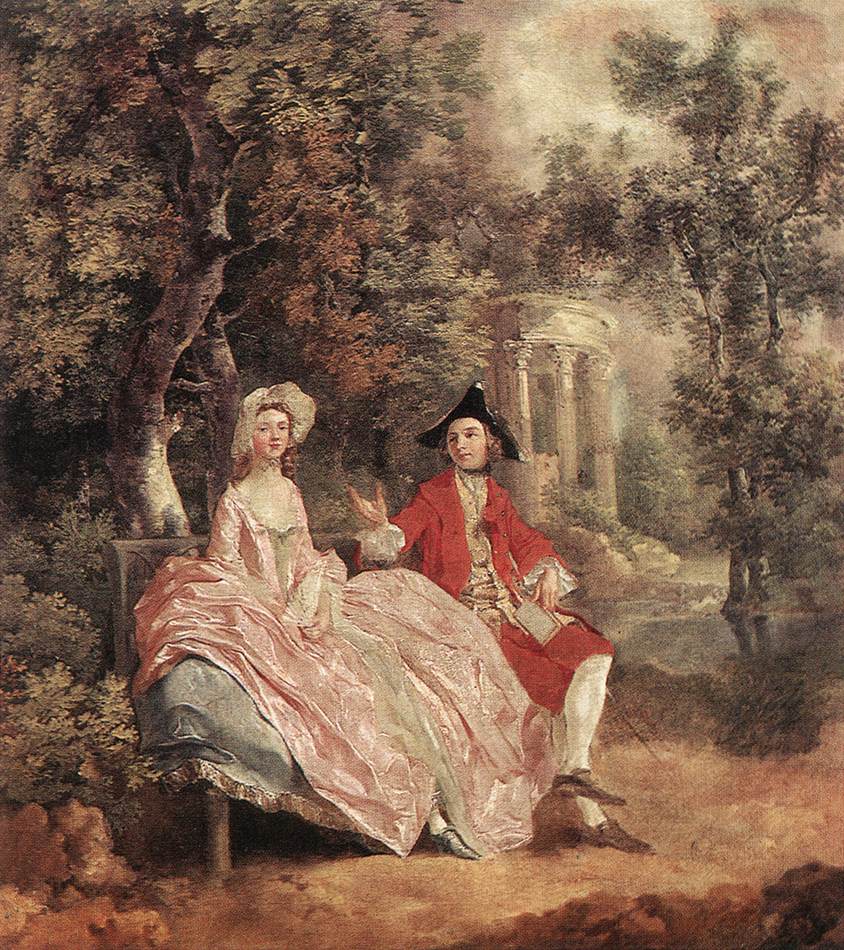
In the early 18th century, whether you married for love or money was often a matter of socioeconomic class. As in ladies’ fashions, the higher your social status, the lower your ability to do as you pleased. For the upper class, marriage was an arrangement made by parents seeking to cement the foundations of their wealth and power in the community. Any notions of romance were seen as secondary and, in truth, detrimental to such pairings. It was a thoughtful business decision set apart from the mercurial passions of the young people. Love, as such, was something one might grow into as the couple lived out their respectable, marriage contract. (Or…attained outside the bonds of marriage.) Young women, especially, had little to say in the matter and knew, once they were married, any small amount of independence they currently enjoyed was put to an end as their husbands would have complete legal control over them. If a young man’s attention was independently drawn to a particular lady, he would first have to receive the permission of his own father who, if he approved of the potential match, would send a formal request to the young lady’s father. The two patriarchs would meet and discuss the financial arrangements and if a 
"Conversation in a Park" (1768) Thomas Gainsborough
satisfactory deal was made, the son was given permission to court the object of his affections prior to the agreed-upon marriage (whether or not the young lady had any interest at all.) If a young couple fell in love without the approval of their fathers, their only choice was to dissolve all financial ties and rights from their families, losing any inheritance they may have expected, and set out on their own. In today’s world of modern love and independence, that choice may seem a no-brainer but it was a very difficult move in the early 1700s. In some areas, the unapproved suitor could be sued by the young woman’s father for inveigling her affections, gaining her love through trickery. It was not until the mid to late 18th century that parental control diminished and young people of the upper classes were freer to court and marry based on romantic love.

    
"Haymaker and Sleeping Girl" (1785) Thomas Gainsborough
Now of course, if you were born into a lower rung of the societal ladder, your choices for courtship and marriage were much broader since wealth and status were not part of the
equation. That did not mean, however, families felt no responsibility for their children's welfare. The practice of “bundling” in which a courting couple were allowed to sleep in the same bed, fully clothed with a bundling board or bolster between them in the young lady’s family home, served a dual purpose. In many lower income families, everyone slept in the same room, and it was a means in which not only the young lovers could get to know each other better but also as a way of proving the identity of the unborn baby’s father if things progressed, as they so often would, despite the physical barriers.

 In this more relaxed attitude toward courtship and marriage, there were varied forms of marriage agreements in the early 1700s, not all dependent upon a minister or magistrate. One of the more prevalent means was “handfasting” or “spousal” in which the young couple, with or without witnesses, simply held hands and promised love and loyalty, declaring themselves married. These personal ceremonies were held anywhere the couple chose and in Colonial America
"Young Girl Listening to Conversation Between Two Lovers"
(1789) by Michel Garnier
were often performed over an anvil in a blacksmith’s shop, symbolizing the strength of their bond. Some were held right in the bedroom just prior to conjugal bliss. Since a number of those husbands disappeared by morning’s light, the bride would sometimes hide her friends in the closet as witnesses to
the ceremony. For spousals that were sincere, the couple often gave each other the gift of a half a broken silver sixpence which each kept until death did them part. Another custom was called “spousal de futuro,” which was an announcement of engagement, but if a baby was conceived in the interim, the status was automatically elevated to “spousal.”

"The Joys of Motherhood" (1752) by Jean-Honore Fragonard
Remember this old chant from your childhood?  “First comes love, then comes marriage, then comes (insert name of choice) with a baby carriage.” As you can see, in the early 18th century, the order of events could take any number of variations and, come to think of it, that’s not so different from today, after all!


Have a good week, dear Reader. Thanks for stopping by...Y'all come back now!