Showing posts with label New Bern. Show all posts

Wednesday, March 19, 2014

The Luck of the Irish...was NOT with Poor John Lawson

Portrait thought to be of John Lawson, 1700, artist unknown
I write this on the eve of St Patrick's Day to be first read on March 19 while I trust visions of all things green and lucky are still dancing in your head (and perhaps a bit of maniacal step dancing by some leaping leprechauns, as well!) At any rate, for some unknown and mysterious reason, my thoughts have turned to that most unlucky of eighteenth century fellows, John Lawson. Oh, poor John. Truly.
Title Page of John Lawson's Book


Last week's blog post featured John Lawson's glowing account of the qualities of women he discovered on his journey throughout the Carolinas in the first decade of the 1700s, published in 1709 as A New Voyage to Carolina; Containing the Exact Description and Natural History of That Country: Together with the Present State Thereof. And a Journal of a Thousand Miles, Travel'd Thro' Several Nations of Indians. Giving a Particular Account of Their Customs, Manners, &c 
See: https://archive.org/details/newvoyagetocarol00laws to view a copy of his book.

Before delving into the awful manner of Mr. 
Carolina Wildlife from John Lawson's Book
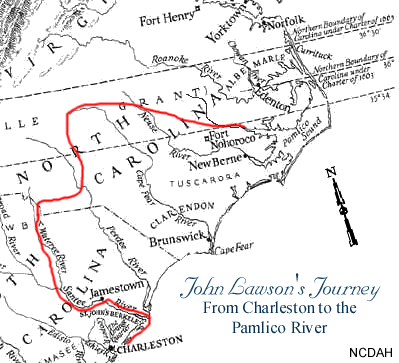
Map of John Lawson's Journey from
Lawson's demise, let me tell you a little of this remarkable man's accomplishments. In addition to exploring, what was then, a land of rough and tumble people, a land filled not only with the natural beauty and grace of its gentler inhabitants, but also with poisonous snakes, savage biting insects, and an air of lawlessness we usually attribute to the Wild West frontier days of America, John Lawson was responsible for the layout and establishment of North Carolina's oldest town, Bath, as well as for that of the town of New Bern, North Carolina. John Lawson traveled on foot and by canoe as he witnessed and recorded the amazing diversity of flora and fauna as well as the people, both native and immigrant. Note--I use the term, "Indian," here as that is how Lawson described them as opposed to today's preferred term, "Native American."--  On December 28, 1700, he, along with a crew of five Englishmen, three Indian men and one Indian woman, set out on a fifty-nine day journey snaking along rivers and trading paths beginning at what is now Charleston, South Carolina, moving in a crescent out to the piedmont region of both South and North Carolina and ending near present day Bath, on the coastal plain. Although probably about five hundred miles as flies the proverbial crow, his trip took such a circuitous route, his claim of a thousand miles is not unwarranted. His descriptions of the many Indian tribes he encountered (often a different one for each river) were, though sometimes colored with his bemusement, most often respectful, sometimes comparing them favorably to his fellow countrymen (and women.) To quote Lawson, with modern spelling:

Amongst (Indian) women, it seems impossible to find a Scold: if they are provoked, or affronted, by their Husbands, or some other, they resent the Indignity offered them in silent tears, or by refusing their Meat. Would some of our European Daughters of Thunder set these Indians for a pattern, there might be more quiet Families found amongst them, occasioned by that unruly Member, the Tongue.

Lawson did not limit his praise to the fairer sex, however, and although he referred to the native people as savages, he often remarked they were less savage in some ways than their Old World counterparts. His praise of the native peoples is all the more ironic in that his death was at the hands of the Tuscarora, whom he acknowledged with sympathy and respect in his book.
Tuscarora Warrior, artist unknown

in 1711, on the verge of war against the colonists, some of the Tuscarora looked upon Lawson as an agent representing people who were the source of terrible injustice and mistreatment of the natives. Not only had Indian lands been confiscated but many Indian women and children had been taken as slaves. Lawson, for all his close interaction with the Indians, appeared unaware of their belief that he was actually working against them. In mid-September, during a time simmering with hostility, John Lawson placed himself in the heart of Indian country as he took an expedition trip along the Neuse River to find a quicker route through North Carolina to the Virginia border. He was captured by Tuscarora warriors and subsequently killed. Baron Christoph Von Graffenried and his slave who accompanied Lawson on that fateful trip were eventually released by their captors and the baron's own illustration of the event is included in today's post. For those with a weak stomach or prone to nightmares, I seriously suggest you stop reading the remainder of this post. I am not being humorous and I certainly want the Reader to understand the grave and graphic nature of the description passed down to us from centuries past. Although it may have been embellished for reasons of propaganda, the methods described match those Lawson, himself, recorded during his time among the Tuscarora. So, here goes:
The Death of John Lawson, 1711, by Baron Christoph Von Graffenried

Splinters made from pitch pine were stuck into Lawson's skin covering his entire body. The horrible pain this caused was then increased a thousand fold when the splinters were set ablaze and the unfortunate man was burned alive. To quote Marjorie Hudson in her article, "Among the Tuscarora: The strange and mysterious death of John Lawson, gentleman, explorer, and writer," reprinted at http://www.learnnc.org/lp/pages/1645  from its original publication in North Carolina Literary Review, Vol. 1, No. 1, Summer 1992: 

His bleeding skin numbed by pitch pine, he begins to feel the heat on the skin of his legs and feet, the rush upward, the death dance now frenzied in his limbs, the last sight of this world framed in fire, and, finally, the soul escaping into a heavenly place like Eden, like the New World when it was still young, belonging to itself alone, a land that fulfills all expectations of balance, of beauty, of perfect enmity.

This terrible event preceded a war between the Tuscarora and the colonists which after two dreadful years ended with all of that tribe either killed, taken as slaves, or fled northward out of the Carolinas.

Have a good week, dear Reader. Thanks for stopping by...Y'all come back now! (And may we learn from the past.)

Kate


Wednesday, January 22, 2014

Uncovering Blackbeard's Treasure...historical riches from "Queen Anne's Revenge"

(Part 2)

Model of Queen Anne's Revenge
In 1718, Captain Edward Teach AKA Blackbeard the Pirate, ran his flagship, Queen Anne's Revenge, aground near Beaufort, North Carolina. The remains of the 200 ton ship rested undisturbed beneath twenty-five feet of water until its discovery in 1996. Since then, a treasure trove providing tens of thousands of 18th century sea-going artifacts has been brought to the surface. Many exciting discoveries still remain beneath the sea promising even more insight into nautical life during the Golden Age of Piracy. A special conservation and restoration lab has been set up on the campus of East Carolina University in Greenville for the sole purpose of caring for these historical treasures. Coincidentally, students and teams of the university are called the
Artifacts still encased in concretions
Pirates.

A traveling exhibit touring the state of North Carolina showcasing many of the artifacts enables residents and visitors alike the opportunity to see, firsthand, items actually handled by the infamous pirate captain and his crew. It's one thing to examine relics uncovered by archaeologists which were used by ancient, unknown people but it's quite another to see items last handled by one of  the most well known characters who ever lived.

My husband and I visited the exhibit while it was housed in the North Carolina History Center in New Bern.
Within the glass display cases we saw items ranging from pewter plates on which they ate their meals, to bits of clay pipes in which they smoked their tobacco, to a tantalizing scattering of gold grains and flakes. There were canon balls, grenades, canon long shot, and shackles on display, reminders of the violent nature of life aboard a pirate ship. Even small, personal items such as brass belt buckles, cuff links, and buttons have been rescued from the deep. The exhibit also contained several large display signs with information and illustrations about this turbulent time in American history and a very informative video ran on a continuous loop. The Beaufort branch of the North Carolina Museum of Maritime History houses a permanent collection of many other artifacts from the ship as well as items salvaged from other ship wrecks.

Some of the most interesting items brought to light are ones that were of medical or hygienic use and give us a real picture of day to day life aboard an early 18th century ship.
One of the more disturbing artifacts is a pewter urethral syringe with a curved funnel tip, still containing vestiges of mercury, used to treat venereal disease. Ouch! Another item was known as a seat of ease: a rolled piece of funnel shaped metal used as a waste tube and fitted in the far stern of the ship for the convenience of the officers.

Photographs of 95 of the artifacts can be seen on the Queen Anne's Revenge website
http://www.qaronline.org/Conservation/Artifacts.aspx

All photographs on today's blog post were taken either by my husband or myself during our visit to the exhibit earlier this month.
Have a good week, dear Reader. Thanks for stopping by...Y'all come back now!

Kate

Wednesday, January 15, 2014

It's a Pirate's Life for Me...discovering historical treasure from Blackbeard's "Queen Anne's Revenge"

(Part I)

"Cutthroat Kate" strikes a pose
My husband, Bill, and I took a Sunday drive down to New Bern, North Carolina (about two hours south of our home in Edenton) to experience the traveling exhibit of artifacts recently brought up from the wreck of Blackbeard the pirate's flagship, the Queen Anne's Revenge.  Most of the photos on today's post are ones we shot at the exhibit and...yes...I had to include some of our silly shenanigans posing with the pirate statues and cutouts. The information garnered from this experience is just too much for a single post so I will divide into at least two segments. In today's post I will share with you the fascinating history of the ship and next week we'll take a look at the artifacts and the amazing efforts to preserve and, literally, bring them to light.


Blackbeard's Flag
The Queen Anne's Revenge's checkered past began long before she became the flagship of the infamous Captain Teach AKA Thatch AKA Blackbeard. Originally named La Concorde, she was owned by a French merchant by the name of Rene Montaudoin who used her as a slave trade ship from 1713 until her capture by Blackbeard in 1717. The ship's home port of operation was Nantes, France with ports of call on the west coast of Africa, to pick up enslaved Africans, and the French Caribbean islands of Martinique, Guadeloupe, and Saint Domingue, to sell the slaves. On July 8, 1717, La Concorde picked up her final human cargo in present-day Benin and, under the leadership of Captain Pierre Dosset, sailed the Middle Passage route toward Martinique. With 516 captive Africans, and seventy-five crew members, La Concorde endured nearly eight weeks of sailing in which sixty-five slaves and sixteen crewmen perished.
 
Models of Queen Anne's Revenge and Adventurer
Queen Anne and Prince George by
Charles Boit (1706) Note the Prince's Big Hair
(see blog post from 1-08-2014)
About 100 miles from their destination, La Concorde encountered Blackbeard with his two armed sloops and crew of 150. The French ship's surviving crew members were further handicapped with thirty-six of them suffering from scurvy and dysentery.  After Blackbeard fired two volleys at the ship, Captain Dosset surrendered. The pirates unloaded the ship's crew and slaves onto the island of Bequia in the Grenadines and sailed away leaving the French the smaller of Blackbeard's two sloops. The French cabin boy and three other crewmen volunteered to join the pirate crew and ten others including a pilot, a sailor, a cook, two carpenters, and three surgeons, were taken by force. The French named their new and much smaller vessel, Mauvaise Rencontre which translates in English to Bad Encounter. Blackbeard renamed his new 200-ton ship, Queen Anne's Revenge. The pirate captain learned his trade while a legal privateer in the service of England's Queen Anne during her war against Spain and France between 1701 and 1714.
After Blackbeard's May, 1718 blockade of the port of Charleston, South Carolina in which he secured medicine for his crew, he sailed Queen Anne's Revenge to Old Topsail Inlet (present-day Beaufort Inlet) on the coast of North Carolina. There his flagship, as well as the sloop Adventure, ran aground on a sandbar and, after removing any valuable cargo, were abandoned.

John Lawson's Map showing Topsail Inlet (1709)
There is some speculation the pirate captain did this on purpose in order to disperse some of his crew whose numbers had grown to, perhaps, an unwieldy size of 300 souls. Blackbeard marooned some of the crewmen and left Beaufort with a hand-picked crew and most of the plunder. Over the centuries, Queen Anne's Revenge remained in place and eventually crumbled in upon itself beneath the sea. It was not until 1996 that the wreck was discovered and research determined it to, indeed, be Blackbeard's ship. Since that time, divers have continued to salvage thousands of artifacts expertly and carefully restored to bring us an unprecedented look at not only 300-year-old nautical life, but at one of the most-renowned and storied characters of all time, Blackbeard.

(See the Queen Anne's Revenge official website at http://www.qaronline.org/Home.aspx)
"Wicked Will" before and after some PhotoShop magic
Next week:  (Part II) Queen Anne's Revenge offers us a tantalizing peek into 18th century pirate life.

Have a good week, dear Reader. Thanks for stopping by...Y'all come back now!

Kate