The movie award season was capped Sunday night by the 86th
Annual Academy Awards ceremony and it made me ponder just what our 18th
century American ancestors did for entertainment. Well,
the answer is quite a lot, actually. For those wishing to sit back and be entertained there was the precursor to film, live theater, and for the more adventurous, there were circuses. Much of 18th century entertainment was, of course, the do-it-yourself variety and included board and card games, sing-alongs, dancing, and books of jokes and instructions in fortune-telling. We'll get to those later but, this week, let's take a look at the spectator-based entertainments, theater and circus.
 |
| The Laughing Audience, mid 1700s, by William Hogarth |
Live theater was determined unsuitable for the mores of the American colonies until the mid-1700s. The Library Company of Philadelphia tells us that in the first half of the century, "religious reformers believed that plays encouraged licentiousness, promoted effeminacy and homosexuality among men, encouraged treachery and hypocrisy (as acting was a form of lying), competed with religious worship, and often challenged religious doctrine." It wasn't until 1752 that theater was considered somewhat respectable, with the first advertised play being a performance of Shakespeare's Merchant of Venice by a theater troupe from Great Britain called the American Company. This production was held in that hotbed of questionable morals, Virginia. It wasn't until 1792 when the anti-theater act of 1767 was finally repealed that New Englanders were free to see such spectacle. Even then, religious purists of that region preached the dangers of the theater and prospective drama devotees had to travel to large cities such as New York to get a taste of such entertainments.
 |
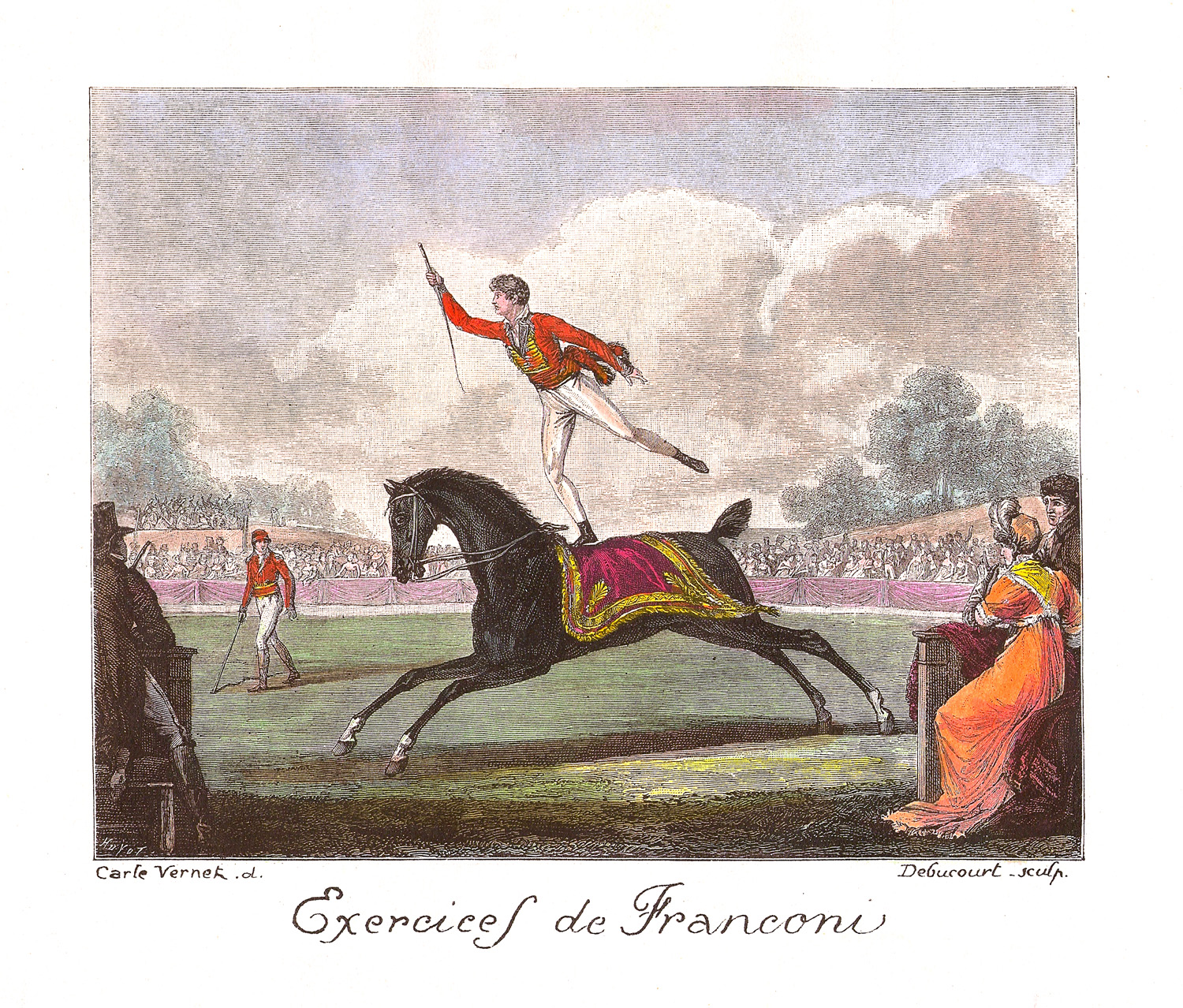
| Laurent Franconi, 1800, by Carle Vernet |
Now, for the circus. As might be expected, some religious leaders of the time were dead set against such exotic entertainment, primarily because it drew together crowds of people of all socio-economic levels, age and gender and heaven knows what that could lead to! It was also considered a dubious distraction from religious duties. Puritanical objections aside, the first circuses were based on feats of equestrian prowess. Riders performed tricks on horseback that were best accomplished and seen when enclosed in a circle. Thus the term circus, as it relates to the modern circus, came into being. By the end of the century, circuses were extremely popular, drawing those crowds of disparate folks together. Over time, the trick-riding acts were interspersed with other entertainers in the way of clowns and acrobats. The first circuses were housed in buildings set aside for the purpose and in 1793 a British equestrian, John Bill Ricketts, opened the first American circus in the city of Philadelphia followed shortly by the circus of another British horseman, Philip Lailson. By then, the ultra-conservative element of the religious faithful were convinced America was surely going to hell in a brightly festooned hand basket.
Have a good week, dear Reader. Thanks for stopping by...Y'all come back now!
Thanks to the following for today's resource material:
http://www.librarycompany.org/zinman/entertainment.htm
http://www.circopedia.org/SHORT_HISTORY_OF_THE_CIRCUS


.jpg)

_by_William_Hogarth.jpg)