 |
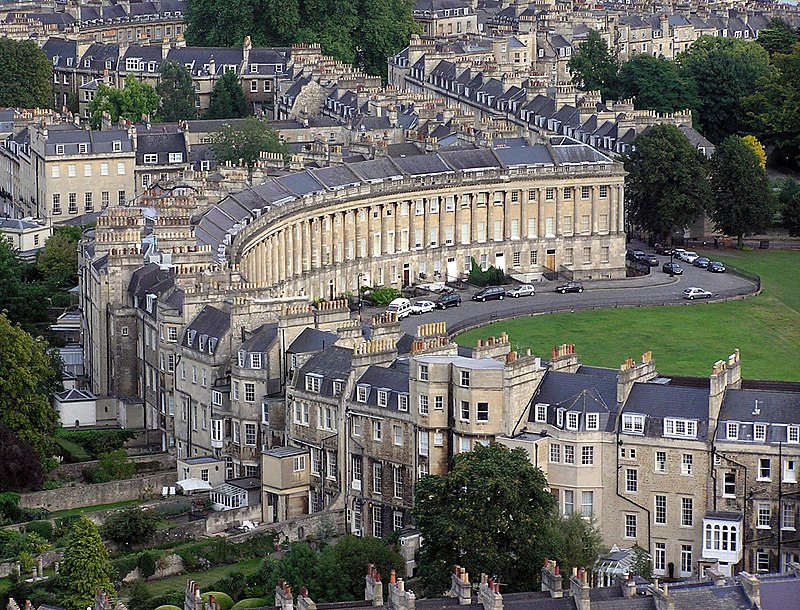
| Bath, England (per: Wikimeida Commons, public domain) |
Now
that the summer season has arrived, it’s vacation time here in America and in
other places around the globe. I believe it’s called “on holiday” across the
Pond in Great Britain. With a variety of activities and guests I, myself, am expecting over the next couple weeks, I will be taking a short (one week) vacation from my blogging once this week's post has published.
So where did our 18th century ancestors spend
their free time for rest and recreation? Of course many never had the luxury of
taking time off from their daily toil but for those who did, especially those
living in or near England, one of the first such destination spots was that of
Bath (England, this time, not little Bath, North Carolina of which I wrote on
May 7, 2014.)
 |
| Roman Bath in Bath, England (per: Wikimedia Commons public domain) |
The
town of Bath, England was blessed with natural hot springs and utilized as a
place of healing all the way back to the times of the Roman occupation.
Although known even earlier for its restorative qualities, the Romans built the
first bath houses, as well as a temple, around AD60 and named the spa town,
Aquae Sulis (“the waters of Sulis.”) Sulis was a Celtic goddess, referred to by
the Romans as Sulis Minerva. This goddess was often asked to punish individuals
who had stolen from others while at the baths. Stone tablets have been found
with inscriptions imploring her help in such matters. One reads, "Docimedis has
lost
 |
| Goddess Sulis Minerva at Bath ( per: Wikimedia Commons) |
two gloves and asks that the thief responsible should lose their minds and
eyes in the goddess' temple."
Over
the years, many additional bath houses were constructed for the sick, lame,
or just plain tired to “take the waters” for healing of mind and body. Once
Anne, Queen of England, visited Bath in 1702, it became THE place to go on
holiday. As
might be expected, other recreational activities flourished along with the
waters, especially those involving gambling, music, wining, dining, and
dancing.
A fairly epic poem, “A Description of Bath” was written in 1733 by
Mary Chandler, a resident
 |
| Princess Amelia of Great Britain, 1738, by Jean-Baptiste van Loo |
of the town, expounding the attributes of Bath and
dedicating the writing to Princess Amelia, daughter of King George II, after
her time spent there. She was sickly as a child but was quite healthy as an
adult, living to the age of seventy-five. (Not to be confused with Princess
Amelia, daughter of King George III who, after years of various illnesses
died at the age of twenty-seven.) In order that you may get a taste of how Bath
was viewed by the people of the time, I have printed, below, several verses
from Miss Chandler’s poem. At the end of this excerpt, the poet refers to a “wonderful
machine” which was a new-fangled method of pulling rocks down from the
mountains in order to use them in the making of more buildings for the town.
From
“A Description of Bath” by Mary Chandler, 1733
…To
sing the Town, where balmy Waters flow,
To which AMELIA'S Health the Nations owe…
 |
| Prior Park (Bath), 1750, Engraving by Anthony Walker |
…Safe
from the Ruin of a thousand Years
These
salutary Streams alone can boast
Their
Virtues not in thrice five Ages lost.
The
floating Waters, from their hidden Source,
Thro’ the
same Strata keep
unerring Course;
The flowing Sulphur meets dissolving Steel,
And
heat in Combat, till the Waters boil:
United then, enrich the healing Stream,
HEALTH to the Sick they give, and to the Waters, FAME…
…THE Min’ral Streams which from the BATHS arise,
From noxious Vapours clear the neighb’ring Skies:
When FEVERS bore an epidemic Sway,
 |
| Bath inside Queen's Bath, 1806 Aquatint by J.C. Nattes |
Unpeopled
Towns, swept Villages away;
While Death abroad dealt Terror, and Despair,
The Plague but gently
touch’d within their Sphere…
…BLEST Source of Health, seated on rising
Ground,
With
friendly Hills by Nature guarded round;
From Eastern Blasts, and sultry
South secure;
The Air’s balsamic, and the Soil is pure…
…THE BATHS adjoining form two ample
Squares,
Around the Walls the Roman Art appears;
Niches and Arches there the Bathers find,
 |
| Roman Bath, Bath, England (per: Wikimedia Commons) |
A Shelter from the Rain, and blust’ring Wind.
BLADUD himself sits Guardian of the Streams,
Whose noble
Virtues give them Royal
Names…
…NOT far from hence, a Bath of
gentler Heat,
The tender Virgin finds a safe Retreat
From Sights indecent, and from Speeches lewd,
Which dare
not there, with Satyr-Face, intrude.
Just in the
midst a Marble Cross there stands,
Which
Popish Minds with pious Awe commands,
Devoid itself of Powe’r to heal our Woes,
Yet, deck’d
with monumental Crutches, shows
What mighty Cures this wond’rous Pool has done,
And these
the Trophies from Diseases won…
…The lovely Landscape, and the silent Stream,
Inspire the Poet, and present the Theme.
Round the green Walk the River glides away,
Where ‘midst Espaliers balmy Zephyrs play,
And fan the
Leaves, and cool the scorching Ray:
View the
brown Shadows of yon pathless
Wood;
And craggy Hills, irregular and
rude
NATURE sports romantick: Hence is seen
The new-made Road, and
wonderful Machine,
Self-moving downward
from the Mountain's Height,
A Rock its Burden of a
Mountain's Weight...
Have a good (2) week(s), dear Reader. Thanks for stopping by...Y'all come back now!


.jpg)


_by_Jean=Baptiste_van_Loo.jpg/640px-Princess_Amellia_of_Great_Britain_(1711-1786)_by_Jean=Baptiste_van_Loo.jpg)


