Showing posts with label Shakespeare. Show all posts

Wednesday, June 20, 2018

Well Wishes...from our Wishing Well

I wish you all the joy you can wish.”
"Our Wishing Well" photo by KL Wood
--William Shakespeare

When my husband, Bill, sets his mind, heart, and creativity to a project, you can rest assured it will be well done. The latest project to catch his imagination has been the designing and building of a Wishing Well for our front yard, complete with water spilling from a tilted brass teapot. The Wishing Well actually serves two purposes: wishing, of course, which I will expound upon in the next paragraph, and the more practical purpose of covering the sump pump necessary to keep our little old cottage from floating away when rainwater pours down Edenton’s West Church Street.

To wish was to hope, and to hope was to expect.”
--Jane Austen

But, let’s talk about Wishes. Some say wishing is an empty and fruitless activity. I say,
Photo, Public Domain via Wikimedia Commons
there’s something innately important in the act of wishing. How many of us have, at that moment before wishing upon a star, a fountain, a Wishing Well, or a birthday candle, stopped to seriously consider what we truly wish for? The very act of wishing crystallizes our most immediate desires and, even believing it to be a silly superstition or ritual, we usually put real thought into it. Having to wish for something makes us think about our priorities in life and, for that fleeting moment, we wonder what it is we really wish were different, or really wish would remain the same. Because...what if that Wish came true? We’ve all heard the old adage, ”Be careful what you wish for.” I can say from my own decades of wishing, I’ve had a couple Wishes come true whose repercussions proved quite challenging.


A dream is a Wish your heart makes.”
--Cinderella
Undine by John William Waterhouse, 1872

And what about the tradition of throwing coins, along with our Wishes, into the water? Although Bill likes to tease that we plan to fund our retirement from the Wishes of our fellow Edentonians, and could even offer a drive-by “Easy Pass” plan, I’ve stopped to ponder why coins and Wishes often go hand-in-hand. Back in ancient times, people believed that certain fountains, springs, or wells, were inhabited by gods with the power to grant Wishes (or at least ensure the continuance of the flow of clear, life-giving water.) Throwing valuables into the water was meant to appease the deities and keep life flowing along in a positive direction. In other societies, a Wish was solidified by the making of a sacrifice. If it was important enough to wish for, it was important enough to sacrifice for. In other words, “Put your money where your mouth is,” if you want to see real change. So, today, when we toss in a coin with our Wish, I think the tiny financial expenditure is symbolic of the importance of the Wish we are making. Our first official Well Wisher was neighbor, Deems Cole, who tossed in coins with his Wishes and allowed me to photograph the moment for posterity.
"Our First Well Wisher" photo by KL Wood


As “Keepers of the Well,” we invite you to wish big and wish small, toss a coin or send a prayer. You’re not limited to the traditional three Wishes! Our Wishing Well at 215 West Church Street is always open to you. So...

Stop on by and wish a spell,
You’re Well-come to our Wishing Well.
Wishes really can come true,
And that’s our Wish for each of you.
Touch the bricks and close your eyes,
Make your Wish and realize,
A Wish is hope for better things,
A starting place to give it wings.”
--Kate Ahearn

Thanks for stopping by...y'all come back, now! (And if you don't live near Edenton, North Carolina, our Well takes long-distance Wishes, too!)
Kate


Wednesday, January 6, 2016

"Follow that Star!"...it's Old Christmas

Twelfth Night , 1668 ,by Jan Steen
What do Julius Caesar, Pope Gregory XIII, the Three Wise Men, Shakespeare, Irish women, and that old holiday favorite--"The Twelve Days of Christmas" have in common? They all relate to January 6th (or 5th depending on your interpretation,) sometimes known as Old Christmas...or Epiphany...or Twelfth Night...or Women's Little Christmas...

Julius Caesar bust photographed by Gautier Poupeu
via Wikimedia commons
Long ago in the "land of far far away" (if you live in 21st century Edenton, North Carolina as do I, anyway,) the yearly passing of time was noted by the phases of the moon. When Julius Caesar came into power, he mandated a more accurate accounting and his Julian Calendar, based on the sun and called a tropical or solar year, came into use in 46 BC. To try and even things out, this system added in a number of extra days, Leap Days, every so often. Problem was, there were too many additions and the years became longer and longer. 


The response came about in 1582 under the leadership of Pope Gregory XIII. By his time, the calendar was ten days longer and growing so he deleted some of the Leap Years and brought the calendar into a more regular schedule. Protestant England, however, refused to accept any such changes, scientific or not, from a Catholic leader and steadfastly held on to the old Julian Calendar until the Calendar Act of 1751 put them in alignment with the Continent. By then there was even more of an imbalance and the "old" December 25th-- Christmas Day-- was actually the "new" January 6th. Okay...so if the math on this doesn't all add up for you, just go with it and don't think about it too deeply or it might give you mathematical brain freeze. Trust me, happens to me all the time.

Pope Gregory XIII by Lavinia Fontana, 1552-1614
The Magi, 1915, Henry Siddons Mowbray
So, January 6th lingered as a traditional day to celebrate Christmas, especially among the Protestant holdouts of England and, today, is affectionately known as "Old Christmas" although most of us don't know why...until now, of course. Now--regarding The Three Wise Men, religious tradition has January 6th as the Feast of the Epiphany. This commemorates the coming of the Magi (i.e. Wise Men, ie astrologers) following the Star of Bethlehem to the the Christ child. An epiphany is a sudden intuitive understanding of the truth of something and this event celebrates the manifestation of Christ to the gentiles as represented by the Wise Men from the East.

Okay, now on to Shakespeare. One of his comedies is entitled, "Twelfth Night or What You Will." There appears to be no reference to Twelfth Night anywhere in the play so its title is a mystery with nothing but conjecture as to its meaning. However-- Twelfth Night is a night celebrated January 6th-- although some say it's celebrated the night before on the 5th. (Can you hear the repetitious strains of "Five Golden Rings" echoing in your musical memory?) With all the brouhaha surrounding Julian versus Gregorian Calendars, "Old Christmas" versus "New Christmas, " some folks decided to just enjoy the best of both worlds and began celebrating Christmas for twelve nights beginning December 25th and ending on January 6th. I like that solution, myself. Gives me an excuse to leave up my decorations through the sixth-- "Oh, Christmas tree, oh Christmas tree, how brittle are thy branches..."
Women Cheering, Dublin, Ireland, photo by Pete Souza

Women's Little Christmas? Well, that's a fun Irish custom stretching back generations in which the women of the house, tired and worn out from all the Christmas preparation and work, take off for a day (January 6th,) leaving the housework to the menfolk and going out on the town together. Slainte!

Have a good couple weeks, dear Reader. Thanks for stopping by...y'all come back now! 

Kate


Wednesday, March 5, 2014

That's Entertainment...18th century American style

    
The movie award season was capped Sunday night by the 86th Annual Academy Awards ceremony and it made me ponder just what our 18th century American ancestors did for entertainment. Well, the answer is quite a lot, actually. For those wishing to sit back and be entertained there was the precursor to film, live theater, and for the more adventurous, there were circuses. Much of 18th century entertainment was, of course, the do-it-yourself variety and included board and card games, sing-alongs, dancing, and books of jokes and instructions in fortune-telling. We'll get to those later but, this week, let's take a look at the spectator-based entertainments, theater and circus. 
The Laughing Audience, mid 1700s, by William Hogarth

Live theater was determined unsuitable for the mores of the American colonies until the mid-1700s. The Library Company of Philadelphia tells us that in the first half of the century, "religious reformers believed that plays encouraged licentiousness, promoted effeminacy and homosexuality among men, encouraged treachery and hypocrisy (as acting was a form of lying), competed with religious worship, and often challenged religious doctrine."  It wasn't until 1752 that theater was considered somewhat respectable, with the first advertised play being a performance of Shakespeare's Merchant of Venice by a theater troupe from Great Britain called the American Company. This production was held in that hotbed of questionable morals, Virginia. It wasn't until 1792 when the anti-theater act of 1767 was finally repealed that New Englanders were free to see such spectacle. Even then, religious purists of that region preached the dangers of the theater and prospective drama devotees had to travel to large cities such as New York to get a taste of such entertainments. 
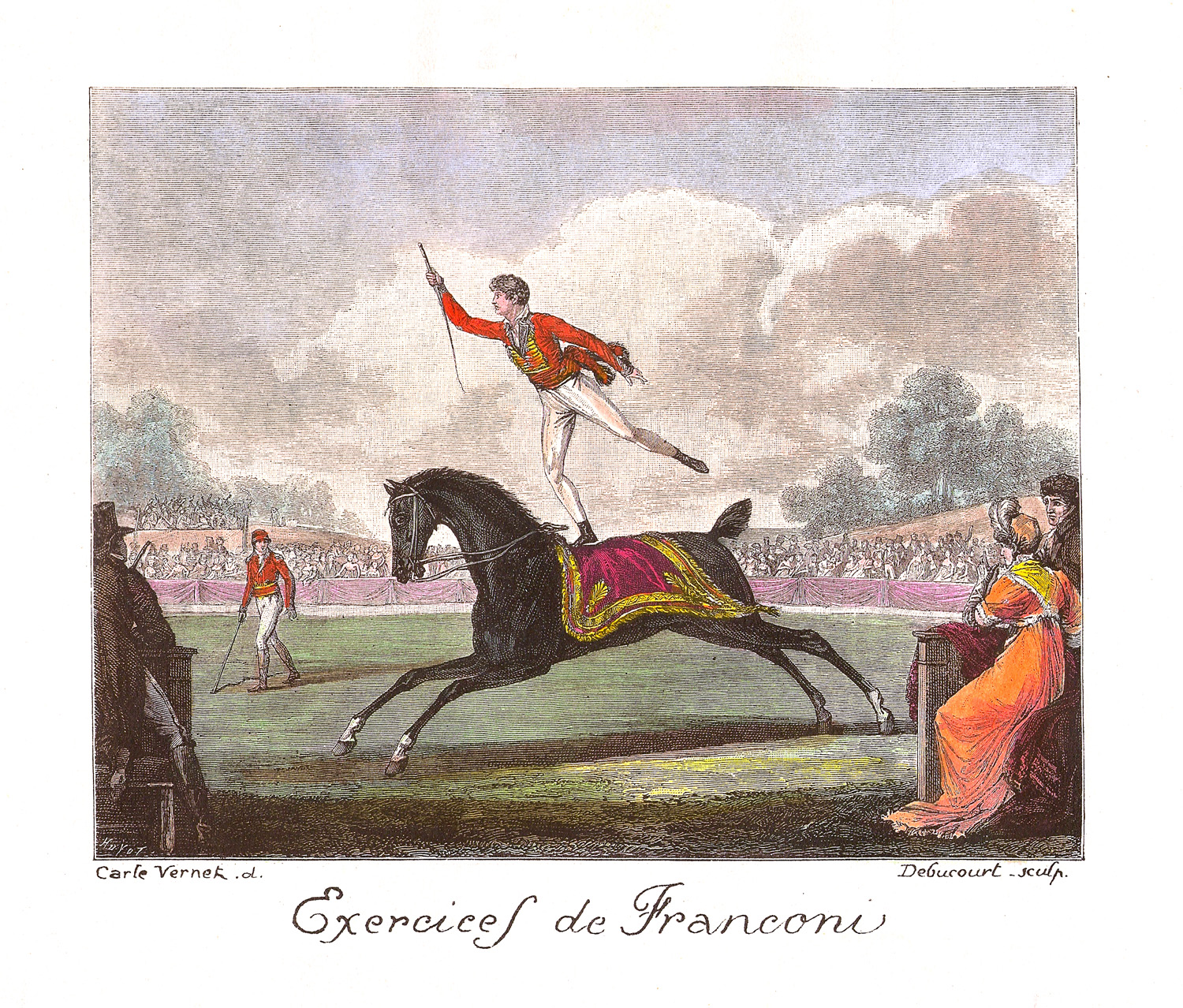
Laurent Franconi, 1800,  by Carle Vernet 

Now, for the circus. As might be expected, some religious leaders of the time were dead set against such exotic entertainment, primarily because it drew together crowds of people of all socio-economic levels, age and gender and heaven knows what that could lead to! It was also considered a dubious distraction from religious duties. Puritanical objections aside, the first circuses were based on feats of equestrian prowess. Riders performed tricks on horseback that were best accomplished and seen when enclosed in a circle. Thus the term circus, as it relates to the modern circus, came into being. By the end of the century, circuses were extremely popular, drawing those crowds of disparate folks together. Over time, the trick-riding acts were interspersed with other entertainers in the way of clowns and acrobats. The first circuses were housed in buildings set aside for the purpose and in 1793 a British equestrian, John Bill Ricketts, opened the first American circus in the city of Philadelphia followed shortly by the circus of another British horseman, Philip Lailson. By then, the ultra-conservative element of the religious faithful were convinced America was surely going to hell in a brightly festooned hand basket.

Have a good week, dear Reader. Thanks for stopping by...Y'all come back now!

Thanks to the following for today's resource material:

http://www.librarycompany.org/zinman/entertainment.htm

http://www.circopedia.org/SHORT_HISTORY_OF_THE_CIRCUS