Showing posts with label Through the Hourglass. Show all posts

Wednesday, May 20, 2015

Fairy Flags and Bridges...legends of Dunvegan

"Land of the Mountain and the Flood" Photograph Copyright by Kathryn Louise Wood
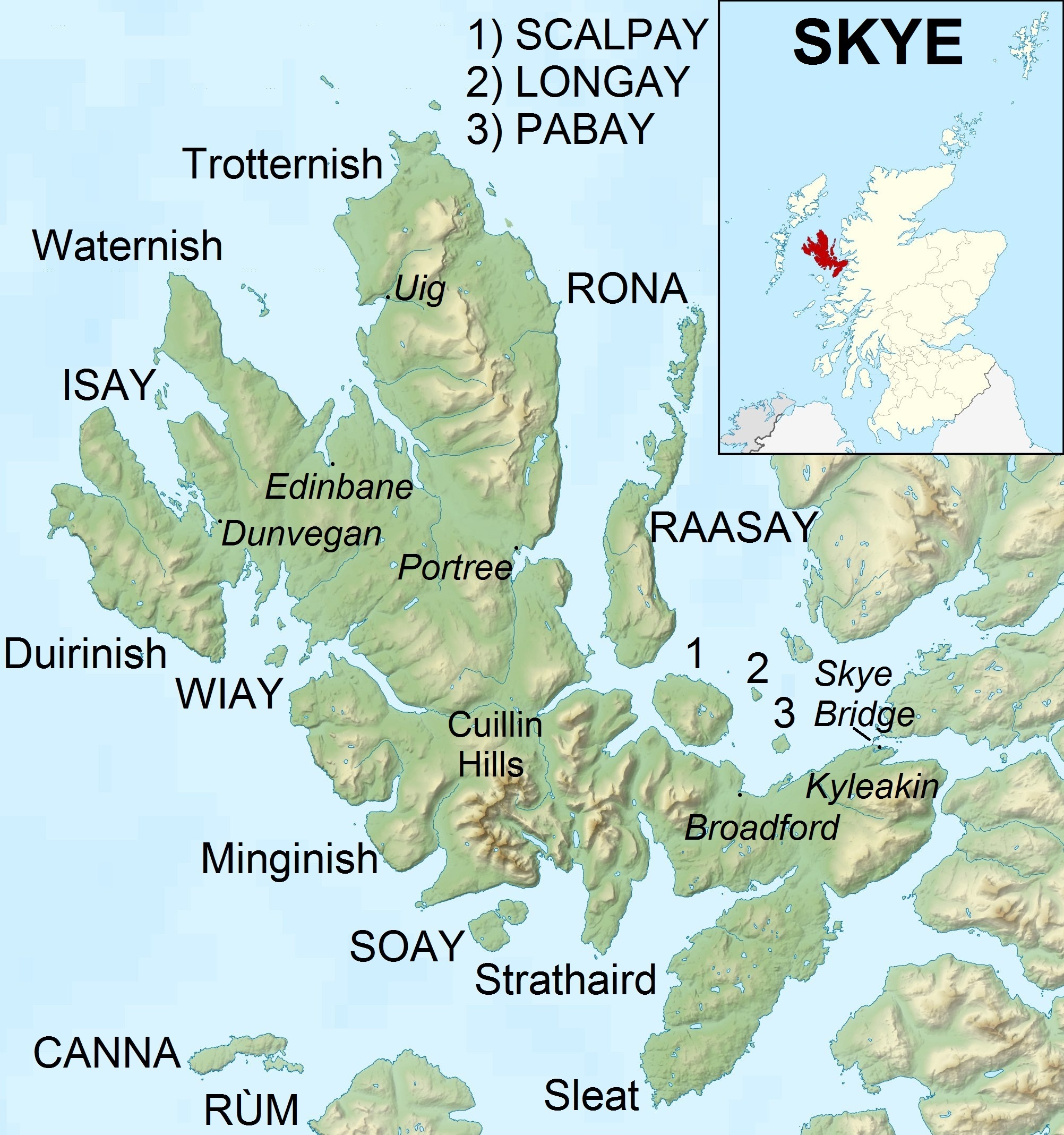
Well, dear and faithful Reader, while Through the Hourglass is searching for its literary champion,  I have begun work on my next novel which includes a fair dose of Magical Realism and I will be sharing my research into all things magical and legendary. Magical Realism, as a fiction genre, presents what one may think of as supernatural as perfectly natural in the protagonist's world and what one normally sees as ordinary is appreciated as extraordinary. For example, my main character may take the receipt of a leather-bound journal whose text periodically changes (and I'm not talking Kindle or Nook, here) in stride, but is awestruck by the changing colors of a sunset. Having traveled to that most magical of places, the Isle of Skye in Scotland, I am excited about sharing some of its legends and lore and will begin by sharing the stories behind the Fairy Bridge and the Fairy Flag of Dunvegan Castle. I am happy to include some of my own photographs taken during my mystical journey of the misty isle.
"The Fairy Bridge" Photograph Copyright by Kathryn Louise Wood

About three miles away from Dunvegan Castle is a picturesque stone arch of a bridge known as the Fairy Bridge. As with many ancient legends, there is more than one story behind it so I will use my novelist's prerogative and choose the one that most tickles my fancy. Long, looooong ago, the Chief of Clan MacLeod fell in love with a beautiful fairy lady who agreed to marry him. Only problem was that after twenty years of nuptial bliss she must return to her own people (fairy folk, that is.) When the time came, the Chief and his fairy wife bid farewell atop the bridge and she left him a token of her love in the form of a golden, silk scarf. This leads us directly to the Fairy Flag of Dunvegan Castle.


"Dunvegan Castle" Photograph Copyright by Kathryn Louise Wood
The Fairy Flag, (the remnants, of which, can still be viewed at Dunvegan Castle) was said to be a gift of favor from the fairies to the Clan MacLeod. The most prevailing legend is that the silken banner could be unfurled three times to provide aid to the clan during time of battle or other crisis and the golden flag with its red, woven "elf spots," was indeed used for that purpose. Some say the flag was the parting gift of the Chief's fairy wife and others say it was brought by fairies to enfold a Chief's fretful infant along with a lullaby blessing that was then sung to all MacLeod babies who would, one day, wear the mantle of clan Chief. (The photograph I have included, here, of Dunvegan Castle was one I shot from pasture land complete with sheep and Highland cattle. The good folk of Scotland are generally quite amenable to travelers entering their fields as along as they are careful to securely close the gates upon entering and leaving.) 
"Highland Cow" Photograph Copyright by Kathryn Louise Wood

The Isle of Skye is fairly bursting with such tales and, exploring its green hills, rippling brooks, deep lochs, and rocky cliffs, it's easy to fall beneath its spell where belief in fairies and their magical flags seems altogether reasonable.

Have a good couple weeks, dear Reader. Thanks for stopping by...y'all come back now! 

Kate


Isle of Skye, Scotland--Contains Ordnance Survey data © Crown
 copyright and database right [CC BY-SA 3.0  via Wikimedia Commons


Wednesday, September 10, 2014

Moonstruck...Native American names for each full moon

"Bluemoon (1)" by Craig Deakin from Newcastle Upon Tyne, United Kingdom
 - Licensed under Creative Commons Attribution 2.0 via Wikimedia Commons - 
I’m back! Completed my first draft of Through the Hourglass and on to the editing phase. (Because of my intense writing schedule, I will be posting new blog posts every two weeks for the foreseeable future.)

We’ve just experienced our third and final Super Moon of 2014 this past Monday, September 8th. Granted, in my part of the world, rainy skies precluded viewing the Super Harvest Moon, however, there is some argument in the astronomical community over whether or not the full moon on October 8th could also be considered a Super Moon. If it were, it would be a Super Hunter’s Moon. (Also known as a Super Blood Moon and, this year, coincides with a full lunar eclipse as seen in North America!) Whew! A whole lot of lunar action going on. It’s a wonder we’re not all moonstruck lunatics! To learn more about the eclipse, see this website: 
"Supermoon" by Peter2006son - File:Supermoon - Howrah 2011-03-19 1881.JPG.
 Licensed under Creative Commons Attribution 3.0 via Wikimedia Commons - 
http://earthsky.org/tonight/total-lunar-eclipse-blood-moon-hunters-moon-october-7-8-2014#eclipse
A Super Moon is one in which it comes to its fullest phase on the same night it swings closest to the earth, at its perigee. (As opposed to when it’s at its most distant, apogee.)  All that’s fine scientific information to know but I’m in love with the names Native Americans gave each full moon, names adopted by our Colonial American ancestors. Each full moon was named to represent something important going on in the natural world, a world in which our ancestors (Native American and otherwise) lived in much more direct contact than do most of us today.
 So, here is a list of those full moon names, some of their alternatives, and an explanation of each (Thanks to the National Geographic website for this fascinating information.) 
January: Wolf Moon
Native Americans and medieval Europeans named January's full moon after the howling of hungry wolves lamenting the midwinter paucity of food. Other names for this month's full moon include old moon and ice moon.
"Blue Canyon Moon (5020077179)" by John Fowler from Placitas, NM, USA -
Licensed under Creative Commons Attribution 2.0 via Wikimedia Commons - 
February: Snow Moon
The typically cold, snowy weather of February in North America earned its full moon the name snow moon. Other common names include storm moon and hunger moon.
March: Worm Moon
Native Americans called this last full moon of winter the worm moon after the worm trails that would appear in the newly thawed ground. Other names include chaste moon, death moon, crust moon (a reference to snow that would become crusty as it thawed during the day and froze at night), and sap moon, after the tapping of the maple trees.
By Hahn Family Wines (Flickr: Harvest Moon8.JPG)
 (http://creativecommons.org/licenses/by/2.0)], via Wikimedia Commons
April: Pink Moon
Northern Native Americans call April's full moon the pink moon after a species of early blooming wildflower. In other cultures, this moon is called the sprouting grass moon, the egg moon, and the fish moon.
May: Flower Moon
May's abundant blooms give its full moon the name flower moon in many cultures. Other names include the hare moon, the corn planting moon, and the milk moon.
June: Strawberry Moon
In North America, the harvesting of strawberries in June gives that month's full moon its name. Europeans have dubbed it the rose moon, while other cultures named it the hot moon for the beginning of the summer heat.
July: Buck Moon
Male deer, which shed their antlers every year, begin to regrow them in July, hence the Native American name for July's full moon. Other names include thunder moon, for the month's many summer storms, and hay moon, after the July hay harvest.
"Harvest Moon" by Original uploader, Roadcrusher at en.wikipedia - 
August: Sturgeon Moon
North American fishing tribes called August's full moon the sturgeon moon since the species was abundant during this month. It's also been called the green corn moon, the grain moon, and the red moon for the reddish hue it often takes on in the summer haze.
September: Harvest Moon
The most familiar named moon, September's harvest moon refers to the time of year after the autumn equinox when crops are gathered. It also refers to the moon's particularly bright appearance and early rise, which lets farmers continue harvesting into the night. Other names include the corn moon and the barley moon.
October: Hunter's Moon
The first moon after the harvest moon is the hunter's moon, so named as the preferred month to hunt summer-fattened deer and fox unable to hide in now bare fields. Like the harvest moon, the hunter's moon is also particularly bright and long in the sky, giving hunters the opportunity to stalk prey at night. Other names include the travel moon and the dying grass moon.
"Hard to focus on! (4317424759)" by Bernal Saborio from Costa Rica
- licensed under Creative Commons Attribution-Share Alike
November: Beaver Moon
There is disagreement over the origin of November's beaver moon name. Some say it comes from Native Americans setting beaver traps during this month, while others say the name comes from the heavy activity of beavers building their winter dams. Another name is the frost moon.
December: Cold Moon
The coming of winter earned December's full moon the name cold moon. Other names include the long night moon and the oak moon.
The Blue Moon
Each year, the moon completes its final cycle about 11 days before the Earth finishes its orbit around the sun. These days add up, and every two and a half years or so, there is an extra full moon, called a blue moon. The origin of the term is uncertain, and its precise definition has changed over the years. The term is commonly used today to describe the second full moon of a calendar month, but it was originally the name given to the third full moon of a season containing four full moons.
From Amazon.com
*And on a less scientific but very romantic note dear Reader, in the 1920’s while on a trip from New York City to Miami, lyricist Benny Davis, pining for his sweetheart and seeing a beautiful moon reflected in the Perquimans River as he crossed the bridge in Hertford, North Carolina (just up the road from my Edenton,) penned the words to the famous song “Carolina Moon”. …Carolina Moon, keep shining, Shining on the one who waits for me…*
Have a good couple weeks dear Reader. Thanks for stopping by...Y'all come back now!

Kate

Wednesday, August 27, 2014

A Word Nerd's Delight...everyday phrases and their surprising nautical origins

Captain Lord George Graham in his Cabin, 1745, by William Hogarth
I guess I’m just a word-nerd (which, I suppose, most writers are) but I love to learn the origins of some of our commonly used terms and phrases, especially the more colorful ones. In researching for my current novel-in-progress, I ran across several glossaries of nautical terminology and was tickled to see how many we’ve transposed into our everyday land-lubbery speech. Below is a sampling for you to enjoy and to hold you over for a couple weeks or so as I near the finish line of the first draft of my Young Adult  novel, Through the Hour Glass (the first installment in my series, Time Shadow.)
Working Cover of my novel-in-progress, Through the Hourglass


So, not to cut and run but since the completion of the all-important first draft is in the offing and I must ensure its ending is first rate I shall bid you adieu for just a little while as I focus my attention on it. Thanks for your kind understanding and your interest in this, my fifty-second blog post, marking my first year anniversary as a blogger! Woo Hoo!

Between the Devil and the deep blue sea -  The Devil Seam is the curved seam in the deck planking closest to the side of the ship, next to the scuppers. A sailor slipping on the deck would be "between the Devil and the deep blue sea". This also relates to the phrase, Devil to pay since  ‘Paying' the Devil is sealing the devil seam. It is a difficult and unpleasant job (with no resources) because of the shape of the seam (closest to the hull).
Bitter end - The anchor cable is tied to the bitts, when the cable is fully paid out, the bitter end has been reached. The last part of a rope or cable.
Booby - A type of bird that has little fear and therefore is particularly easy to catch, hence Booby prize.
By and large - "By" means into the wind, while "large" means with the wind. By and large is used to indicate all possible situations "the ship handles well both by and large".
Chock-a-block- Rigging blocks that are so tight against one another  they cannot be further tightened.
The West Indiaman "Britannia", 1838 by Joseph Walter
Clean bill of health- A certificate issued by a port indicating that the ship carries no infectious diseases.
Clean slate - At the helm, the watch keeper would record details of speed, distances, headings, etc. on a slate. At the beginning of a new watch the slate would be wiped clean.
As the crow flies - A direct line between two points (which might cross land) which is the way crows travel rather than ships which must go around land.
Cut and run- When wanting to make a quick escape, a ship might cut lashings to sails or cables for anchors, causing damage to the rigging, or losing an anchor, but shortening the time needed to make ready by bypassing the proper procedures.
First rate- The classification for the largest sailing warships of the 17th through 19th centuries. They had 3 masts, 850+ crew and 100+ guns.
Fly-by-night- A large sail used only for sailing downwind, requiring little attention.
Footloose - If the foot of a sail is not secured properly, it is footloose, blowing around in the wind.
Groggy - Drunk from having consumed a lot of grog.
Hand over fist - To climb steadily upwards, from the motion of a sailor climbing shrouds on a sailing ship (originally "hand over hand.")
In the offing - In the water visible from on board a ship, now used to mean something imminent.
Know the ropes - A sailor who 'knows the ropes' is familiar with the miles of cordage and ropes involved in running a ship.
Leeway - The amount that a ship is blown leeward (away from) the wind.
A British Man of War before the Rock of Gibraltar, late 18th cent, by Thomas Whitcombe
Let the cat out of the bag - To break bad news (the "cat o' nine tails" being taken out of the bag by the bosun was bad news, announcing a flogging).
No room to swing a cat - The entire ship's company was expected to witness floggings, assembled on deck. If it was very crowded, the bosun might not have room to swing the 'cat o' nine tails' (the whip).
Over the barrel - Adult sailors were flogged on the back or shoulders while tied to a grating, but boys were beaten instead on the posterior (often bared), with a cane or cat, while bending, often tied down, over the barrel of a gun, known as (kissing) the gunner's daughter.
Overwhelmed - Capsized or foundered.
Pipe down - A signal on the bosun's pipe to signal the end of the day, requiring lights (and smoking pipes) to be extinguished and silence from the crew
Pooped - 1. Swamped by a high, following sea. 2. Exhausted. (Poop deck - A high deck on the aft superstructure of a ship from French for stern: la poupe.)
Rummage sale - A sale of damaged cargo (from French for stowage: arrimage).
Shakes - Pieces of barrels or casks broken down to save space. They are worth very little, leading to the phrase No great shakes.
Skyscraper - A small, triangular sail, above the skysail. Used in light winds on a few ships.
Slush fund - The money obtained by the cook selling slush ashore. Used for the benefit of the crew (or the cook). Slush - Greasy substance obtained by boiling or scraping the fat from empty salted meat storage barrels, or the floating fat residue after boiling the crew's meal. In the Royal Navy the perquisite of the cook who could sell it or exchange it (usually for alcohol) with other members of the crew. Used for greasing parts of the running rigging of the ship and therefore valuable to the master and bosun.
Son of a gun - The space between the guns was used as a semi-private place for trysts with prostitutes and wives, which sometimes led to pregnancies. Other thoughts on this are that the gun deck afforded the necessary amount of space for a woman to give birth aboard ship and that sometimes shooting off a canon would give a woman’s labor a kick start.
Taken aback - An inattentive helmsmen might allow the dangerous situation to arise where the wind is blowing into the sails 'backwards', causing a sudden (and possibly dangerous) shift in the position of the sails.
Taking the wind out of his sails - To sail in a way that steals the wind from another ship. To overbear.
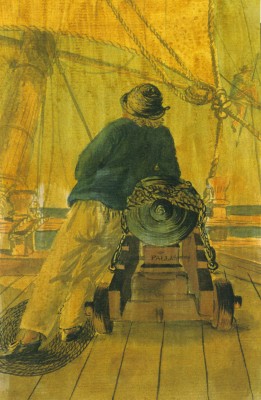
A Seaman of The Pallas Leaning on a Bowchaser ,
 1776 by Gabriel Bray
Three sheets to the wind - On a three-masted ship, having the sheets of the three lower courses loose will result in the ship meandering aimlessly downwind. Also, a sailor who has drunk strong spirits beyond his capacity.
Touch and go - The bottom of the ship touching the bottom, but not grounding.
Under the weather - Serving a watch on the weather side of the ship, exposed to wind and spray.
Wide berth - To leave room between two ships moored (berthed) to allow space for maneuver (To give a wide berth.)

Have a good (couple) weeks (or so,) dear Reader. (There's lots to read or re-read over the last 52 posts. Probably enough to keep you busy till I return!) Thanks for stopping by...Y'all come back now!
Kate


(Although my research sent me far and wide, the bulk of the information for today’s post is thanks to http://en.wiktionary.org/wiki/Appendix:Glossary_of_nautical_terms#H)

Wednesday, March 26, 2014

Lost in Translation...meaning what you say in the 18th century

Doctor Johnson in the Ante-Room of the Lord Chesterfield Waiting for an Audience, 1748
by Edward Matthew Ward, 1845
So, having reached Part II of my work-in-progress, Through the Hourglass, my young heroine time travels back to 1718. As a sixteen-year-old from the year 2014, one of her immediate adjustments is that of language. Even though she is in her hometown of Edenton, North Carolina (known at the time as the Town on Queen Anne's Creek,) and even though the inhabitants are speaking her own native English, she finds the meanings of many words have changed, causing much room for misunderstandings!

In researching the changes in word usage, I came across the dictionary authored by
Samuel Johnson's 1755 Dictionary of the English Language
Samuel Johnson in 1755. (Another 18th century book with a loooong sub-title:)

A DICTIONARY OF THE ENGLISH LANGUAGE: 
IN WHICH The WORDS are deduced from their ORIGINALS, 
AND ILLUSTRATED in their DIFFERENT SIGNIFICATIONS 
BY EXAMPLES from the best WRITERS. 
TO WHICH ARE PREFIXED, A HISTORY of the LANGUAGE, 
AND An ENGLISH GRAMMAR, 
By SAMUEL JOHNSON, A. M. 
In TWO VOLUMES.  

Thanks to the wonders of the Internet, you can peruse Mr. Johnson's work at: 
 www.johnsonsdictionaryonline.com 
(You can see photos of the actual original pages by clicking "Page View.")

Here is a list of examples, one for each letter of the alphabet, to give you some idea of the misunderstandings a time traveler might encounter:

AWFUL—Not rotten but awe-inspiring, as in “awful majesty.”
BAGGAGE—An insulting term for a woman, like “hussy.”
CLOWN—A rustic or bumpkin, not a circus performer.
DESERT—Any deserted or uninhabited place—a wilderness, not necessarily a place filled with sand. 18th century author Daniel Defoe placed his Robinson Crusoe on a desert island filled with lush vegetation.
ENTHUSIASM—Fanaticism, especially in religious matters. Not a positive attribute.
FOND—Foolish, naive, innocent.
GENEVA—Gin. The word and its shortened form come not from the Swiss city, but from genever, Dutch for juniper, the plant which provided the flavor for the original Dutch variety.
HOTHOUSE—Brothel.
INTERVIEW—Any sort of meeting. Not just to see about getting hired for a job.
JADE—Could refer to the green stone we think of today but also as an abusive term applied to women; something like slut.
KID—Young goat. To kid meant to bring forth young goats. (Nothing at all to do with teasing!)
LEECH—Johnson’s first meaning is: physician (and not derogatory at all) and second meaning is: the critter that sucks blood. The norm for medical treatment was bleeding the patient.
MAKE LOVE—Johnson lists 59 entries under "to make___" and this is number 39: To court, to woo (with no sexual connotation.)
NICKNAME—A name given in contempt with great derision.
OUCH—An ornament of gold or jewels, unless referring to the ouch of a boar in which it means a blow from a boar’s tusk, (Ouch!)
PECULIAR—Particular (not odd or unusual.)
SNACK—A share of something often by a compact or agreement.
TOILET—A dressing table (no indoor plumbing, remember?)
UPHOLSTERER—One who furnishes houses (not limited to one who makes or repairs upholstered furniture.)
VINE—The plant that bears the grape (apparently all vines were assumed to be those that produced vino.)
WOMANIZE—To make a man more like a woman, effeminate, emasculate (something done TO a man not BY a man.)
X—“No words in English language begin with this letter” according to Samuel Johnson.
YUCK—Itch
ZONE—Girdle (which meant anything that surrounded one’s middle not just the suck-you-in undergarment of your grandmother’s day. )
Sophia Drake, by Ralph Earl, 1784

As you can see, a young time traveler could get herself into a lot of hot water if she misspoke or misunderstood. Let's hope she doesn't go for an interview as a hothouse worker!

Have a good week, dear Reader. Thanks for stopping by...Y'all come back now! 

Kate