Showing posts with label Isle of Skye. Show all posts

Sunday, March 8, 2020

Celtic Kissing Cousins...Ireland and Scotland


"Woodland at Loch Lomond" photo by the author, Kate Wood
I’ve always wished to travel to the magical lands of Ireland and Scotland. Must be something deep in my DNA calling me home. I’ve not yet made it to the Emerald Isle (not to be confused with North Carolina’s lovely Emerald Isle, to which I have traveled!) But several years ago, I spent a couple weeks in Scotland, half of that time on the wild and windswept Isle of Skye. At every turn, I found both photographic and literary inspiration, much of which has made it into my latest “work-in-progress” contemporary fantasy novel, Murmuration.

In researching for my book, I found several crossovers of Irish and Scottish mythological creatures such as, water horses—the Irish Aughisky, and the Scottish Kelpie, and the wailing criers of impending death—the Irish Banshee and the Scottish Ben Nighe. With similar origins, including the Norwegian Vikings, and just the Irish Sea between them, (as narrow as 47 miles across in places,) it’s not surprising.

"Dunvegan Castle" by Kate Wood
Both cultures take their fairies seriously. While traveling on Skye, I was able to capture a photograph of Dunvegan Castle, which I think illustrates its fairytale qualities. Later, I learned there is a real fairy story connected to Dunvegan and the Clan MacLeod, whose chiefs have resided at the castle in an uninterrupted line since the 13th century.

"The Fairy Bridge" by Kate Wood
The tale is one of love and marriage between a fairy lady and chief of the Clan MacLeod. Apparently, there are a couple versions of the story, although both tell of a time-limit on the union before the fairy must return to her own kind. In one, the fairy wife left their baby with the saddened MacLeod and when she heard the child crying one night, returned and wrapped him in her silken shawl. Another tells of her giving the shawl to her husband as they parted ways on The Fairy Bridge (three miles away from Dunvegan Castle and still standing.)

Both stories agree that, waved as a flag, the red-dotted yellow silk shawl would shield the clan from harm as long as it was employed no more than three times. At last count, it had been raised twice. Though fragile and tattered, the Fairy Flag can still be viewed by today’s visitors, the enchanted shawl protected within a glass case inside Dunvegan Castle, ready to fly one last time in defense of the MacLeods.
"Kiss Bill, He's Irish" photo of author's husband by Kate Wood

Thanks for stopping by. Y’all come back, now. (And a Happy St. Patrick’s Day to all you Celtic Kissing Cousins!)

Kate

Wednesday, May 20, 2015

Fairy Flags and Bridges...legends of Dunvegan

"Land of the Mountain and the Flood" Photograph Copyright by Kathryn Louise Wood
Well, dear and faithful Reader, while Through the Hourglass is searching for its literary champion,  I have begun work on my next novel which includes a fair dose of Magical Realism and I will be sharing my research into all things magical and legendary. Magical Realism, as a fiction genre, presents what one may think of as supernatural as perfectly natural in the protagonist's world and what one normally sees as ordinary is appreciated as extraordinary. For example, my main character may take the receipt of a leather-bound journal whose text periodically changes (and I'm not talking Kindle or Nook, here) in stride, but is awestruck by the changing colors of a sunset. Having traveled to that most magical of places, the Isle of Skye in Scotland, I am excited about sharing some of its legends and lore and will begin by sharing the stories behind the Fairy Bridge and the Fairy Flag of Dunvegan Castle. I am happy to include some of my own photographs taken during my mystical journey of the misty isle.
"The Fairy Bridge" Photograph Copyright by Kathryn Louise Wood

About three miles away from Dunvegan Castle is a picturesque stone arch of a bridge known as the Fairy Bridge. As with many ancient legends, there is more than one story behind it so I will use my novelist's prerogative and choose the one that most tickles my fancy. Long, looooong ago, the Chief of Clan MacLeod fell in love with a beautiful fairy lady who agreed to marry him. Only problem was that after twenty years of nuptial bliss she must return to her own people (fairy folk, that is.) When the time came, the Chief and his fairy wife bid farewell atop the bridge and she left him a token of her love in the form of a golden, silk scarf. This leads us directly to the Fairy Flag of Dunvegan Castle.


"Dunvegan Castle" Photograph Copyright by Kathryn Louise Wood
The Fairy Flag, (the remnants, of which, can still be viewed at Dunvegan Castle) was said to be a gift of favor from the fairies to the Clan MacLeod. The most prevailing legend is that the silken banner could be unfurled three times to provide aid to the clan during time of battle or other crisis and the golden flag with its red, woven "elf spots," was indeed used for that purpose. Some say the flag was the parting gift of the Chief's fairy wife and others say it was brought by fairies to enfold a Chief's fretful infant along with a lullaby blessing that was then sung to all MacLeod babies who would, one day, wear the mantle of clan Chief. (The photograph I have included, here, of Dunvegan Castle was one I shot from pasture land complete with sheep and Highland cattle. The good folk of Scotland are generally quite amenable to travelers entering their fields as along as they are careful to securely close the gates upon entering and leaving.) 
"Highland Cow" Photograph Copyright by Kathryn Louise Wood

The Isle of Skye is fairly bursting with such tales and, exploring its green hills, rippling brooks, deep lochs, and rocky cliffs, it's easy to fall beneath its spell where belief in fairies and their magical flags seems altogether reasonable.

Have a good couple weeks, dear Reader. Thanks for stopping by...y'all come back now! 

Kate


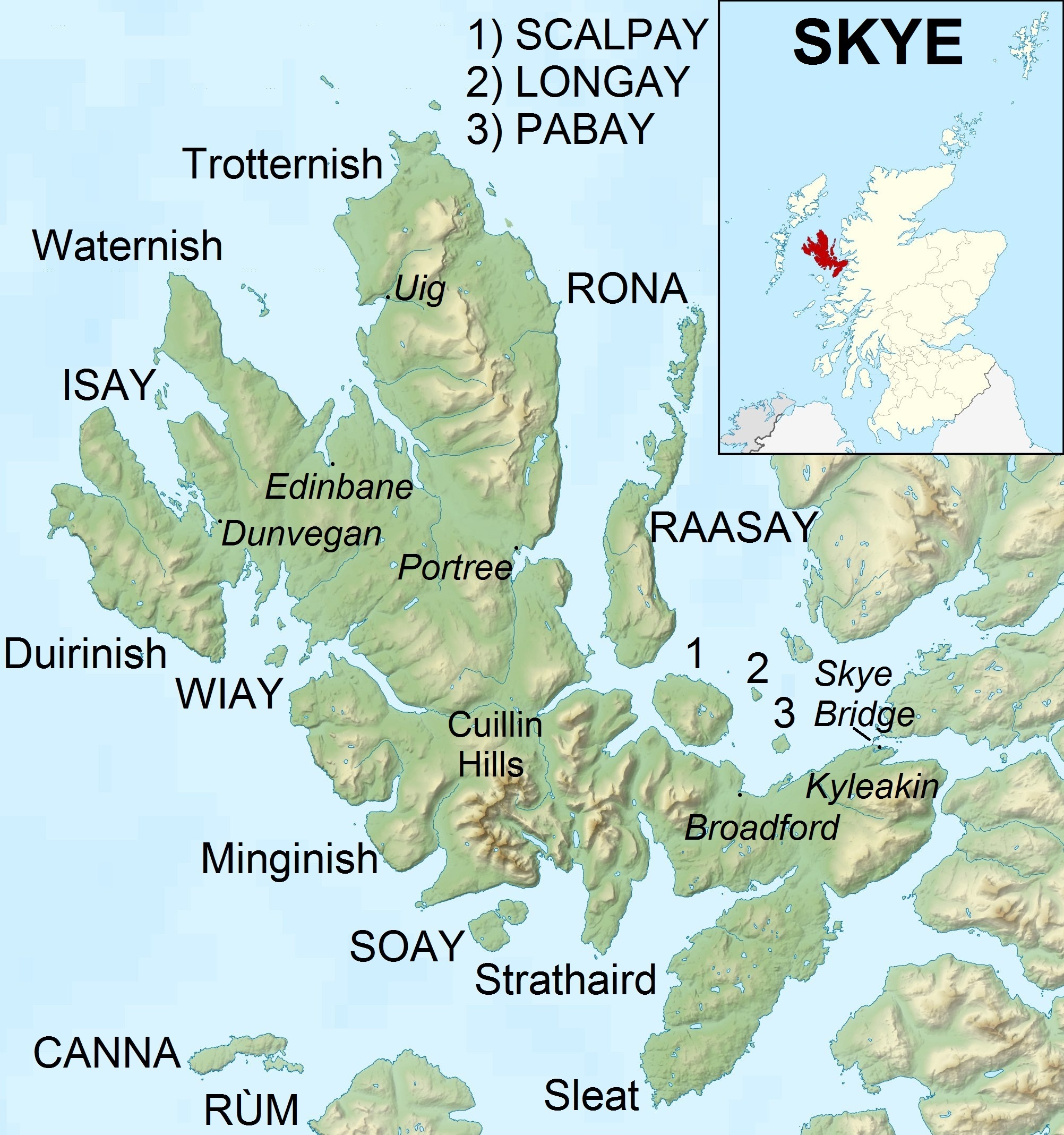
Isle of Skye, Scotland--Contains Ordnance Survey data © Crown
 copyright and database right [CC BY-SA 3.0  via Wikimedia Commons