Wednesday, February 26, 2014

18th Century Man, Woman, and Child's Best Friend...going to the dogs

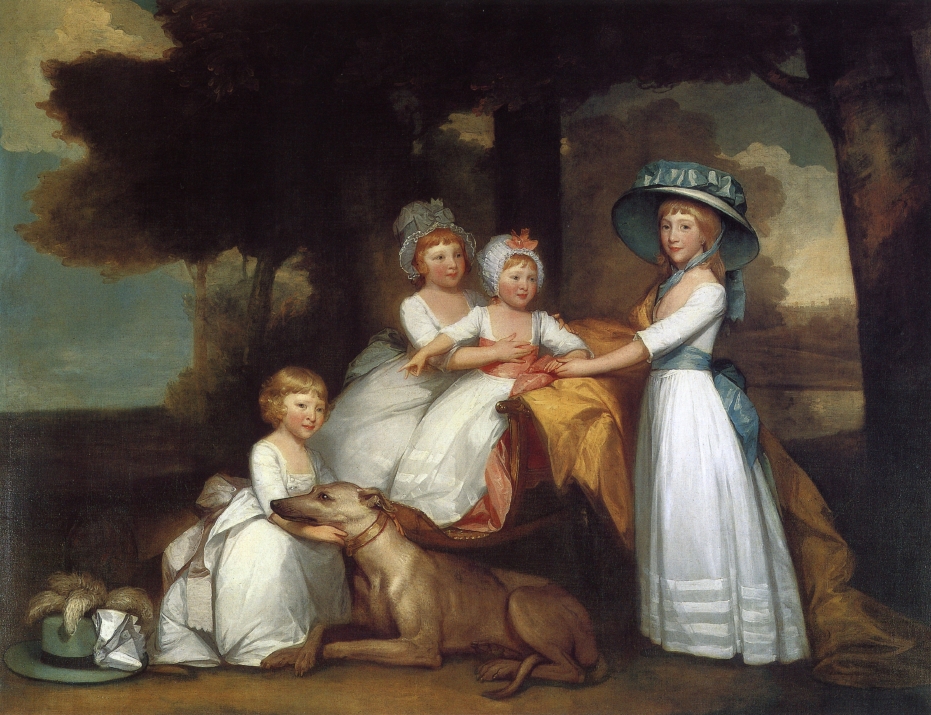
The Children of the Second Duke of Northumberland, 1787, Gilbert Stuart
In 21st century America, our pets are often considered family members, be they dogs, cats, goldfish, ferrets, rabbits, pot-bellied pigs, horses, llamas, hamsters, what have you. Examining portraits from the 18th century, we see this is really nothing new at all. Many portraits included dogs, cats, and birds, as well as more exotic pets and, by virtue of them being painted with their people, we can easily surmise the importance they played in the family structure. Today I would like to salute the 18th century pet dog and show you several paintings that include man's (as in mankind's) best friend. As you can see, dogs were included in paintings depicting all
Louis XIV and His Family, 1710, by Unknown, formerly attributed to Nicolas de Largillierre
socioeconomic strata from the humblest peasant to the highest monarch. My novel-in-progress has a dog as an integral part of the story so I was interested in seeing the kinds of dogs who populate 18th century paintings.
Enjoy!


George Venebles Vernon, 1767, Thomas Gainsborough
Cottage Girl with Dog and Pitcher, 1785, by Thomas Gainsborough


Woodes Rogers and his family, 1729, by William Hogarth
The Children of King Charles I of England, 1637, Anthony van Dyck (17th century but just had to include it!)
Louis Philippe Joseph, Duc d'Orleans and Duc de Chartres
18th century, by Louis Tocque
Elisabeth Isabella Mniszech , 1797, by Marie Élisabeth Louise Vigée
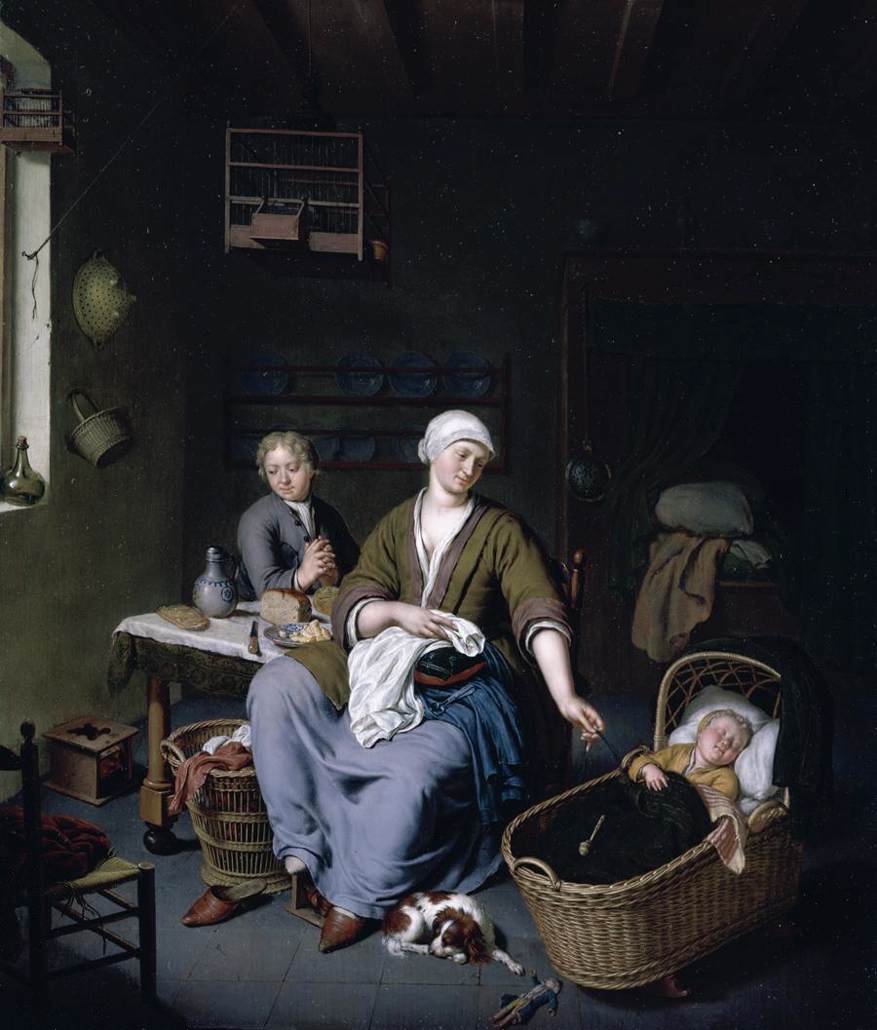
 Interior with a Mother Attending her Children, 1728, by Willem van Mieris


e
Portrait of a Lady with a Dog and a Monkey, 1710, by Nicolas de Largillierre
Teresa Vandoni, Italian singer, 1797, Carl Frederick von Breda
Philip of Parma, 1765, by  Laurent Pécheux
I even found our Betsy in the portrait above! 

Kate and Betsy at Yellowstone National Park, 2011, by William F. Ahearn
Have a good week, dear Reader. Thanks for stopping by...Y'all come back now!

Wednesday, February 19, 2014

What's Love Got To Do With It?...18th century courtship and marriage


"The Judicious Lover" 18th century after Hubert Gravelot
In the early 18th century, whether you married for love or money was often a matter of socioeconomic class. As in ladies’ fashions, the higher your social status, the lower your ability to do as you pleased. For the upper class, marriage was an arrangement made by parents seeking to cement the foundations of their wealth and power in the community. Any notions of romance were seen as secondary and, in truth, detrimental to such pairings. It was a thoughtful business decision set apart from the mercurial passions of the young people. Love, as such, was something one might grow into as the couple lived out their respectable, marriage contract. (Or…attained outside the bonds of marriage.) Young women, especially, had little to say in the matter and knew, once they were married, any small amount of independence they currently enjoyed was put to an end as their husbands would have complete legal control over them. If a young man’s attention was independently drawn to a particular lady, he would first have to receive the permission of his own father who, if he approved of the potential match, would send a formal request to the young lady’s father. The two patriarchs would meet and discuss the financial arrangements and if a 
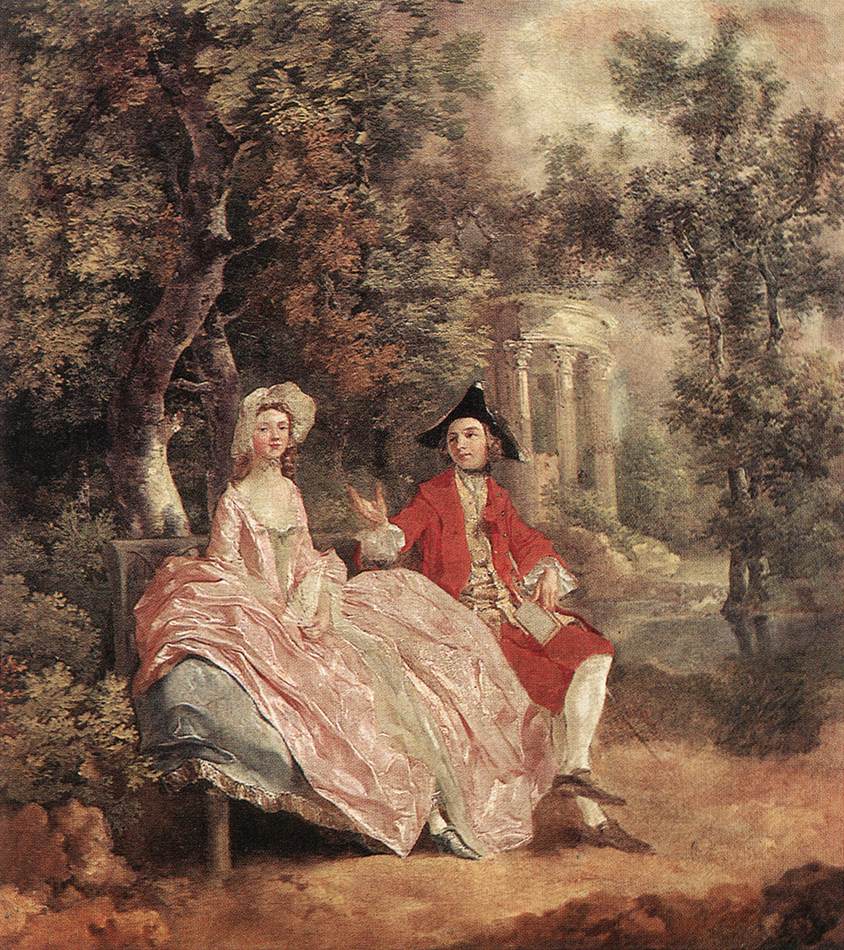
"Conversation in a Park" (1768) Thomas Gainsborough
satisfactory deal was made, the son was given permission to court the object of his affections prior to the agreed-upon marriage (whether or not the young lady had any interest at all.) If a young couple fell in love without the approval of their fathers, their only choice was to dissolve all financial ties and rights from their families, losing any inheritance they may have expected, and set out on their own. In today’s world of modern love and independence, that choice may seem a no-brainer but it was a very difficult move in the early 1700s. In some areas, the unapproved suitor could be sued by the young woman’s father for inveigling her affections, gaining her love through trickery. It was not until the mid to late 18th century that parental control diminished and young people of the upper classes were freer to court and marry based on romantic love.

    
"Haymaker and Sleeping Girl" (1785) Thomas Gainsborough
Now of course, if you were born into a lower rung of the societal ladder, your choices for courtship and marriage were much broader since wealth and status were not part of the
equation. That did not mean, however, families felt no responsibility for their children's welfare. The practice of “bundling” in which a courting couple were allowed to sleep in the same bed, fully clothed with a bundling board or bolster between them in the young lady’s family home, served a dual purpose. In many lower income families, everyone slept in the same room, and it was a means in which not only the young lovers could get to know each other better but also as a way of proving the identity of the unborn baby’s father if things progressed, as they so often would, despite the physical barriers.

 In this more relaxed attitude toward courtship and marriage, there were varied forms of marriage agreements in the early 1700s, not all dependent upon a minister or magistrate. One of the more prevalent means was “handfasting” or “spousal” in which the young couple, with or without witnesses, simply held hands and promised love and loyalty, declaring themselves married. These personal ceremonies were held anywhere the couple chose and in Colonial America
"Young Girl Listening to Conversation Between Two Lovers"
(1789) by Michel Garnier
were often performed over an anvil in a blacksmith’s shop, symbolizing the strength of their bond. Some were held right in the bedroom just prior to conjugal bliss. Since a number of those husbands disappeared by morning’s light, the bride would sometimes hide her friends in the closet as witnesses to
the ceremony. For spousals that were sincere, the couple often gave each other the gift of a half a broken silver sixpence which each kept until death did them part. Another custom was called “spousal de futuro,” which was an announcement of engagement, but if a baby was conceived in the interim, the status was automatically elevated to “spousal.”

"The Joys of Motherhood" (1752) by Jean-Honore Fragonard
Remember this old chant from your childhood?  “First comes love, then comes marriage, then comes (insert name of choice) with a baby carriage.” As you can see, in the early 18th century, the order of events could take any number of variations and, come to think of it, that’s not so different from today, after all!


Have a good week, dear Reader. Thanks for stopping by...Y'all come back now!

Wednesday, February 12, 2014

Love is in the Air...18th Century Valentine Wishes

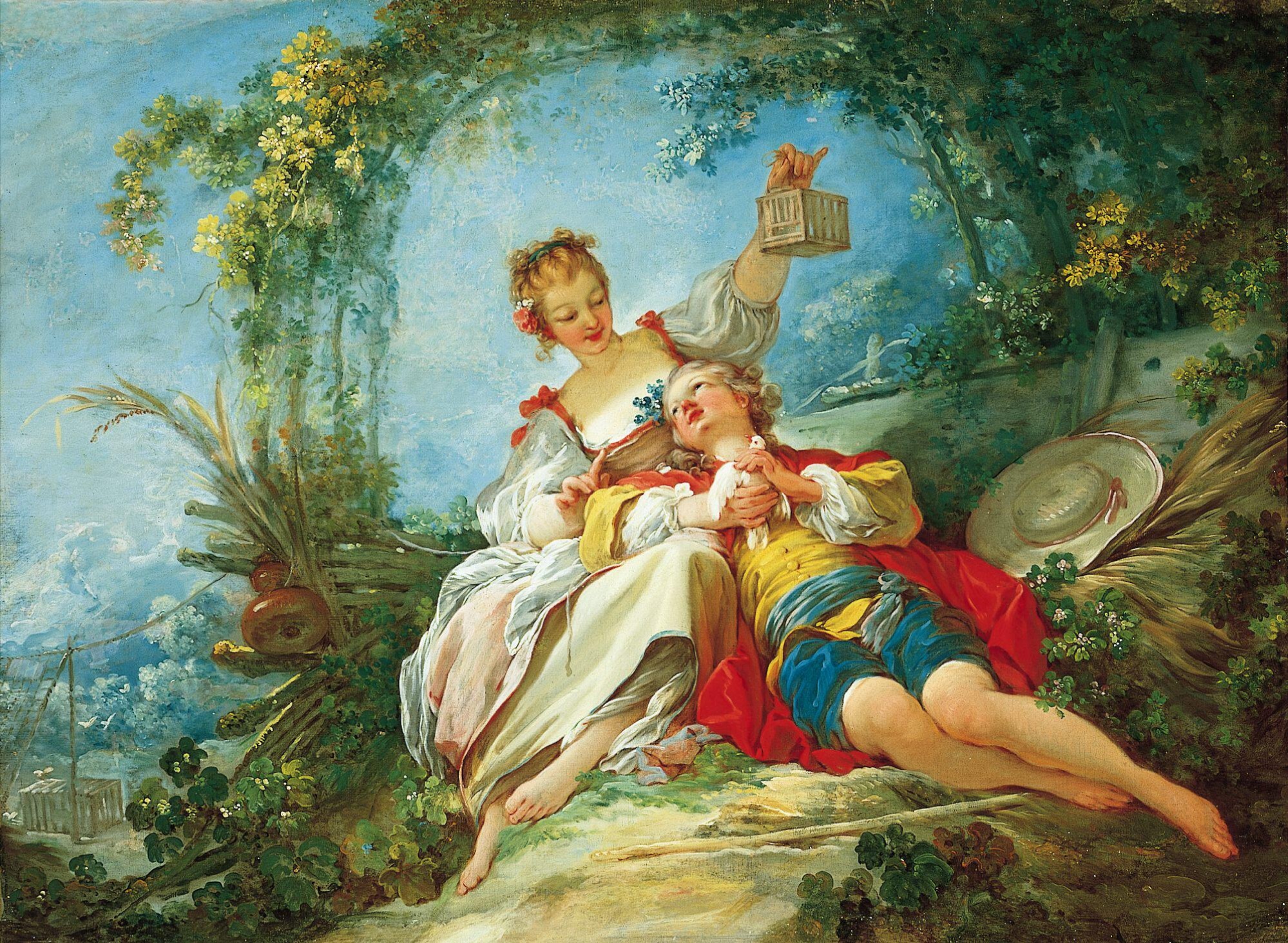
"Happy Lovers" (1760-1765) by Jean-Honore Fragonard


"St. Valentine Baptizing St. Lucilla" (1575) by Jacopo Bassano
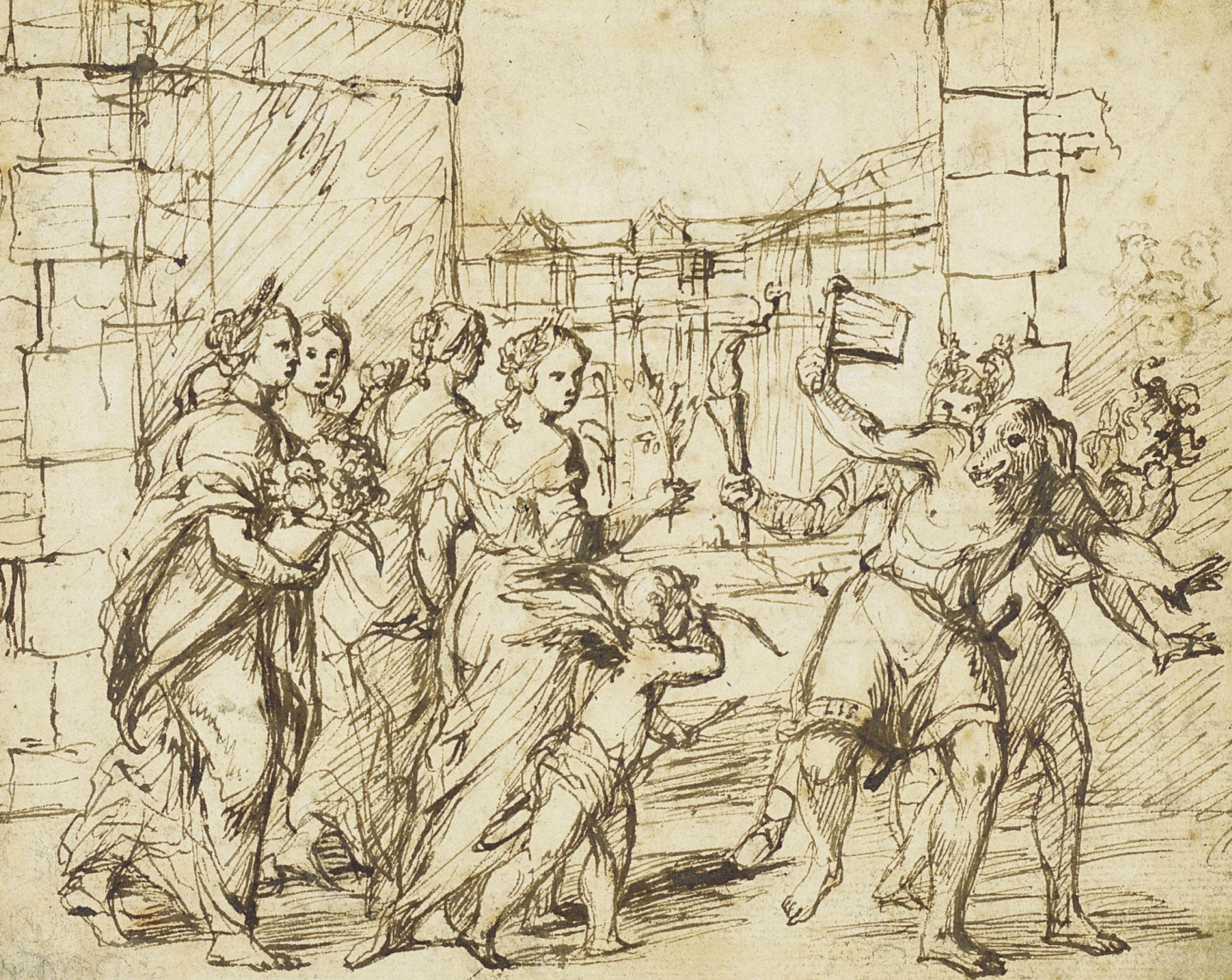
"The Lupercalian Festival in Rome" by the Circle of Adam Elsheimer (1578-1610)
Ah…’tis the week of love culminating in Valentine’s Day this Friday the 14th. Many’s the modern man who looks upon this day with disdain claiming it’s just a made-up day by the greeting card companies, a pernicious ploy to part the lover from his cash, to trap his heart in ransom until he buys his love a valentine. Oh, but he would be wrong, at least as far as the origins of the day are concerned. Celebrating February 14 as a day for proclamations of love goes waaaay back to ancient Roman times. Although more than one story exists as to how the saint, for which the day is named, became associated with romantic love, there are two likely scenarios. One, is that a priest named Valentine, who lived in 3rd century Rome, defied Emperor Claudius II’s orders and performed secret wedding ceremonies for soldiers. The emperor had outlawed the marriage of his soldiers, deeming them less useful if they had wives and children to think of. When Claudius II learned of the priest’s actions, he had him imprisoned and sentenced to death. Another story has it that while in prison, Valentine fell in love with the jailer’s daughter who was kind to him and, before his death, penned her a letter reading “From your Valentine.” 

Long before Valentine, however, the Romans celebrated the festival of Lupercalia, a day in mid- February dedicated to the god of fertility, Faunus. In the 5th century, in an effort to distract Christians from the pagan activities, the church deemed February 14 as
Saint Valentine’s Day, the day on which the saintly priest was martyred. In the middle ages, the good folk of England and France thought that February 14 was the day birds chose their mates for the season and in this mix of pagan fertility rites, loving saints, and love birds, the romantic notions of Saint Valentine’s Day came to full flower.


"Lovers in a Landscape" (1740) Pieter Jan van Reysschoot 
                    
Helene Lambert de Thorigny" (1700) Portrait by Nicolas de Largillierre
Flowers by 
Jean-Baptiste Belin de Fontenay
Jumping ahead to the 18th century, we find many poems flowing from romantic hearts and hand-written messages of love being exchanged on February 14. And if a love-struck Romeo of the late 18th century found himself at a loss for words, he could refer to a book published in Great Britain in 1797 entitled, The Young Man’s Valentine Writer. Remember the old standard, “Roses are red, Violets are blue?” Well you will find the original is a Valentine message written in a collection of English nursery rhymes in 1784, 
Gammer Gurton’s Garland
Here, you see it in its original version:

The rose is red, the violet's blue,
The honey's sweet, and so are you.
Thou are my love and I am thine;
I drew thee to my Valentine:
The lot was cast and then I drew,
And Fortune said it shou'd be you.


"Mary Darby Robinson as 'Perdita' "(1782) by Joshua Reynolds 
For more adult verses, I give you a prolific female poet of the 18th century, Mary Darby Robinson, whose life was short on years but long on romantic intrigue (including a bout with the teenaged Prince of Wales, but that’s for another day!) Here, I present one of her many poems touting the sweet pain love can inflict upon us:

“Sonnet XVII: Love Steals Unheeded”

Love steals unheeded o'er the tranquil mind,
As Summer breezes fan the sleeping main,
Slow through each fibre creeps the subtle pain,
'Till closely round the yielding bosom twin'd.

Vain is the hope the magic to unbind,
The potent mischief riots in the brain,
Grasps ev'ry thought, and burns in ev'ry vein,
'Till in the heart the Tyrant lives enshrin'd.
Oh! Victor strong! bending the vanquish'd frame;
Sweet is the thraldom that thou bid'st us prove!
And sacred is the tear thy victims claim,
For blest are those whom sighs of sorrow move!
Then nymphs beware how ye profane my name,
Nor blame my weakness, till like me ye love.
    
"Robert Burns" by Alexander Naysmith (1758-1840)
Turning to that 18th century superstar of songs and poetry, I give you Scotland’s Robert Burns whose hundreds of verses are full of romantic notions. Here is one of his all-time favorites:

"A Red, Red Rose" 

O my Luve's like a red, red rose
That's newly sprung in June;
O my Luve's like the melodie
That's sweetly played in tune.

As fair art thou, my bonnie lass,
So deep in luve am I;
And I will luve thee still, my dear,
Till a' the seas gang dry:

Till a' the seas gang dry, my dear,
And the rocks melt wi' the sun;
I will luve thee still, my dear,
While the sands o' life shall run.

And fare thee weel, my only Luve,
And fare thee weel awhile!
And I will come again, my Luve,
Tho' it ware ten thousand mile.

Yes, just give Robbie a lass’s name and he’ll pen her tribute. Here is a list of names I pulled from his long list of poems and songs (perhaps you’ll find your lady’s name!)
Lesley
Mary
Mary Ann
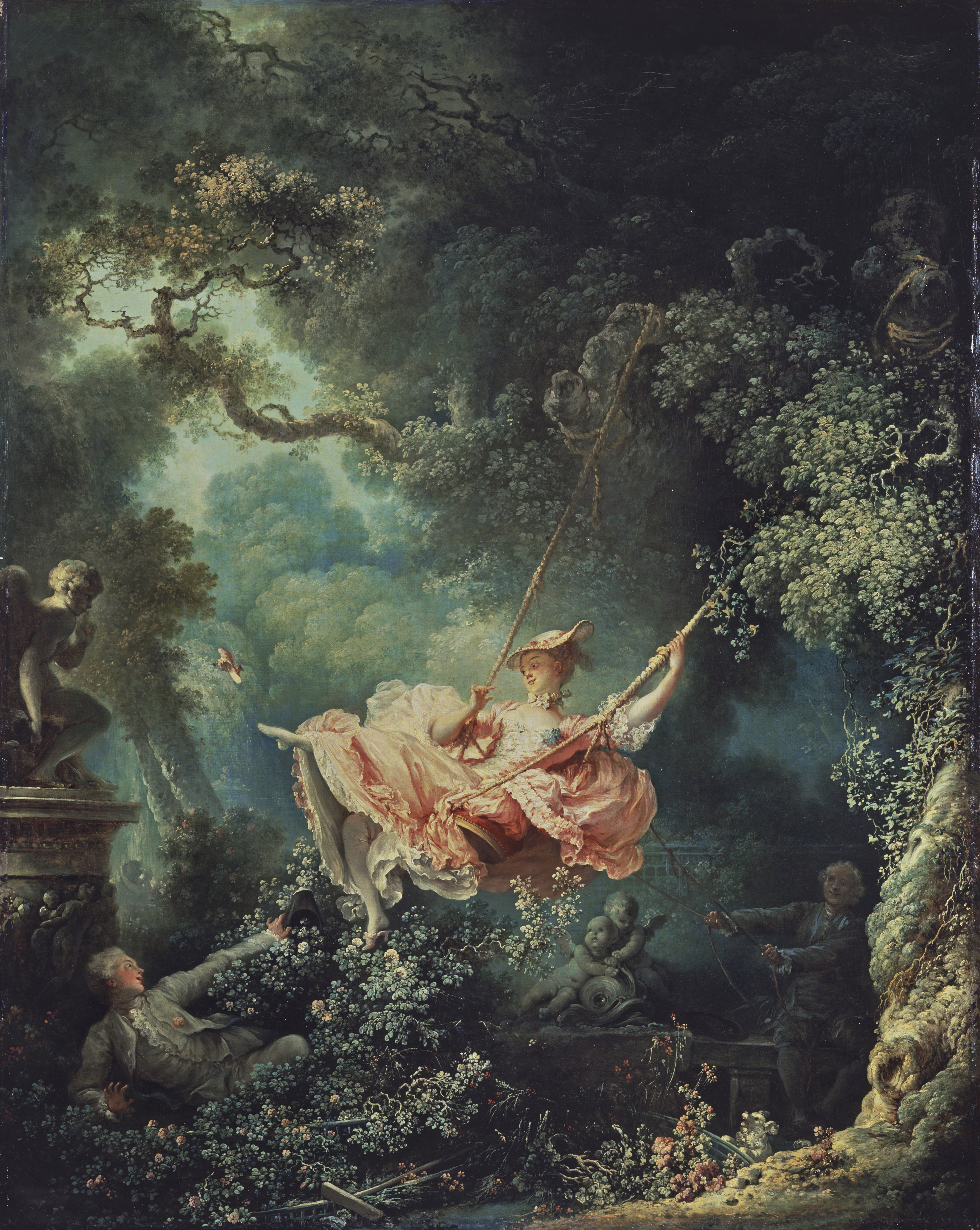
"The Swing" (1767) by Jean-Honore Fragonard
Bell
Nell
Eliza
Eppie
Nanie   
Polly
Sylvia
Bessie
Jessie
Meg
Peggy
Peg
Stella
Jean
Jeanie
Clarina
Clarinda
Ann
Anna
Phillis
Nancy
Jessie
Cholris
Philly
Leezie
Mally
Katie
"Lovers First Tiff" (1876 painting of an 18th century scene)
by Louis Haghe

A busy man was our Rrrobbie! Now, if you find a poem suitable for your love, you may want to do a little Scottish/modern English translation or you just might honor her with a line like this from one of his poetic ditties: “Johnie lad, cock up your beaver…”

Hmmm…well on that note, I think it’s time to draw this post to close!

Have a good week, dear Reader. Thanks for stopping by...Y'all come back now!  (And Happy Valentine's Day!)


Wednesday, February 5, 2014

How to Survive Winter...18th Century Style

The Four Seasons, Winter, 1755 by Francois Boucher
Brrrrrrr, it's been a cold winter, so far, even down here in Edenton, North Carolina where we're still recovering from our six inches of snow and two degree (F) wind chills a few days ago. (Yes, I know for some of you in more northern climes, that sounds down right balmy, but it's all relative!) Living in a drafty old house made me wonder how our 18th century ancestors managed without central heat and indoor plumbing. Chills me to the bone just thinking about it!

Comtesse Tessin, 1741, by Jean Marc Nattier
So, let's say you are a woman who has time traveled back to the 18th century in the dead of winter and you need to warm up...fast! First of all, let's be sure you are properly dressed. If you are a highly fashionable woman such as the young lovely pictured above in her swan-decorated, man-driven sleigh, your choices are fewer than if you are of the lower-classed variety. Your silk gowns are low-cut in the bodice and the sleeves end right around your elbows. You can achieve some relief by wearing woolen stockings and quilted petticoats beneath your skirt and perhaps a woolen waistcoat over your corset and beneath your gown. You may keep your hands warm by tucking them inside a fur muff. During the 18th century, the size of your fur muff increases dramatically and becomes a status symbol. The wealthier you are, the larger your muff. As a matter of fact, some French women were known to carry small dogs inside their huge muffs. I suppose that would add another layer of warmth as well! Now, if you are still cold and must cover your beautiful gown, you might wear an elbow-length, fur-lined cape. A light scarf can cover your head but if you arrive in the latter quarter of the century, your formal wigs double
A Winter Landscape with Figures Skating on a Frozen River, early 1700s, by Dirck Dalens III
as head warmers. Of course, the flipside to that is the undesired heat they capture come summertime, but that's for another, more sultry day... If you are a less fashionable lady you have more latitude and may wear skirts of heavier, courser, warmer fabric and cover your less-than-vogue dress with a longer, hooded cloak. Think you might get by wearing long underwear? Think again, dear lady, no matter your class, women did not wear underpants or drawers of any kind in the 18th century.

Traveling? Be sure you have plenty of warm woolen blankets or furs, if you can afford them, to cuddle beneath while riding in your carriage or... your swan-decorated, man-driven sleigh.

How about something to warm your insides? You may have your choice of hot broth, hot chocolate, hot tea, hot coffee, hot toddy, hot mulled wine or cider. You see the trend here. A nice hot bowl of Brunswick Stew would go a long way to warm you up on an icy day! (See my blog post for 11-20-13 for an authentic Brunswick Stew recipe.)
Bed Warmer--  Algont at nl.wikipedia

Your home is heated by fireplaces and if your abode is a humble one, the kitchen fireplace doubles as the place to cook and as the source for heat. A single fireplace kept stoked with embers will warm your small home. If your time machine drops you into a large mansion, your bedroom will have its own fireplace kept glowing by the household servants. The servants may also have warmed your bed with a warming pan before you retire (lucky you!) The warming pan consists of a large round or oval metal pan, often copper, attached to a long wooden pole. The pan is filled with hot coals or ash from the fireplace and closed with its hinged top. Not only does the pan warm the bed linens as it slides from end to end, it helps eliminate dampness often felt before the days of dry, central heat.

Woman at her Toilet, 1660, by Jan Hacvicksz Steen
So, now you've survived your day in the cold and tucked yourself into a bed made toasty by a warming pan, or perhaps by the companionship of other inhabitants of your home, and with a tummy warmed by a bowl of hot stew and a mug of hot, mulled cider. Oh dear, perhaps you had a little too much of that warming liquid and Nature calls. What to do? Nothing to do but haul yourself out of bed and head for the unheated, outdoor privy or, perhaps on second thought, make use of the indoor chamber pot. Just be sure you've located it before the candles are snuffed out. It's mighty dark at night in the 18th century and you wouldn't want to trip over it or, worse yet, knock it over!

Have a good week, dear Reader. Thanks for stopping by...Y'all come back now! (And stay warm!)

Portrait of Princess Daria Galitzine - "Winter", 1756 by Jean Samsois II
Kate


Wednesday, January 29, 2014

"Arrrrgh, it's the Hoi Toiders!"...hearing early 18th century speech today

Blackbeard the Pirate by Joseph Nicholls, 1736
Having moved to the three-hundred-year-old northeastern North Carolina town of Edenton two years ago, in the area known as the Inner Banks (as opposed to the more well known Outer Banks,) I have come to discover the particular accent native to these parts. In many pronunciations I hear remnants of both Tidewater Virginia and Outer Banks/Southeastern North Carolina brogues. In turn, these accents with their hard "r's" sound similar to English and Irish accents, specifically of southwestern England in the Bristol area and the Ulster area of Ireland. So what does all this have to do with research pertaining to all things early 18th century, the primary time setting for my novel-in-progress? Quite a lot, actually, since I am beginning to hear the characters' voices in my head. And before you call for the men in the white coats, that's actually a good thing for a novelist!

450 year old map of Outer and Inner Banks by Gov. John White
I have been pondering how the speech of eastern North Carolinians, as well as Blackbeard the infamous pirate and his ilk, may have sounded in the year, 1718. I would surmise they sounded much like the parts of Great Britain from which they came. The unique accents still heard in pockets of eastern North Carolina are in areas where, for centuries, the people were somewhat isolated, particularly down around Ocracoke and Harkers Island. With the vast influx of tourists and people moving to "God's Country" from elsewhere, the strength of the accent is weakening but is still very present to the attentive ear.

Southwestern England including Bristol in red (Wikimedia Commons)
Knowing that Blackbeard was said to have come from Bristol, England, I went to YouTube to hear examples of current day Bristolian and southwestern English accents and, lo and behold, I could hear similarities between them and those of the "Hoi Toiders," the name sometimes given to speakers of the Outer Banks brogue since they pronounce the long "i" sound as "oi/oy." "High tide" becomes "hoi toide." I'm not the only one to hear the similarity of speech between them. When the noted English
dialectologist, Peter Trudgill, took recorded samples of Outer Banks speech back to England, most listeners agreed the origins were British, most likely from the West Country (southwestern England.)

Outer Banks of North Carolina, map by NOAA
I have heard this same accent on tiny Tangier Island on the Eastern Shore of Virginia, my own relatives from the Swansboro area of southeastern North Carolina, and even a friend whose family had fished the waters of southern New Jersey for generations. My ninety-year-old mother, growing up in Swansboro, remembers being called a "Hoi Toider" by outsiders. She has lived in many places up and down the east coast, from North Carolina to New York, and has lost much of her old accent but my cousins "down home," as mother still calls it, retain the strong brogue. It is apparent not only in the hard "r" and "oy" sounds but also in the way the  "ow" sound, as in the word "brown," becomes more of a long "o" sound as in "brone." It's hard to put it down in writing since the pronunciations are more intricate than I present here and often have more syllables pronounced than they would appear to have in print. "Toide" is more like "t-uh-ee-d." "Brone" is more like "breh-on" with a long "o." My husband Bill (a New Englander by birth,) likes to tell folks his name has changed since he moved to Edenton. Here he's called "Bee-al" by many of our dear, new friends

Regarding that hard "r" sound...my research shows that prior to the American Revolution, all of England, including the upper crust, pronounced the "r's" of their words (rhotic) and it was not until late in the 18th century that some began dropping the "r" (non-rhotic) in an attempt to distinguish themselves from the rabble. This became the fashion and made its way to America through its eastern port towns taking hold especially in the upper classes of southern society.

I think my characters may begin to take on speech blessed with the rich colors of both Old World Bristolians and New World Hoi Toiders. And if I need an interpreter I can just call my sweet cousins "down home" and they'll straighten me out I'm sure!

 Have a good week, dear Reader. Thanks for stopping by...Y'all come back now!

Kate

Thanks to the following for today's resource information:

The North Carolina Language and Life Project:   http://www.ncsu.edu/linguistics/ncllp/

Hoi Toide on the Outer Banks: The Story of the Ocracoke Brogue by Walt Wolfram and Natalie Schilling-Estes 

http://mentalfloss.com/article/29761/when-did-americans-lose-their-british-accents 

YouTube:  http://www.youtube.com/watch?v=FENw5satQsA (Bristol accent) 

http://www.youtube.com/watch?v=jXs9cf2YWwg (Outer Banks accent)

Wednesday, January 22, 2014

Uncovering Blackbeard's Treasure...historical riches from "Queen Anne's Revenge"

(Part 2)

Model of Queen Anne's Revenge
In 1718, Captain Edward Teach AKA Blackbeard the Pirate, ran his flagship, Queen Anne's Revenge, aground near Beaufort, North Carolina. The remains of the 200 ton ship rested undisturbed beneath twenty-five feet of water until its discovery in 1996. Since then, a treasure trove providing tens of thousands of 18th century sea-going artifacts has been brought to the surface. Many exciting discoveries still remain beneath the sea promising even more insight into nautical life during the Golden Age of Piracy. A special conservation and restoration lab has been set up on the campus of East Carolina University in Greenville for the sole purpose of caring for these historical treasures. Coincidentally, students and teams of the university are called the
Artifacts still encased in concretions
Pirates.

A traveling exhibit touring the state of North Carolina showcasing many of the artifacts enables residents and visitors alike the opportunity to see, firsthand, items actually handled by the infamous pirate captain and his crew. It's one thing to examine relics uncovered by archaeologists which were used by ancient, unknown people but it's quite another to see items last handled by one of  the most well known characters who ever lived.

My husband and I visited the exhibit while it was housed in the North Carolina History Center in New Bern.
Within the glass display cases we saw items ranging from pewter plates on which they ate their meals, to bits of clay pipes in which they smoked their tobacco, to a tantalizing scattering of gold grains and flakes. There were canon balls, grenades, canon long shot, and shackles on display, reminders of the violent nature of life aboard a pirate ship. Even small, personal items such as brass belt buckles, cuff links, and buttons have been rescued from the deep. The exhibit also contained several large display signs with information and illustrations about this turbulent time in American history and a very informative video ran on a continuous loop. The Beaufort branch of the North Carolina Museum of Maritime History houses a permanent collection of many other artifacts from the ship as well as items salvaged from other ship wrecks.

Some of the most interesting items brought to light are ones that were of medical or hygienic use and give us a real picture of day to day life aboard an early 18th century ship.
One of the more disturbing artifacts is a pewter urethral syringe with a curved funnel tip, still containing vestiges of mercury, used to treat venereal disease. Ouch! Another item was known as a seat of ease: a rolled piece of funnel shaped metal used as a waste tube and fitted in the far stern of the ship for the convenience of the officers.

Photographs of 95 of the artifacts can be seen on the Queen Anne's Revenge website
http://www.qaronline.org/Conservation/Artifacts.aspx

All photographs on today's blog post were taken either by my husband or myself during our visit to the exhibit earlier this month.
Have a good week, dear Reader. Thanks for stopping by...Y'all come back now!

Kate

Wednesday, January 15, 2014

It's a Pirate's Life for Me...discovering historical treasure from Blackbeard's "Queen Anne's Revenge"

(Part I)

"Cutthroat Kate" strikes a pose
My husband, Bill, and I took a Sunday drive down to New Bern, North Carolina (about two hours south of our home in Edenton) to experience the traveling exhibit of artifacts recently brought up from the wreck of Blackbeard the pirate's flagship, the Queen Anne's Revenge.  Most of the photos on today's post are ones we shot at the exhibit and...yes...I had to include some of our silly shenanigans posing with the pirate statues and cutouts. The information garnered from this experience is just too much for a single post so I will divide into at least two segments. In today's post I will share with you the fascinating history of the ship and next week we'll take a look at the artifacts and the amazing efforts to preserve and, literally, bring them to light.


Blackbeard's Flag
The Queen Anne's Revenge's checkered past began long before she became the flagship of the infamous Captain Teach AKA Thatch AKA Blackbeard. Originally named La Concorde, she was owned by a French merchant by the name of Rene Montaudoin who used her as a slave trade ship from 1713 until her capture by Blackbeard in 1717. The ship's home port of operation was Nantes, France with ports of call on the west coast of Africa, to pick up enslaved Africans, and the French Caribbean islands of Martinique, Guadeloupe, and Saint Domingue, to sell the slaves. On July 8, 1717, La Concorde picked up her final human cargo in present-day Benin and, under the leadership of Captain Pierre Dosset, sailed the Middle Passage route toward Martinique. With 516 captive Africans, and seventy-five crew members, La Concorde endured nearly eight weeks of sailing in which sixty-five slaves and sixteen crewmen perished.
 
Models of Queen Anne's Revenge and Adventurer
Queen Anne and Prince George by
Charles Boit (1706) Note the Prince's Big Hair
(see blog post from 1-08-2014)
About 100 miles from their destination, La Concorde encountered Blackbeard with his two armed sloops and crew of 150. The French ship's surviving crew members were further handicapped with thirty-six of them suffering from scurvy and dysentery.  After Blackbeard fired two volleys at the ship, Captain Dosset surrendered. The pirates unloaded the ship's crew and slaves onto the island of Bequia in the Grenadines and sailed away leaving the French the smaller of Blackbeard's two sloops. The French cabin boy and three other crewmen volunteered to join the pirate crew and ten others including a pilot, a sailor, a cook, two carpenters, and three surgeons, were taken by force. The French named their new and much smaller vessel, Mauvaise Rencontre which translates in English to Bad Encounter. Blackbeard renamed his new 200-ton ship, Queen Anne's Revenge. The pirate captain learned his trade while a legal privateer in the service of England's Queen Anne during her war against Spain and France between 1701 and 1714.
After Blackbeard's May, 1718 blockade of the port of Charleston, South Carolina in which he secured medicine for his crew, he sailed Queen Anne's Revenge to Old Topsail Inlet (present-day Beaufort Inlet) on the coast of North Carolina. There his flagship, as well as the sloop Adventure, ran aground on a sandbar and, after removing any valuable cargo, were abandoned.

John Lawson's Map showing Topsail Inlet (1709)
There is some speculation the pirate captain did this on purpose in order to disperse some of his crew whose numbers had grown to, perhaps, an unwieldy size of 300 souls. Blackbeard marooned some of the crewmen and left Beaufort with a hand-picked crew and most of the plunder. Over the centuries, Queen Anne's Revenge remained in place and eventually crumbled in upon itself beneath the sea. It was not until 1996 that the wreck was discovered and research determined it to, indeed, be Blackbeard's ship. Since that time, divers have continued to salvage thousands of artifacts expertly and carefully restored to bring us an unprecedented look at not only 300-year-old nautical life, but at one of the most-renowned and storied characters of all time, Blackbeard.

(See the Queen Anne's Revenge official website at http://www.qaronline.org/Home.aspx)
"Wicked Will" before and after some PhotoShop magic
Next week:  (Part II) Queen Anne's Revenge offers us a tantalizing peek into 18th century pirate life.

Have a good week, dear Reader. Thanks for stopping by...Y'all come back now!

Kate