Wednesday, March 30, 2016

Spring- when a young man's fancy lightly turns to...Ylang Ylang!

Cananga Flower (Ylang Ylang Flowers) by Ks.mini via Wikimedia Commons 
Back in 1835, Alfred Lord Tennyson pronounced, "In the Spring young man's fancy lightly turns to thoughts of love." One might add that the warmth and promise of Spring turns all our thoughts to love! And the essential oil to help encourage such thoughts to move into desired channels of attention or just keep our own minds and hearts focused on the emotion of the season? According to aromatherapists, that would be Ylang Ylang. From my own experience with this essential oil in aromatherapy blends, I heartily agree. It has the most luscious, sensual fragrance you can imagine. No wonder it is often used in perfumes. And its fragrance is so concentrated, just a little bit goes a long way. Too much is overpowering.

Ylang Ylang is utilized as an:
Ylang
Ylang Ylang (
Cananga odorata) Essential Oil in clear glass vial
by Iteneranttrader via Wikimedia Commons
Antidepressant- its fragrance has qualities that lift the spirit, ease stress, and relax the body and mind
Antiseborrhoeic- helps regulate the natural sebum production in the skin, aiding in relief of seborrhoeic eczema
Antiseptic- acts as a disinfectant and inhibits microbial growth in wounds
Aphrodisiac- used in many cultures to stimulate those thoughts and feelings that arise come Springtime! (Also attributed to balancing hormone levels)
Hypotensive- its stress-lowering qualities contribute to a lower blood pressure
Nervine- boosts the nervous system and reduces emotional strain on nerves
Sedative- its ability to lower stress levels and calm the mind helps induce a good night's sleep (of course, if you are thinking all those "love thoughts" it encourages, that might keep you awake at night!)
Cananga Odorata in Maui, Hawaii by Forest and Kim Starr
via Wikimedia Commons

The essential oil of Ylang Ylang is steam distillation extracted from the fresh flowers of the Ylang Ylang tree, (Cananga Odorata,) commonly found in the rain forests of Asian and South Pacific Islands like Indonesia, Philippines, Java, Sumatra, Comoro and Polynesia. Its chief components are benzyl acetate, benzyl benzoate linalool, caryophyllene, geranyl acetate, methyl benzoate, p-cresyl methyl ether and other components known as Sesquiterpenes, all of which contribute to its fragrance and medicinal properties.

So inhale it, soak in a bath infused with it, massage it in with your carrier oil of choice, or lightly dab it on your skin, and lose yourself in Ylang Ylang's sensual, joyous cloud of Springlike goodness. 

Have a good couple weeks, dear Reader. Thanks for stopping by...y'all come back now! (And inhale deeply...)

Kate
(As always: this post is for information only and does not replace medical advice. Тest out an oil first by placing a small diluted amount on your arm as a patch test. In particular, those who are or could be pregnant should always refer to their physicians before using any essential oils.) 


Wednesday, March 16, 2016

Caraway Seed Essential Oil...a nod to the Irish

"Caraway" photo by H. Zell , via Wikimedia Commons 
'Tis St. Patrick's Day week so I searched for an essential oil with an Irish connection and decided upon caraway seed. Although caraway seeds are actually an American addition to traditional Irish soda bread, caraway seed cake is indeed authentically Irish. Sometimes called "seedy cake," it is a lovely, gently sweet cake perfect for afternoon tea, especially spread with some wondrously creamy Irish butter. (I've included a recipe at the end of today's post.)

Caraway Seed essential oil has a sweet, spicy, mildly peppery fragrance. It can be dropped into an infuser for inhalation, bath water for soaking, carrier oil/ lotion/ or shampoo for massaging into the skin or scalp. The following are benefits widely
"Caraway Seeds" by Slick, via Wikimedia Commons
attributed to caraway seed oil:


Emotional Wellbeing-- its warming fragrance aids stress relief, mental strain, and emotional fatigue.

Respiratory Health-- acts as an expectorant and useful for coughs, bronchitis, and other respiratory ailments.

Skin and Hair-- as a tissue regenerator, it can help fight oily skin, clear acne, heal bruises and boils, and clean infected wounds. It also soothes itchy skin, as well as dandruff and other scalp problems.

Digestion-- helps relieve upset stomach, colic, and gastric spasms.

So, as if that isn't enough, toss some caraway seeds into a cake recipe and enjoy their unique texture and flavor. You might say you "can have your cake and eat it, too!" Thanks to edible-ireland.com for this culinary treat:
From Edible-Ireland.com


Caraway Seed Cake
adapted from Make, Bake, Love by Lilly Higgins
Serves 8 to 10
175 g (1 1/2 cups) self-raising flour
150 g (1 1/4 cups) caster sugar, plus extra to sprinkle
125 g (1/2 cup + 1 tablespoon) butter, softened
2 eggs
1 tablespoon caraway seeds
(If you’re worried that your batter looks too dry, add in 1 or 2 tablespoons of milk.)
Preheat the oven to 170°C (340°F). Grease and line a 1 lb loaf tin.
Cream the sugar and butter together, then add the eggs one at a time, mixing well after each addition. Add in the flour and mix just until smooth, taking care not to overmix, then fold in the caraway seeds. Pour the batter into the tin, level the top and sprinkle with sugar.
Bake for about 1 hour (check it after 50 minutes), or until risen and an inserted skewer comes out clean. Leave to rest in the tin for 5 minutes before turning out onto a wire rack to cool
"Rugby Union Flag of Ireland" [Public domain], via Wikimedia Common
Have a good couple weeks, dear Reader. Thanks for stopping by...y'all come back now! 
Sláinte!

Kate
(As always: this post is for information only and does not replace medical advice. Тest out an oil first by placing a small diluted amount on your arm as a patch test. In particular, those who are or could be pregnant should always refer to their physicians before using any essential oils.) 

Wednesday, March 2, 2016

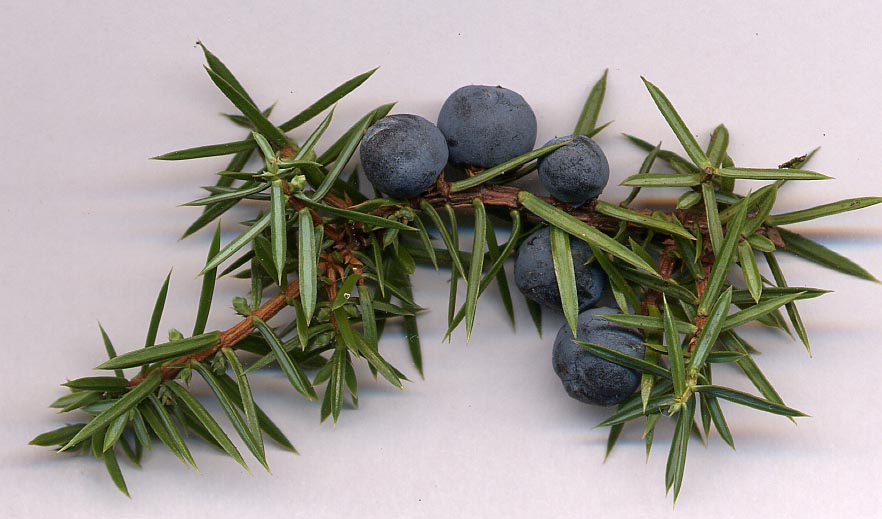
Reguvinating Juniper...Juniper Berry Essential Oil

"Juniper Berries" By MPF (Own work) via Wikimedia Commons
"Essential OIl" By Itineranttrader (Own work) 
via Wikimedia Commons
I plan to use Juniper Berry essential oil as an essential story element of my work-in-progress cozy mystery novel. So, today, I will share what I've learned about this aromatic botanical. As always: this is for information only and does not replace medical advice. Always test out an oil first by placing a small diluted amount on your arm as a patch test. In particular, those who are or could be pregnant should always refer to their physicians before using any essential oils. Today's featured oil, Juniper Berry, carries a specific precaution for pregnancy as it has been known to stimulate the uterine muscle and must not be used by expectant mothers. It is also advised against for those with kidney or liver disease. Since this essential oil should not be used for young children or infants, it should also not be used by nursing mothers.

Now! After getting those disclaimers out of the way (sounding like those drug ads on TV that show people dancing in the sunshine while the narrator, speaking in a calmly hushed voice, rushes through possible side effects like suicidal thoughts or death,) here are the attributes and uses of Juniper Berry essential oil: 

Three of the major properties of Juniper Berry oil are terpineol, terpinene, and pinene, which can be helpful in treating skin infections and other health issues. It also contains chemicals that flush out free radicals in your bloodstream. 

For:

"Diffuser" by Borutp] via Wikimedia Commons
-Relief of stress, anxiety, drowsiness, and headaches: diffuse into the air using 2-3 drops in an oil warmer or vaporizer or add 8-10 drops to bath water for soaking (in addition, for headaches, add 2-3 drops into carrier oil such as jojoba oil and massage into temples; add lavender oil for enhanced benefit.)

-Pain relief for arthritis, joint pain, muscle fatigue and aiding circulation: add 8-10 drops to bath water for soaking or 2-3 drops to one ounce of carrier oil such as jojoba for massaging into applicable areas

-Alleviating skin problems such as acne, oily skin, psoriasis, dermatitis, weeping eczema: add 2-3 drops to lotion or cream and apply to affected skin or dampen a cotton ball with juniper berry oil and gently wipe skin

-Aiding in healing of wounds: add 6-10 drops to 9 ounces of water, then soak a clean cloth in the mixture, wring it out, and apply as a compress to the infected area

Foot Bath by John R. Frazier, ca 1920 John R. Frazier via Wikimedia Commons
-Relieving hemorrhoids: add a diluted drop to your bath and soak for 20 minutes

-Relieving menstrual cramps: add 2-3 drops to one ounce of carrier oil and massage into lower abdomen

-Regulating appetite: add 2-3 drops to a vaporizer or use in steam inhalation

-Disinfecting the home: mix 5 drops in a quart of water and apply with spray bottle (shake before using)

I understand it is also the main flavoring ingredient in the making of gin...but that's another story...
     
Have a good couple weeks, dear Reader. Thanks for stopping by...y'all come back now! 

Kate


Tuesday, February 16, 2016

Setting a New Course...and getting cozy

Illustration unknown
Over the past several months I've shared my research into diverse figures of cultural mythology, from Scotland's Kelpie to the Cherokee Little People. The purpose of this intellectual adventure was to aid in the writing of my current work-in-progress, Murmuration, a novel woven with threads of magical realism. And although I've found the subject fascinating, I've decided to set this project aside for a variety of reasons. Not abandoned. Just on an indefinite leave of absence while I pursue a different literary direction. 


Bath Oil with Herbs and Leaves in Glass Bottle
Photo by Matte via Wikimedia commons
My creative compass is pulling me toward a genre that feels right for me at present; one in which my natural tendency toward gentle humor and love of puzzling out solutions is at home-- the Cozy Mystery. Think Agatha Christie's "Miss Marple" series, Alexander McCall Smith's The Number 1 Ladies' Detective Agency, and Lilian Jackson Braun's "The Cat Who" books. I'm in the very beginning stage of bringing this book to life but I do know a few facts: the main character is a female (age to be determined,) living in Edenton, North Carolina, who works as an aromatherapist/perfumier. My amateur sleuth's occupation will both lead her into and help her solve crimes that boil to the surface of this quaint southern town. My days as a certified massage therapist introduced me to the world of aromatherapy and the power of fragrance and essential oils. We all know how our sense of smell can affect our moods, transport us to a different time and place, rekindle memories (pleasant or un.) So! For the next several weeks, my blog posts will introduce us to the qualities and uses of essential oils. Of course, this information is never meant to be a replacement for appropriate medical care and if you try any of these oils, start with a small test amount to be sure you have no allergies to them. There are many great online sources of information regarding the use of essential oils and sources from which to purchase them. Always be sure your oils are pure essential, not the extracts you buy from the grocery store. A couple good online suppliers are Aura Cacia and Plant Therapy.

With all the "chill-you-to-the-bone" weather we are experiencing, I found several oils that
Ginger,  Photograph by Frank C. Müller, Baden-Baden
via Wikimedia Commons
warm us up, physically and emotionally. One of those is ginger. Pure essential oil of ginger root has been used for thousands of years to aid circulation, ease indigestion, and relieve muscle aches and pains. It has a lovely warm, citrusy fragrance that is a comfort on these cold days. There are many ways to use ginger oil but two easy and lovely methods are to add about 6 drops to your bath water just before you step in and add 6 drops to 10 ml of a carrier oil or lotion that you massage into your skin. I like to use pure jojoba oil as a carrier since it is very similar to our natural skin oil and is generally at home with any skin type.


Have a good couple weeks, dear Reader. Thanks for stopping by...y'all come back now! (And stay cozy.)

Kate


Wednesday, February 3, 2016

February...you give me Fever

Vintage Valentine
Cue the rhythmic finger snapping in 4/4 time: snap--snap--snap--snap--

"Never know how much I love you
Never know how much I care
When you put your arms around me
I get a fever that's so hard to bear
You give me fever
When you kiss me
Fever when you hold me tight
Fever! in the morning
Fever all through the night..." 

Fever! Peggy Lee's sultry voice will forever be connected with this sensuous song. Experience it for yourself via this YouTube video: 
https://www.youtube.com/watch?v=JGb5IweiYG8  


So what does Fever have to do with February? This month of groundhogs, Valentines, presidents, and civil rights activists, has a name we trace back to its Roman origins. It originally honored Februus, the god of purification, and marked the time of year when spring purification ceremonies were held. Spring? Spring? Did someone say Spring? Sounds to me like a little wishful thinking on the part of those ancient Romans...but perhaps spring came earlier there. Of course February 2nd was
Faun and Nymph, about 1615, Peter Paul Rubens
Groundhog Day and Punxsutawney Phil did not see his shadow which means an early spring...except it was sunny here in Edenton, North Carolina--so does that mean our spring will be late? Sorry, I digress. Anyway, getting back to Februus--one means of purification is by fire and heat and thus Febris, goddess of fever, came to be. The heat of a fever does, in fact, help to purify by killing off infection which is why we are advised to not take steps to lower a fever unless the fever itself has gone so high it is, in itself, dangerous. 
Another celebration about the same time of year which included ritual purification was that of Lupercalia. That day honored the god Faun, so Faun and Februus were often thought of as the same being. Hmmm. Somehow I just don't usually connect Faun with purity. Lupercalia also honored the she-wolf who nursed the founders of Rome -- Romulus and Remus. Not sure how all that relates, but there you have it. 
Februus's festival of purification, known as Februalia, fell on the 15th of the month. That means it's exactly one day following that traditional celebration of feverish romance, Valentine's Day. I shall say no more.
Peggy Lee


Have a good couple weeks, dear Reader. Thanks for stopping by...y'all come back now! 

Kate (snap--snap--snap--snap...)

Wednesday, January 20, 2016

The Two-Faced Month...that's January for you

Coca Cola Calendar 1901
For thirty-one days a year, every year, we date our letters and signatures with the word "January"-- most of us, I imagine, not giving it a second thought. But what exactly is a "January" other than the name we give the first month of our calendar year? What exactly is a "February" for that matter? I decided it was high time I stopped blindly and blithely writing the names next to mine without finding out what they meant.

Once you get to September, the months have quite mundane origins in that they only represent their numerical position on the original Roman calendar invented by King Romulus in 753 BC. Since that calendar began with March, September was the seventh month and comes from the Latin for "seven"-- septem. October was the eighth month (octo,) November the ninth (novem) and December, the tenth (decem.)  This first calendar did not take the winter months into consideration and so did not work very well. Who knows, maybe they thought if they just ignored them, they'd go away. Since that method didn't rid the world of winter but did cause undo confusion, King Numa Pompilius added two more months and January and February were born in 700 BC. 
Head of Janus, Vatican Museum, photo by By Loudon Dodd
(via Wikimedia Commons)


But what of the name January? That's where it gets more interesting and a lot more creative. January (or Januarias in the Roman style) is named for the Roman god, Janus. Janus, most often portrayed as having a face on both sides of his head--one looking forward and one looking backward--is the god of beginnings and endings. Quite appropriate for our first month of the year. Janus represents passages and transitions as well, both physical and psychological. He represents the passage from childhood to maturity, the dark of night to the light of day, the beginnings of life and the transitions to death. He is the god of gates and doorways and all they symbolize. When Rome was at war the gate to Janus's temple was open and when at peace the gate was closed. Janus is seen presiding over the beginning of marriages, planting, and harvests. So, as we tear open the cellophane wrappers on our brand new calendars, give a nod to our
Temple of Janus,1748, Giovanni Battista Piranesi
ancestors' acknowledgement of the symbolic importance of recognizing transitions and passages in our lives. That puts Janus in his place.


February? Well, I'll wait until next month to tell you about it but I'll give you a clue. Remember the song Fever made famous by Peggy Lee in the 1950s? Think about it.

Have a good couple weeks, dear Reader. Thanks for stopping by...y'all come back now! 

Kate


Wednesday, January 6, 2016

"Follow that Star!"...it's Old Christmas

Twelfth Night , 1668 ,by Jan Steen
What do Julius Caesar, Pope Gregory XIII, the Three Wise Men, Shakespeare, Irish women, and that old holiday favorite--"The Twelve Days of Christmas" have in common? They all relate to January 6th (or 5th depending on your interpretation,) sometimes known as Old Christmas...or Epiphany...or Twelfth Night...or Women's Little Christmas...

Julius Caesar bust photographed by Gautier Poupeu
via Wikimedia commons
Long ago in the "land of far far away" (if you live in 21st century Edenton, North Carolina as do I, anyway,) the yearly passing of time was noted by the phases of the moon. When Julius Caesar came into power, he mandated a more accurate accounting and his Julian Calendar, based on the sun and called a tropical or solar year, came into use in 46 BC. To try and even things out, this system added in a number of extra days, Leap Days, every so often. Problem was, there were too many additions and the years became longer and longer. 


The response came about in 1582 under the leadership of Pope Gregory XIII. By his time, the calendar was ten days longer and growing so he deleted some of the Leap Years and brought the calendar into a more regular schedule. Protestant England, however, refused to accept any such changes, scientific or not, from a Catholic leader and steadfastly held on to the old Julian Calendar until the Calendar Act of 1751 put them in alignment with the Continent. By then there was even more of an imbalance and the "old" December 25th-- Christmas Day-- was actually the "new" January 6th. Okay...so if the math on this doesn't all add up for you, just go with it and don't think about it too deeply or it might give you mathematical brain freeze. Trust me, happens to me all the time.

Pope Gregory XIII by Lavinia Fontana, 1552-1614
The Magi, 1915, Henry Siddons Mowbray
So, January 6th lingered as a traditional day to celebrate Christmas, especially among the Protestant holdouts of England and, today, is affectionately known as "Old Christmas" although most of us don't know why...until now, of course. Now--regarding The Three Wise Men, religious tradition has January 6th as the Feast of the Epiphany. This commemorates the coming of the Magi (i.e. Wise Men, ie astrologers) following the Star of Bethlehem to the the Christ child. An epiphany is a sudden intuitive understanding of the truth of something and this event celebrates the manifestation of Christ to the gentiles as represented by the Wise Men from the East.

Okay, now on to Shakespeare. One of his comedies is entitled, "Twelfth Night or What You Will." There appears to be no reference to Twelfth Night anywhere in the play so its title is a mystery with nothing but conjecture as to its meaning. However-- Twelfth Night is a night celebrated January 6th-- although some say it's celebrated the night before on the 5th. (Can you hear the repetitious strains of "Five Golden Rings" echoing in your musical memory?) With all the brouhaha surrounding Julian versus Gregorian Calendars, "Old Christmas" versus "New Christmas, " some folks decided to just enjoy the best of both worlds and began celebrating Christmas for twelve nights beginning December 25th and ending on January 6th. I like that solution, myself. Gives me an excuse to leave up my decorations through the sixth-- "Oh, Christmas tree, oh Christmas tree, how brittle are thy branches..."
Women Cheering, Dublin, Ireland, photo by Pete Souza

Women's Little Christmas? Well, that's a fun Irish custom stretching back generations in which the women of the house, tired and worn out from all the Christmas preparation and work, take off for a day (January 6th,) leaving the housework to the menfolk and going out on the town together. Slainte!

Have a good couple weeks, dear Reader. Thanks for stopping by...y'all come back now! 

Kate


Wednesday, December 23, 2015

Cats and Christmas...they go waaay back

"Madonna of the Cat" 1523 by Guilio Romano
(cat beside Mary's foot)
Ever look closely at the markings on a tabby cat's forehead? In nearly every case, you will find a capital letter "M" prominently displayed above their lovely feline eyes. Legend has it, this distinctive marking stands for "Madonna" or "Mary," as in Mary, the Madonna, the mother of Jesus. Here's the story, just in time for Christmas. I guarantee you'll never look at a tabby cat, again, without seeing the "M" and remembering the tale.

"Madonna with the Cat" 15th century, Leonardo Da Vinci
On the night Jesus was born in a Bethlehem stable, Mary-- like most new mothers-- found herself with a fretful baby unable to settle him down to sleep. Among the animals sharing the space was a little tabby cat that, seeing Mary's distress, lept into the manger and snuggled up beside the baby. Purring softly, the cat lulled Jesus to sleep thus earning Mary's maternal and eternal gratitude. To thank the kitty and memorialize such kindness, she placed her mark, an "M," on the cat's forehead. To this day, every tabby cat bears the Madonna's initial.

"Hide and Seek" photo by K L Wood
There is another legend that a mother cat, nestled below the manger in which Jesus was placed, gave birth to a litter of kittens just as Mary, herself, gave birth.

Cats and Christmas. Who knew?

Have a good couple weeks, dear Reader. Thanks for stopping by...y'all come back now! And a very Merry Christmas to all!

Kate


Photo of Tabby Legend ornament created by K L Wood

Wednesday, December 9, 2015

Santa's Evil Twin...Krampus

"Greetings from Krampus!" 1900s Greeting Card
In North America children look forward to the coming of Santa Claus on Christmas Eve and his wonderful toys for "good little girls and boys." But what of the not-so-good children? Traditionally they are left bereft of gifts, with only a lump of coal in their Christmas stockings. Kind of sad, that. But it's nothing compared to the attention those children receive in Austria and other Alpine countries from a dark being who accompanies Saint Nicholas on his rounds on December 5th, the eve of the St. Nicholas Festival.

A truly horrific-looking creature--horned, cloven-hooved, wildly hairy, with a long pointed tongue lolling from his mouth-- this is Krampus. He usually carries a bundle of switches with which to strike ill-behaved children. In modern renditions, he just rattles the bundle in a menacing way but the threat of physical punishment for those more naughty than nice is loud and clear. He often carries a big sack, or even a wash tub, on his back for collecting wicked kiddies to carry back to his abode. We won't even talk about what he might do when he gets them home, but...they never come back...
"St. Nicholas and Krampus" 1896, Austrian newspaper illustration


So children, if you've made the naughty list this year, you can count your lucky stars you live in the USA.  A lump of coal left by Santa is a lot better than a lump on the head doled out by Krampus but, just to be on the safe side, it doesn't hurt to be extra nice these last few days before Christmas!


Have a good couple weeks, dear Reader. Thanks for stopping by...y'all come back now! (And remember, "he knows if you've been bad or good...")


Kate

Wednesday, November 25, 2015

Giving Thanks...no matter what

Detail from "The First Thanksgiving" by Jennie Augusta Brownscombe, 1914


I beg your indulgence as I take a blogging break and simply reflect upon all of which I have to be thankful. 

Like most folks I, too often, let minor things annoy me and do my share of grumbling. But then...I drive past the large fortress of a prison up the road a ways and give thanks neither I nor a loved one is in residence there. I observe a severely disabled woman laboriously crossing the street and give thanks my minor aches and pains are reminders I am able to walk about on my own two feet. I see a man riding his ramshackle bicycle in the pouring rain and give thanks for the expensive gasoline I can pump into my car. I pass by a cemetery where a graveside service is underway and give thanks for the dirt my husband tracks into the house.

Everywhere I look, whether in my own neighborhood or across the world via TV and the Internet, I am reminded of just how fortunate I am. It really is all a matter of perspective and Thanksgiving is a good opportunity to remember that universal fact. 

Have a good couple weeks, dear Reader. Thanks for stopping by...y'all come back now! (And keep counting your blessings.)

Kate


Wednesday, November 11, 2015

Witch Way to Enter the House...and where to store your broom

"Witches Hut" photo by Sunblade 1500 via Wikimedia Commons
Today I am writing this post to the sound of workers installing a new front entry door on our old house. Since most everything about our century-plus-old Buttercup Cottage is just a wee bit crooked and out of plumb, installing a twenty-first century door is like pounding the proverbial square peg into the round hole. It can be done but it takes a lot of time, creativity, and a fair dose of stubborn willpower. So...drawing from this inspiration, I researched the role of doors in legend, lore, and superstition. I ran across a wonderful resource in the form of a book you can read online: 
The Frank C. Brown Collection of North Carolina Folklore-- Popular Beliefs and Superstitions from North Carolina. Duke University Press, 1964.

https://books.google.com/booksid=Oudc1sjV6cgC&printsec=frontcover#v=onepage&q&f=false

Read and heed these important rules relating to home doorways. There is a surprising number of rules involving witches. Apparently North Carolina witches are a particularly wicked group. Not one word about witches bringing good luck or granting wishes. 
"Broom" photo by Schmidti via Wikimedia Commons

Hang onto your hats. Here we go!

--"If you want to keep witches away, lay a straw broom in the doorway."
     -Don't leave a broom propped up beside the door because a witch might take it to ride on.
     -If you have a witch in your house, lay a broom in the doorway and she can't budge.
     -Apparently, witches can enter your house by stepping over the broom so if you visit a neighbor and see a broom in the doorway, don't step over it or you might be accused of witchcraft. (Yes, it seems to negate the whole witch-barring-doorway-broom thing to me too.)
    -Along those contradictory lines: if you are bewitched, lay a broomstick in the doorway and the first person to pick it up and enter is your witch.

--"If anybody comes to your house and acts crazy, go out to your front door and scatter salt, for he's a witch and it will keep the charm away."
    -If you sprinkle salt in front of your door, a witch cannot enter.

--"By hanging a sieve on the door of your home you could be assured a witch could not enter while you were asleep, because she had to go through every hole in the sieve."
    - If you fill the sieve with dirt, it makes it even harder for the witch!


"Clitheroe Museum Lucky Horse Shoe" photo by 
Clem Rutter via Wikimedia Commons
--"If you are shown a piece of hair near the door and you do not pick it up, the witches will overtake you soon."

--"If you find a horseshoe in the road, cover it with tin foil and hang it over your door. This will ward off witches."

--"If a door opens of itself, a ghost is the operator."

--"If a rooster comes up to the front door and crows five times, it is a sign of death in the family."
"Cockadoodledoo!!" by Steve Selby via Wikimedia Commons
     -There are many variations on this theme and it doesn't seem to matter whether the rooster crows at the front door or the back door, head in or head out, once or many times. Anyway you look at it, a rooster at your door is ominous!

--"If you make a window out of a door, one of your family will die." (Doesn't appear to be a time limit for this one so it's probably true. Might just take a while...)

--"If someone dies in the family, it is bad luck for everyone to go off and close the front door." (There are many rules about leaving doors and windows open following a death at home so the deceased person's spirit is free to leave the house.)

I know there are many more superstitions and "rules" regarding doors but I think this is enough to keep me and my new door busy. (Now...if you hear me complaining because I can't find the sieve to strain the tea, just remind me to check the front door.)

Have a good couple weeks, dear Reader. Thanks for stopping by...y'all come back now! 

Kate


Wednesday, October 28, 2015

Stingy Jack...the Jack O' Lantern's spooky history

Photo by By Petar Milošević (Own work) via Wikimedia Commons
So, does your Jack O' Lantern sport a Happy face? Creepy face? Goofy face? Donald Trump (or other presidential candidate of choice?) Harvest scene? Broom-riding Witch? Owl? Bats? Or, as we did for our daughter's October wedding thirteen years ago--Hearts? Bride and Groom? Monogram? Anyway you carve it, a Jack O' Lantern is an integral part of any Halloween celebration in most parts of America. Over the years, the simple, classic, snaggletoothed grin has transformed into complicated but often amazing vegetable art. BUT...Where did it all begin? When? And Who is Jack?

Where--- Ireland (well, of course.)
When-- Long ago (hundreds of years per my research.)  
Who-- Stingy Jack. 
By Toby Ord (Own work) via Wikimedia Commons

Seems there was this Irish fellow named Jack who spent a few years consorting with the Devil without paying the Devil his due. It all began when he invited Satan to a pub to share a pint and a bit of unholy camaraderie. At the end of the evening Jack turned out his pockets, empty except for a small silver cross, and showed his companion he had no way to pay the bill. The Devil wasn't in the habit of carrying around currency so Jack proposed that His Lowness could use some supernatural power and turn himself into a coin to pay the barman. And he did. But, instead of paying for the drinks, Jack slipped the coin into his pocket and exited the public house. Not sure how he got away with that, but perhaps the pub's owner recognized Jack's drinking buddy and decided not to press the issue. Jack was careful to put the demonic coin into the pocket holding the cross so, of course, the Devil could not return to his original form and escape. Jack made a deal with the Devil that he would release him under the condition he would not bother Jack for one year and he would not steal his soul when he died. Deal. Devil released.
"Our Scary Tree" photo by Terry Wood (author's brother)

By Bodrugan (Own work) via Wikimedia Commons
A year passed and the Devil once more shared a day with our Jack. This time Jack tricked him into climbing a tree to retrieve a piece of fruit. Perhaps Satan was tempted by the memory of Eden's Forbidden Fruit. While the Devil climbed into the tree's branches, Jack carved a cross into its trunk preventing the Horned One's escape until he promised not to bother Jack for ten more years. Deal. Devil released. (It's not clear how he removed the sign of the cross, trickier than just taking a cross out of one's pocket, but perhaps he added a few more marks rendering the cross into something less holy.)

As with all mortal beings Jack died and, true to his word, the Devil did not steal his soul and take him to Hell. But because of his previous lifestyle consorting with Satan, neither was he allowed into Heaven. Jack returned to the Devil for help but was merely given a lump of burning coal to light his way as he wandered eternally and aimlessly across the Earth. 

Seeing this unfortunate and creepy soul 
By Wyscan, via Wikimedia Commons
haunting the countryside, the Irish began calling him Jack of the lantern. Jack O' Lantern. Kind of like O'Brien or O'Malley. To keep spooky Mr. O'Lantern as well as evil spirits away from their doors especially on All Hallow's Eve, they carved out lanterns from turnips, gourds, rutabagas, and beets. The weird carved faces were meant to scare the spirits away. When Irish immigrants reached American shores and discovered pumpkins, they were able to carve out even more effective lanterns using those larger gourds.

By MANSOUR DE TOTH  (Own work) via Wikimedia Commons

Happy pumpkin carving, my friends, and Happy Halloween! (Watch out for Jack though. Centuries of aimless wandering can make for a pretty testy spirit I think.)

Have a good couple weeks, dear Reader. Thanks for stopping by...y'all come back now! 

Kate