Wednesday, January 29, 2014

"Arrrrgh, it's the Hoi Toiders!"...hearing early 18th century speech today

Blackbeard the Pirate by Joseph Nicholls, 1736
Having moved to the three-hundred-year-old northeastern North Carolina town of Edenton two years ago, in the area known as the Inner Banks (as opposed to the more well known Outer Banks,) I have come to discover the particular accent native to these parts. In many pronunciations I hear remnants of both Tidewater Virginia and Outer Banks/Southeastern North Carolina brogues. In turn, these accents with their hard "r's" sound similar to English and Irish accents, specifically of southwestern England in the Bristol area and the Ulster area of Ireland. So what does all this have to do with research pertaining to all things early 18th century, the primary time setting for my novel-in-progress? Quite a lot, actually, since I am beginning to hear the characters' voices in my head. And before you call for the men in the white coats, that's actually a good thing for a novelist!

450 year old map of Outer and Inner Banks by Gov. John White
I have been pondering how the speech of eastern North Carolinians, as well as Blackbeard the infamous pirate and his ilk, may have sounded in the year, 1718. I would surmise they sounded much like the parts of Great Britain from which they came. The unique accents still heard in pockets of eastern North Carolina are in areas where, for centuries, the people were somewhat isolated, particularly down around Ocracoke and Harkers Island. With the vast influx of tourists and people moving to "God's Country" from elsewhere, the strength of the accent is weakening but is still very present to the attentive ear.

Southwestern England including Bristol in red (Wikimedia Commons)
Knowing that Blackbeard was said to have come from Bristol, England, I went to YouTube to hear examples of current day Bristolian and southwestern English accents and, lo and behold, I could hear similarities between them and those of the "Hoi Toiders," the name sometimes given to speakers of the Outer Banks brogue since they pronounce the long "i" sound as "oi/oy." "High tide" becomes "hoi toide." I'm not the only one to hear the similarity of speech between them. When the noted English
dialectologist, Peter Trudgill, took recorded samples of Outer Banks speech back to England, most listeners agreed the origins were British, most likely from the West Country (southwestern England.)

Outer Banks of North Carolina, map by NOAA
I have heard this same accent on tiny Tangier Island on the Eastern Shore of Virginia, my own relatives from the Swansboro area of southeastern North Carolina, and even a friend whose family had fished the waters of southern New Jersey for generations. My ninety-year-old mother, growing up in Swansboro, remembers being called a "Hoi Toider" by outsiders. She has lived in many places up and down the east coast, from North Carolina to New York, and has lost much of her old accent but my cousins "down home," as mother still calls it, retain the strong brogue. It is apparent not only in the hard "r" and "oy" sounds but also in the way the  "ow" sound, as in the word "brown," becomes more of a long "o" sound as in "brone." It's hard to put it down in writing since the pronunciations are more intricate than I present here and often have more syllables pronounced than they would appear to have in print. "Toide" is more like "t-uh-ee-d." "Brone" is more like "breh-on" with a long "o." My husband Bill (a New Englander by birth,) likes to tell folks his name has changed since he moved to Edenton. Here he's called "Bee-al" by many of our dear, new friends

Regarding that hard "r" sound...my research shows that prior to the American Revolution, all of England, including the upper crust, pronounced the "r's" of their words (rhotic) and it was not until late in the 18th century that some began dropping the "r" (non-rhotic) in an attempt to distinguish themselves from the rabble. This became the fashion and made its way to America through its eastern port towns taking hold especially in the upper classes of southern society.

I think my characters may begin to take on speech blessed with the rich colors of both Old World Bristolians and New World Hoi Toiders. And if I need an interpreter I can just call my sweet cousins "down home" and they'll straighten me out I'm sure!

 Have a good week, dear Reader. Thanks for stopping by...Y'all come back now!

Kate

Thanks to the following for today's resource information:

The North Carolina Language and Life Project:   http://www.ncsu.edu/linguistics/ncllp/

Hoi Toide on the Outer Banks: The Story of the Ocracoke Brogue by Walt Wolfram and Natalie Schilling-Estes 

http://mentalfloss.com/article/29761/when-did-americans-lose-their-british-accents 

YouTube:  http://www.youtube.com/watch?v=FENw5satQsA (Bristol accent) 

http://www.youtube.com/watch?v=jXs9cf2YWwg (Outer Banks accent)

Wednesday, January 22, 2014

Uncovering Blackbeard's Treasure...historical riches from "Queen Anne's Revenge"

(Part 2)

Model of Queen Anne's Revenge
In 1718, Captain Edward Teach AKA Blackbeard the Pirate, ran his flagship, Queen Anne's Revenge, aground near Beaufort, North Carolina. The remains of the 200 ton ship rested undisturbed beneath twenty-five feet of water until its discovery in 1996. Since then, a treasure trove providing tens of thousands of 18th century sea-going artifacts has been brought to the surface. Many exciting discoveries still remain beneath the sea promising even more insight into nautical life during the Golden Age of Piracy. A special conservation and restoration lab has been set up on the campus of East Carolina University in Greenville for the sole purpose of caring for these historical treasures. Coincidentally, students and teams of the university are called the
Artifacts still encased in concretions
Pirates.

A traveling exhibit touring the state of North Carolina showcasing many of the artifacts enables residents and visitors alike the opportunity to see, firsthand, items actually handled by the infamous pirate captain and his crew. It's one thing to examine relics uncovered by archaeologists which were used by ancient, unknown people but it's quite another to see items last handled by one of  the most well known characters who ever lived.

My husband and I visited the exhibit while it was housed in the North Carolina History Center in New Bern.
Within the glass display cases we saw items ranging from pewter plates on which they ate their meals, to bits of clay pipes in which they smoked their tobacco, to a tantalizing scattering of gold grains and flakes. There were canon balls, grenades, canon long shot, and shackles on display, reminders of the violent nature of life aboard a pirate ship. Even small, personal items such as brass belt buckles, cuff links, and buttons have been rescued from the deep. The exhibit also contained several large display signs with information and illustrations about this turbulent time in American history and a very informative video ran on a continuous loop. The Beaufort branch of the North Carolina Museum of Maritime History houses a permanent collection of many other artifacts from the ship as well as items salvaged from other ship wrecks.

Some of the most interesting items brought to light are ones that were of medical or hygienic use and give us a real picture of day to day life aboard an early 18th century ship.
One of the more disturbing artifacts is a pewter urethral syringe with a curved funnel tip, still containing vestiges of mercury, used to treat venereal disease. Ouch! Another item was known as a seat of ease: a rolled piece of funnel shaped metal used as a waste tube and fitted in the far stern of the ship for the convenience of the officers.

Photographs of 95 of the artifacts can be seen on the Queen Anne's Revenge website
http://www.qaronline.org/Conservation/Artifacts.aspx

All photographs on today's blog post were taken either by my husband or myself during our visit to the exhibit earlier this month.
Have a good week, dear Reader. Thanks for stopping by...Y'all come back now!

Kate

Wednesday, January 15, 2014

It's a Pirate's Life for Me...discovering historical treasure from Blackbeard's "Queen Anne's Revenge"

(Part I)

"Cutthroat Kate" strikes a pose
My husband, Bill, and I took a Sunday drive down to New Bern, North Carolina (about two hours south of our home in Edenton) to experience the traveling exhibit of artifacts recently brought up from the wreck of Blackbeard the pirate's flagship, the Queen Anne's Revenge.  Most of the photos on today's post are ones we shot at the exhibit and...yes...I had to include some of our silly shenanigans posing with the pirate statues and cutouts. The information garnered from this experience is just too much for a single post so I will divide into at least two segments. In today's post I will share with you the fascinating history of the ship and next week we'll take a look at the artifacts and the amazing efforts to preserve and, literally, bring them to light.


Blackbeard's Flag
The Queen Anne's Revenge's checkered past began long before she became the flagship of the infamous Captain Teach AKA Thatch AKA Blackbeard. Originally named La Concorde, she was owned by a French merchant by the name of Rene Montaudoin who used her as a slave trade ship from 1713 until her capture by Blackbeard in 1717. The ship's home port of operation was Nantes, France with ports of call on the west coast of Africa, to pick up enslaved Africans, and the French Caribbean islands of Martinique, Guadeloupe, and Saint Domingue, to sell the slaves. On July 8, 1717, La Concorde picked up her final human cargo in present-day Benin and, under the leadership of Captain Pierre Dosset, sailed the Middle Passage route toward Martinique. With 516 captive Africans, and seventy-five crew members, La Concorde endured nearly eight weeks of sailing in which sixty-five slaves and sixteen crewmen perished.
 
Models of Queen Anne's Revenge and Adventurer
Queen Anne and Prince George by
Charles Boit (1706) Note the Prince's Big Hair
(see blog post from 1-08-2014)
About 100 miles from their destination, La Concorde encountered Blackbeard with his two armed sloops and crew of 150. The French ship's surviving crew members were further handicapped with thirty-six of them suffering from scurvy and dysentery.  After Blackbeard fired two volleys at the ship, Captain Dosset surrendered. The pirates unloaded the ship's crew and slaves onto the island of Bequia in the Grenadines and sailed away leaving the French the smaller of Blackbeard's two sloops. The French cabin boy and three other crewmen volunteered to join the pirate crew and ten others including a pilot, a sailor, a cook, two carpenters, and three surgeons, were taken by force. The French named their new and much smaller vessel, Mauvaise Rencontre which translates in English to Bad Encounter. Blackbeard renamed his new 200-ton ship, Queen Anne's Revenge. The pirate captain learned his trade while a legal privateer in the service of England's Queen Anne during her war against Spain and France between 1701 and 1714.
After Blackbeard's May, 1718 blockade of the port of Charleston, South Carolina in which he secured medicine for his crew, he sailed Queen Anne's Revenge to Old Topsail Inlet (present-day Beaufort Inlet) on the coast of North Carolina. There his flagship, as well as the sloop Adventure, ran aground on a sandbar and, after removing any valuable cargo, were abandoned.

John Lawson's Map showing Topsail Inlet (1709)
There is some speculation the pirate captain did this on purpose in order to disperse some of his crew whose numbers had grown to, perhaps, an unwieldy size of 300 souls. Blackbeard marooned some of the crewmen and left Beaufort with a hand-picked crew and most of the plunder. Over the centuries, Queen Anne's Revenge remained in place and eventually crumbled in upon itself beneath the sea. It was not until 1996 that the wreck was discovered and research determined it to, indeed, be Blackbeard's ship. Since that time, divers have continued to salvage thousands of artifacts expertly and carefully restored to bring us an unprecedented look at not only 300-year-old nautical life, but at one of the most-renowned and storied characters of all time, Blackbeard.

(See the Queen Anne's Revenge official website at http://www.qaronline.org/Home.aspx)
"Wicked Will" before and after some PhotoShop magic
Next week:  (Part II) Queen Anne's Revenge offers us a tantalizing peek into 18th century pirate life.

Have a good week, dear Reader. Thanks for stopping by...Y'all come back now!

Kate


Wednesday, January 8, 2014

Men with Big Hair...an unfortunate 18th century fashion statement

"Portrait of a Gentleman" by Nicolas de Largillierre.(early 1700's)
Between 1700 and 1720, during the time in which my work-in-progress novel is placed, men wore wigs and women, generally, did not. While women's hairstyles were close to a natural, nearly negligent look, men wore tall, long curly wigs (albeit their own hair trimmed quite short beneath.) The time for women's outrageously tall wigs, complete with theatrical touches such as miniature sailing ships and flags was a thing of the future (1770's-1780's.)

Head lice was a normal part of life in the early 1700's and  shampooing the head on a regular basis was considered abnormal and unhealthy. Men found they could more easily maintain a comfortable scalp by keeping their own hair close cropped and wearing a wig which, upon necessity, could be fumigated for pesky critters. Men of all classes wore head coverings, most with wigs, but at least with close fitting caps which could be worn beneath hats. At home, at least, men could dispense with their wig and wear the little embroidered cap in its place. 

Although there is evidence of wig wearing since the time of the ancient Egyptians, apparently "modern" wigs came into popular fashion with 17th century King Louis XIII of France who used them to cover his balding
head. The first fashionably large wigs for men of the early 18th century were periwigs, full-bottomed hair pieces divided into 3 sections: 2 masses of curls falling in front of the shoulders and one down the back. Curls framed the face and extended above the forehead (often quite high above the forehead) parted down the center, sometimes giving the impression of great horns. As the years progressed and the inconvenience of so much hair became evident to all but the most leisurely of gentlemen, the wig was altered to be one length all the way around (although still shoulder-length) and sometimes divided in back with a ribbon securing the end of each section. As time passed and cooler heads prevailed, the wig decreased in size and the style of soldiers, which was to tie the hair back with one ribbon, became the fashion. The bag-wig, a pouch of gummed black taffeta with a matching ribbon was a style borrowed directly from the military. The man's wig hair was pulled back, stuffed into the bag and tied at the base. At first this was considered a form of "undress" but, later, attained popularity and obtained acceptance in more formal situations.

"Brook Taylor" by Hans Hysing, 1720
White or grey was the approved wig color denoting sophistication and, if the wig was not naturally white or grey, was powdered to achieve the effect. The powder was made of starch and was such a messy affair some wealthier homes had rooms set aside for the process ("Powder Rooms!") The wig-wearer held a large cone-shaped mask over his face while the powder was liberally applied.  

After this research, I must admit I am having trouble thinking of my romantic male lead character sporting a mass of powdered curls. Perhaps he will throw convention to the wind and his wig with it. Hmmmmm....we'll see.


Have a good week, dear Reader. Thanks for stopping by...Y'all come back now!

Kate

Wednesday, January 1, 2014

Auld Lang Syne...translating 18th century lyrics

By Prefeitura de Sete Lagoas (Flickr) [CC-BY-2.0
(http://creativecommons.org/licenses/by/2.0)], via Wikimedia Commons
It's midnight, January 1st, and all over the world folks link arms and sing out the strains of a song written in 1788 by Scotland's Robert Burns. Often the words are mumbled and slurred, not just because of all the champagne toasts but because many (most) of us have no idea what we're really singing, much less what we're singing about. I had a general notion it's about not forgetting old acquaintances but that's about all! It did not become ubiquitous to New Year's until band leader Guy Lombardo struck up the strains just after midnight, January 1, 1929. Oh and, by the by, Great Britain and its dominions did not officially adopt the Gregorian calendar until 1752. Before that year, the first day of each new year fell on March 25, the day of the Annunciation called Lady Day (not to be confused with the jazz singer Billie Holiday's nickname)  when tradition has it the angel Gabriel announced to the Virgin Mary she was carrying baby Jesus. Since most of Europe celebrated the New Year on January 1, the Brits and their colonists certainly did some extra partying December 31 even if it wasn't "official!"
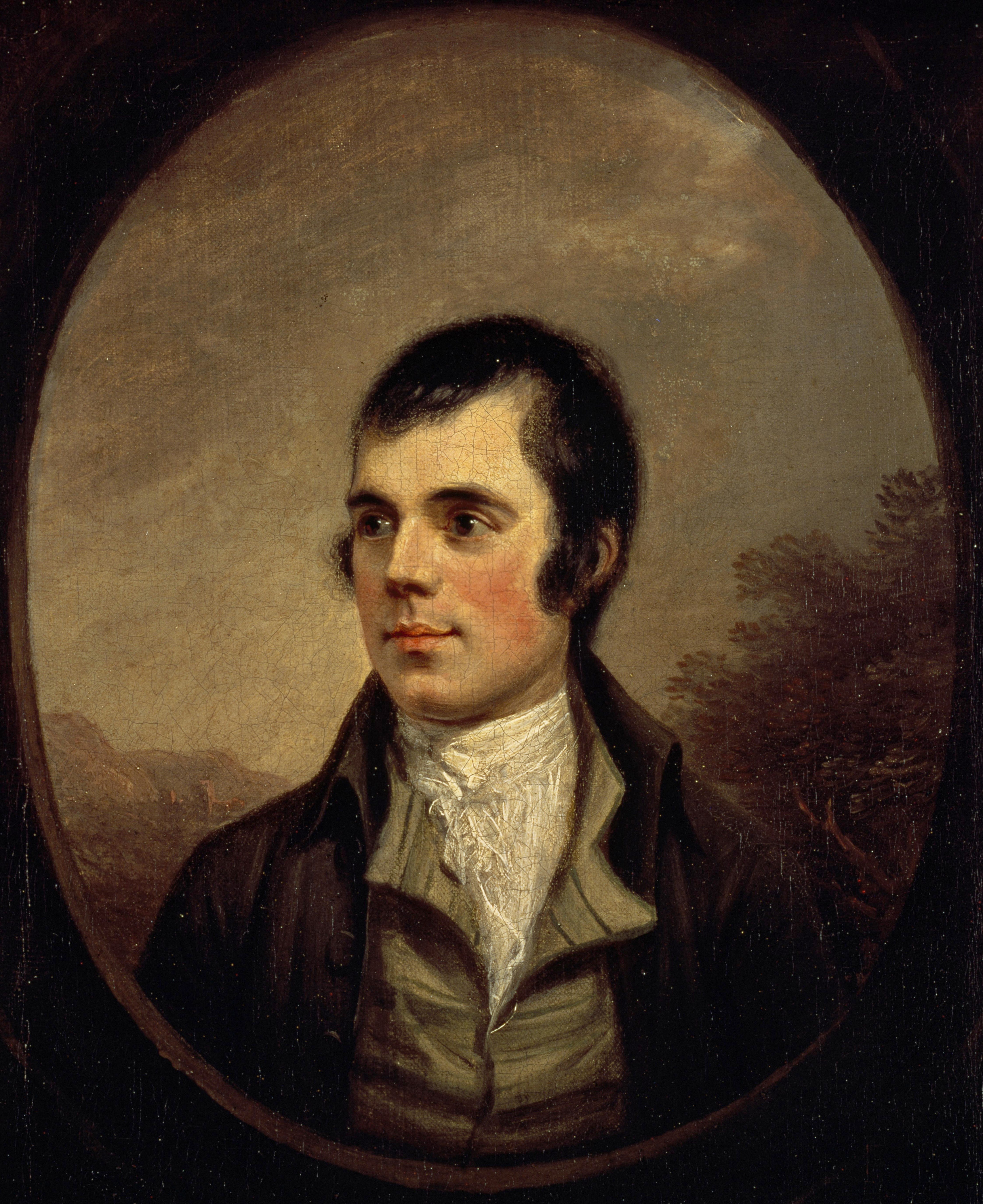
"Robert Burns" by Alexander Naysmith, 1787

Below are the original lyrics of the entire song in Burns's Scottish dialect followed by an "English" translation.

"Auld Lang Syne"

Should auld acquaintance be forgot, 
And never brought to mind? 
Should auld acquaintance be forgot, 
And auld lang syne? 

(Chorus: 
For auld lang syne, my jo, 
For auld lang syne, 
We'll tak a cup o' kindness yet 
For auld lang syne.)
 

And surely you'll be your pint-stowp, 
And surely I'll be mine, 
And we'll tak a cup o' kindness yet 
For auld lang syne!
 
(Chorus) 
We twa hae ran about the braes, 
And pu'd the gowans fine, 
But we've wander'd monie a weary fit 
Sin' auld lang syne. 

(Chorus) 
We twa hae paidl'd in the burn 
Frae morning sun til dine, 
But seas between us braid hae roar'd 
Sin' auld lang syne.
 
(Chorus) 
And there's a hand, my trusty fiere, 
And gie's a hand o' thine, 
And we'll tak a right guid-willie waught 
For auld lang syne! 
Keith Evans [CC-BY-SA-2.0 (http://creativecommons.org/licenses/by-sa/2.0)],
 via Wikimedia Commons

Modern Translation:

Should old acquaintances be forgotten,
And never brought to mind?
Should old acquaintances be forgotten,

And days of long ago !

(Chorus:
For old long ago, my dear
For old long ago,
We will take a cup of kindness yet

For old long ago.) 

We two have run about the hillsides
And pulled the daisies fine,
But we have wandered many a weary foot
For old long ago.
(Chorus)
We two have paddled (waded) in the stream
From noon until dinner time,
But seas between us broad have roared
Since old long ago.
(Chorus)
And there is a hand, my trusty friend,
And give us a hand of yours,
And we will take a goodwill draught (of ale)
For old long ago!
(Chorus)
And surely you will pay for your pint,
And surely I will pay for mine!
And we will take a cup of kindness yet
For old long ago!


Have a good week, dear Reader. Thanks for stopping by...Y'all come back now...
and Happy New Year!

Kate

Wednesday, December 25, 2013

Christmas Verses for the Printer's Devil...an 18th century poem of a Colonial Christmas

"The Mistletoe Bough" by Francis Wheatley, 1790
This week I beg my Reader's pardon and indulgence as I celebrate this busy and beloved Christmas week, with little time to research and write, with a poem I've just discovered which gives an amusing look and first person insight into 18th century American Christmas traditions. It was written in the late 1700's by St. George Tucker of Williamsburg, Virginia. The term "Printer's Devil" refers to a printer's apprentice, often the youngest, who spent much of his time stained with black ink. As my husband was a printer's apprentice in his younger days, this poem is especially dear to me. 

 "Christmas Verses for the Printer's Devil"
                   by St. George Tucker
Now the season for mirth and good eating advances,
Plays, oysters and sheldrakes, balls, mince pies and dances;
Fat pullets, fat turkeys, and fat geese to feed on,
Fat mutton and beef; more by half than you've need on;
Fat pigs and fat hogs, fat cooks and fat venison,
Fat aldermen ready the haunch to lay hands on;
Fat wives and fat daughters, fat husbands and sons,
Fat doctors and parsons, fat lawyers and duns;
What a dancing and fiddling, and gobbling and grunting,
As if Nimrod himself had just come in from hunting!
These all are your comforts—while mine are so small,
I may truly be said to have nothing at all.
I'm a Devil you know, and can't live without fire,
From your doors I can see it, but I dare not come nigher;
Now if you refuse me some wood, or some coal,
I must e'en go and warm, in old Beelzebub's hole;
Next, tho' I'm a devil, I drink and I eat,
Therefore stand in need of some rum, wine and meat;
Some clothes too I want—for I'm blacker than soot,
And a hat, and some shoes, for my horns and my foot;
To supply all these wants, pray good people be civil
And give a few pence to a poor printer's devil.
Have a good week, dear Reader. Thanks for stopping by...Y'all come back now...
and a Merry Christmas to one and all!

Kate


Wednesday, December 18, 2013

"Oh Bring Us Some Figgy Pudding"...only if you're over 21!

English Tudor Christmas Carolers
Back in the 18th century (and a couple centuries before) when caroler's sang out "We Wish You a Merry Christmas" and implored, "Oh bring us some figgy pudding," and warned, "We won't go until we get some" and demanded, "So bring it right here," they were calling out for a Christmas pudding imbued with tradition...and quite a bit of alcohol. Figgy Pudding, AKA Christmas Pudding, AKA Plum Pudding, AKA Christmas Pottage, is brought to us from 17th century England and, as this writer can attest from personal experience, can be prepared today with as much or as little Christmas spirit (spirits) as the intended audience requires. I am sure those merry-makers of old, caroling from door to door on cold December evenings, were warmed by both the goodwill and alcohol content of their beloved pudding.

As with all things setting Christmas apart from any other time of the year, the Puritans banned Christmas Pudding (way too festive for those folks.) It came back to roaring popularity with the reign of King George I of England who loved it and who became known (along with other less endearing names, especially here in the Colonies) as the "Pudding King." The king included the pudding in his royal Christmas feast of 1714 when he first arrived from Hanover and taken the throne.

Tradition has it that each member of the family should have a hand in the preparation with each taking a turn to stir from "East to West" to represent the Magi on their journey from East to West to find and honor the Christ Child. Admittedly I am most directionally challenged so, living on the east coast of America, I suppose I would just have the stirring be done counterclockwise.

Christmas Pudding from Wikipedia
Below are directions for the pudding you can prepare yourself anytime during the season (it keeps a loooong time.) Traditional recipes include suet but this one leaves it out. Having made pudding with suet, I can assure you the pudding will be fine without it! Thanks to NPR.org and baker, Dorrie Greenspan, for this recipe. Enjoy!

Figgy/Christmas/Plum Pudding

Dorie Greenspan, author of Baking: From My Home to Yours, created this recipe for figgy Christmas pudding fo rAll Things Considered.
Makes 8 to 10 servings

12 plump dried Calymyrna figs, snipped into small pieces
1/2 cup water
1/2 cup dark rum
1/3 cup cognac or brandy
1/2 cup raisins
1 1/3 cups all-purpose flour
2 teaspoons baking powder
1 1/2 teaspoons cinnamon
1 teaspoon ginger
1/2 teaspoon freshly grated nutmeg
1/4 teaspoon cloves
1/4 teaspoon salt
3 large eggs
1 (packed) cup brown sugar
2 cups fresh white bread crumbs (made from about 8 inches of baguette)
1 stick (4 ounces) unsalted butter, melted and cooled
1 cup dried cherries
1 cup dried cranberries
1/3 cup brandy, cognac or rum, to flame the pudding (optional)
Softly whipped, lightly sweetened heavy cream, vanilla ice cream or applesauce, homemade or store-bought, for serving (optional)
Getting ready: You'll need a tube pan with a capacity of 8 to 10 cups — a Bundt or Kugelhopf pan is perfect here — and a stock pot that can hold the pan. (If you've got a lobster pot, use that; it'll be nice and roomy.) Put a double thickness of paper toweling in the bottom of the pot — it will keep the pudding from jiggling too much while it's steaming. Spray the tube pan with cooking spray, then butter it generously, making sure to give the center tube a good coating.
Put the figs and water in a saucepan and bring to a boil. Lower the heat and, keeping an eye on the pan, cook until the water is almost evaporated. Add the cognac or brandy, rum and raisins and bring the liquids back to a boil. Remove the pan from the heat, make sure it's in an open space, have a pot cover at hand and, standing back, set the liquid aflame. Let the flames burn for 2 minutes, then extinguish them by sealing the pan with the pot cover. For a milder taste, burn the rum and brandy until the flames die out on their own. Set the pan aside uncovered.
Whisk together the flour, baking powder, cinnamon, ginger, nutmeg, cloves and salt and keep at hand.
Working in a mixing bowl with a whisk, beat the eggs and brown sugar together until well blended. Switch to a rubber spatula and stir in the bread crumbs, followed by the melted butter and the fig mixture (liquids included). Add the dry ingredients to the bowl and gently mix them in — you'll have a thick batter. Fold in the cherries and cranberries.
Scrape the batter into the prepared pan and seal the pan tightly with aluminum foil. Set the pan into the stock pot and fill the pot with enough hot water to come one-half to two-thirds of the way up the sides of the baking pan. Bring the water to a boil, then cover the pot tightly with foil and the lid.
Lower the heat so that the water simmers gently, and steam the pudding for 2 hours. (Check to make sure that the water level isn't getting too low; fill with more water, if necessary.) Carefully remove the foil sealing the pot — open the foil away from you to protect your arms and face — and then take off the foil covering the pan. To test that the pudding is done, stick a skewer or thin knife into the center of the pudding — the skewer or knife should come out dry.
To remove the pudding from the pan (a tricky operation), I find it easiest to carefully empty the water into the sink, and then carefully ease the baking pan out on its side. Transfer the pan to a cooling rack and let the pudding cool for 5 minutes. Detach the pudding from the sides of the pan using a kitchen knife, if necessary, then gently invert it onto the rack. Allow the pudding to cool for 30 minutes.
Flaming Figgy Pudding from Wikipedia
If you'd like to flame the pudding — nothing's more dramatic — warm 1/3 cup of brandy, cognac or rum in a saucepan over medium heat. Pour the warm liquid over the top of the pudding, and then, taking every precaution that Smokey Bear would, set a match to the alcohol. When the flames die out, cut the pudding into generous pieces. Actually, there's so much fruit in the pudding, the only way to cut neat slices is to make the slices generous.
Serve the pudding with whipped cream, ice cream or applesauce.
Alternatively, you can cool the pudding completely, wrap it very well in several layers of plastic wrap and refrigerate it for up to two weeks. When you are ready to serve, butter the pan the pudding was cooked in, slip the pudding back into the pan, seal the pan with foil, and re-steam for 45 minutes.
Have a good week, dear Reader. Thanks for stopping by...Y'all come back now!


Kate

Wednesday, December 11, 2013

Sing a Song of Christmas...18th century style

Bruton Parish Church, Colonial Williamsburg, VA*
~First, a brief but important (to me, at least!) announcement: If you happen to be fortunate enough to be in Edenton, North Carolina this Friday or Saturday, Dec 13 and 14 to see and participate in the free and paid events of the beautiful annual Christmas Candlelight Tour, stop by for complimentary confections from 1-5pm at the Chowan Arts Council Gallery, 504 S Broad St, where I will be having a book signing of my novel Sea Snow, the gentle haunting of a 19th century lighthouse. For more information about this special town-wide Edenton offering see:
http://visitedenton.com/christmas-candlelight-tour
(free egg nog and cookies and goodies galore!)~

"It's beginning to look a lot like Christmas..." sings out from radios, televisions, store speakers, and cell phone ring tones but, in the 18th century, the weeks leading up to Christmas Day were times of quiet introspection called Advent. Many present-day churches still follow the same liturgical calendar encouraging their congregants to spend the four pre-Christmas Day weeks meditating upon the preparation of their hearts and souls for the coming of Christ into the world, but as soon as they step back into day-to-day life, I think most cannot ignore the festive atmosphere that surrounds us this time of year. I, for one, believe it's possible to merge faith and festivities but in parts of 18th century America, that was not the case. As a matter of fact, thanks to Puritan influences, most of 1700' s New England completely turned its back on anything that set Christmas apart from any other time of the year. BUT...in the South where the Anglican church was dominant, Christmas was celebrated, albeit more conservatively than we now do.

An integral part of 18th century Advent and Christmastide activities was the singing of songs of the season. Several of our well-loved Christmas hymns and carols were written in the 1700's. The lyrics were sometimes set to old, traditional tunes of Great Britain and Europe and the carols we sing today are sometimes set to music composed a century later. The heart of the songs, however, lies in the words themselves and today I would like to share some of them in the form of spiritual poetry. Sometimes we are so caught up in the melodic singing, we do not pay attention to the words. So, in the spirit of an 18th century Advent and Christmas, here are three songs brought to us directly from the writers of the time. In some, I have omitted the repetitious lines used when singing and I challenge you to read them without hearing the musical notes in your head (harder than you think!)

"Le sommeil de l'enfant Jésus "by Francesco Travisani, 1656-1746

"Come Thou Long Expected Jesus"
(an Advent hymn by Charles Wesley, 1701-1788,  also the author of  
"Hark! The Herald Angels Sing")


Come Thou long expected Jesus
Born to set Thy people free
From our fears and sins release us
Let us find our rest in Thee
Israel's strength and consolation
Hope of all the earth Thou art
Dear desire of every nation
Joy of every longing heart
Born Thy people to deliver
Born a child and yet a King
Born to reign in us forever
Now Thy gracious kingdom bring
By Thine own eternal spirit
Rule in all our hearts alone
By Thine all sufficient merit
Raise us to Thy glorious throne

"Oh, Come All Ye Faithful"
 (as "Adeste Fideles" by John Francis Wade, 1711-1786)

"Nativity" by Jean-Baptiste Marie Pierre, 1714-1789
Oh, come, all ye faithful, 
Joyful and triumphant!
Oh, come ye, oh, come ye to Bethlehem;
Come and behold him
Born the king of angels:
Oh, come, let us adore him,

Christ the Lord.

Highest, most holy,
Light of light eternal,
Born of a virgin,
A mortal he comes;
Son of the Father 
Now in flesh appearing!
Oh, come, let us adore him,

Christ the Lord.

Sing, choirs of angels,
Sing in exultation,
Sing, all ye citizens of heaven above!
Glory to God
In the highest:
Oh, come, let us adore him,
Christ the Lord.


Yea, Lord, we greet thee,
Born this happy morning;
Jesus, to thee be glory given!
Word of the Father, 
Now in flesh appearing!
Oh, come, let us adore him,
Christ the Lord.


"Joy To The World"
(by Isaac Watts, 1674-1748)
"The Holy Family" by Giuseppe Antonio Petrini, 1677-1758
Joy to the world! the Lord is come;
Let earth receive her King;
Let every heart prepare him room,
And heaven and nature sing.
Joy to the world! the Saviour reigns;
Let men their songs employ;
While fields and floods, rocks, hills, and plains
Repeat the sounding joy.

No more let sins and sorrows grow,
Nor thorns infest the ground;
He comes to make His blessings flow
Far as the curse is found.

He rules the world with truth and grace,
And makes the nations prove
The glories of His righteousness,
And wonders of His love.


Have a good week, dear Reader. Thanks for stopping by...Y'all come back now!

Kate

*By Rainer Halama (Own work) [CC-BY-SA-3.0 (http://creativecommons.org/licenses/by-sa/3.0)], via Wikimedia Commons

Wednesday, December 4, 2013

Syllabub Anyone?...18th Century Festive Holiday Drinks

"The Sense of Taste" by Philip Mercier (circa 1689-1760) 
Ah, 'tis the season for raising a toast of good cheer or simply sipping something warm and wonderful by candlelight or a crackling fire. The 18th century had its share of Christmas "spirits" whose tasty descendants still grace our tables and tickle our taste buds today. One of these that made its way from 16th century Tudor England into my own 20th century North Carolina childhood is that creamy, luscious concoction known as Syllabub, a frothy blend of sweetened wine or cider and rich cream. I had such fond memories of this holiday treat, I even named a dear, big, beautiful Maine Coon Cat of mine, "Sir Syllabub" ("Bubba" for short.)

Syllabub. The origins of the name are speculative but it's so much fun to say aloud, isn't it? Rolls around your tongue and then just pops right out. A multi-syllabic party in your mouth! Syllabub was a very popular, festive beverage in 18th century Colonial America, as well as in Great Britain, and many recipes of the period show a goodly amount of variations on the theme. There are even recipes that involve milking a cow directly over a bowl of sweetened wine or cider. I think I'll pass on that one this year, thank you very much. There are two basic forms of Syllabub, one in which the sweetened wine/fruit juice is whipped into heavy cream in such a way as to remain consolidated, and one in which the liquid drains out of the mixture leaving the wine in the bottom of the glass and the thick cream on top. For this latter method, there were special Syllabub drinking vessels with a spout from which one could drink the liquid and use a spoon for the creamy froth on top. 

North Carolina Scuppernong Grapes,
 photo by Kathryn Louise Wood
My childhood memories are of the type that stays consolidated, served chilled, and is a cross between a drink and a dessert to be eaten with a spoon. Now, my family's roots are of the tea-totaling Methodist and Baptist variety and alcohol was not considered acceptable holiday fare so our Syllabub was made with "soft" cider made from apples or Scuppernong grapes. HOWEVER...once in a while (no one claims to know exactly how it happened) that cider might sit in the pantry for quite a spell waiting for Christmas and could (under just the right, mysterious circumstances) have a little extra kick about it, bordering on the "hard" side. When that happened, there would be a bit more of the "silly" in the Syllabub.

In the weeks to come I will share other 18th century holiday recipes but, for now, I will give you directions from some historic cookbooks for Syllabub. You may adapt these instructions with modern methods and ingredients and still enjoy a traditional treat with which your ancestors would feel at home. The first is closer to the kind of Syllabub of my youth (replacing the wine-- Rhenish and sack-- with "soft" cider...of course...) The second is of the liquid on the bottom, cream on the top variety.

"To Make Everlasting Syllabubs"
Hannah Glasse, The Art of Cookery made Plain and Easy, London 1758

~Take five half pints of thick cream, half a pint of Rhenish, half a pint of sack, and the juice of two large Seville Oranges; grate in just the yellow rind of three lemons and a pound of double-refined sugar well beat, and sifted. Mix all together with a spoonful of orange flower water, beat it well together with a whisk half an hour, then with a spoon fill your glasses. These will keep above a week, and is better made the day before.~


"Lemon Syllabub"
Elizabeth Raffald, The Experienced English Housekeeper, London 1784
Detail from"The Sense of Taste" by Philip Mercier (circa 1689-1760) 

~Put a pint of cream to a pint of white wine, then rub a quarter of a pound of loaf sugar upon the out rind of two lemons, till you have got out all the essence, then put the sugar to the cream, and squeeze in the juice of both lemons, let it stand for two hours, then mill them with a chocolate mill, to raise the froth, and take it off with a spoon as it rises, or it will make it heavy, lay it upon a hair sieve to drain, then fill your glasses with the remainder, and lay on the froth as high as you can, let them stand all night and they will be clear at the bottom.~

Enjoy your Syllabub mustaches!

Have a good week, dear Reader. Thanks for stopping by...Y'all come back now! 
Kate


Wednesday, November 27, 2013

We Gather Together...a Thanksgiving Excerpt from Sea Snow, the gentle haunting of a 19th century lighthouse

"The First Thanksgiving at Plymouth" by Jennie A. Brownscombe
Those of us in the United States are preparing for tomorrow's All-American Holiday of Thanksgiving which falls on the fourth Thursday of each November. (Of course, like many American traditions, it probably has its roots in British and European harvest celebrations.) Where and when the First Thanksgiving was observed is up to some debate, some saying it was the 1621 Pilgrims' Thanksgiving in Plymouth, Massachusetts  while others believe it was the 1619 Settlers' Thanksgiving at Berkeley Plantation in Charles City County, Virginia. Either way, it is a day to give thanks for all of our blessings, big and small, with many of us celebrating by eating copious amounts of food!

Today, I would like to take you back to a traditional celebration that would have been at home in turn-of-the-20th century Massachusetts by way of printing an excerpt from my novel, Sea Snow, the gentle haunting of a 19th century lighthouse. Here the villagers gather together to enjoy each others' company and favorite foods as the children perform a Thanksgiving pageant. 

"Freedom From Want" by Norman Rockwell
...High, clear voices were heard in the distance and we all craned our necks toward the garden from which the sound came. A line of children, from youngest to oldest, marched in single file, singing “We Gather Together” as they approached. They were dressed in Pilgrim costume, black trousers and jackets for the boys and black dresses with starched white aprons and caps for the girls. Each one carried something symbolic of the harvest—pumpkins, gourds, clusters of grapes, bowls of cranberries and raspberries and nuts—and the tallest boy, bringing up the rear, proudly bore a great platter holding an enormous, roasted turkey, its golden brown skin glistening in the autumn sunlight. 
 With great ceremony, the children set down their treasures on a table until there was a long, colorful centerpiece stretching the length of the rows of tables where sat the admiring adults. Once the young man set his turkey on one of the serving tables, the children gathered into a cluster, all eyes on the garden. They completed the last verse of their Thanksgiving hymn just as drumbeats were heard resounding from the garden entrance. Gasps of  “Ooo’s” and “Ah’s” emitted from the grown-ups as another line of children, dressed in all manner of Indian garb, began their parade toward the tables. Brown leggings and shirts for the boys, and short, brown shifts for the girls, formed the backdrop for fanciful ornaments of feathers and beads and seashells. I noticed their feet were wrapped in soft, tan cloth, secured with leather cord. Each young “Indian” carried a gift of speckled Indian corn or a fish fashioned, quite realistically, from papier-mâché. These were placed on the tables among the Pilgrims’ gifts, to the steady drumbeat of a serious-faced little boy, his skin darkened for the occasion, blue eyes startlingly bright against his new complexion. The Indians joined the Pilgrims and all sang one verse of  “Come Ye Thankful People Come” with our minister urging us all to join in.
As the voices died down, he stepped before the children and raised his hands and closed his eyes, signaling the saying of the blessing. We all bowed our heads as Rev. Harris intoned a prayer of thanks for the bounteous goodness of God and for all the blessings He had bestowed upon us, particularly the blessing of these lovely children. With “Amen’s” arising from the gathering, Mr. Buchanan instructed us to take the plates we’d brought for the occasion and line up to share in the smorgasbord.
 I’ve heard of “groaning boards” before, and I think those tables would have groaned if they’d had voices! Never have I seen such a delicious display. Rev. Harris carved the great turkey and offered up juicy slices to adjunct the rest of the food. The tables were resplendent with corn puddings, baked beans, sliced beef, chicken and turkey, roasted potatoes—both white and sweet—string beans, butter beans, cranberry sauce, greens, and an incredible assortment of desserts. I cannot begin to name them all, everything from pumpkin pies sweetened with maple syrup to buttery pound cakes, to my favorite—Jenny’s sweet potato pie. I was proud to see my pie gobbled up quickly (although Joseph gazed forlornly at the empty dish, making me promise to fix another just for him!)
 We returned to our places at the tables and joyfully dug into our heavily laden plates. There was a chorus of satisfied remarks as we dove in, with many an inquiry as to “who made this pudding,” “these beans,” “this pie,” etc. It was a glorious time of food and fellowship! I introduced Mother and Father to everyone in turn, and I could see the blossom of peace blooming on Mother’s face as she was reassured, once more, of her daughter’s well being in this “foreign” land.
Once we were completely sated, Mrs. Buchanan stood at the end of one of the tables and rang a bell for our attention.
 “Now,” she said, “to complete the day, the children will give each of you a small piece of paper and place pencils on the tables for you to share. Please write down one thing for which you are truly thankful and pass your paper to the end of the table where either an Indian or a Pilgrim is standing. Once all have been collected, Mr. Buchanan will place them in the Thanksgiving fire and their ashes will rise to heaven in a symbolic gesture of our gratitude!”
 Dutifully, we set to our task. Some quickly wrote down their blessing while others thoughtfully scratched their heads or rubbed their chins in concentration. The choice was very difficult for me as there is so much for which I am thankful. Seeing the distress of those of us trying to decide among our blessings, Mr. Buchanan rose and said, “Remember, this is just one of your blessings. Just write down whatever comes into your heads. God knows your gratitude isn’t limited to this choice!”
 I scribbled down my response and passed it down the table, playfully slapping Joseph’s hand as he tried to read it. As the slips of paper were handed to them, the children dropped them into carved-out pumpkins, stationed at the head of each row of tables. Each pumpkin, brimming with thanks, was then carried to the schoolmaster standing by a great bonfire.
 “Dear God, Father, and Provider of us all, may the fragrance of these expressions of thanksgiving fill Heaven with their sweetness and gratitude.”
 With that, Mr. Buchanan took a pumpkin from each child, in turn, and emptied the contents onto the leaping flames.
 “Looks kind of pagan to me,” I heard Sam’s raspy whisper.
 “Shh!” Esther scolded.
 A titter of laughter rippled through the gathering, threatening to break the mood so skillfully cast by the dramatic Mr. Buchanan. When the last thankful notes sent smoke spiraling up toward the heavens, the schoolmaster turned and pronounced, “A Happy Thanksgiving to us all!”...

Have a good week, dear Reader. Thanks for stopping by...Y'all come back now!

Kate

("The First Thanksgiving at Plymouth" (1914) By Jennie A. Brownscombe : This image is in the public domain because its copyright has expired.)