Showing posts with label herbs. Show all posts

Saturday, December 3, 2016

Sage Advice about Holiday Thyme...and other seasonal herbs

"Bill's Turkey" by KLWood
For many of us the holidays, stretching from Thanksgiving to Christmas, are alive with aromas that transport us to days gone by, full of the love and warmth of family and friends. A good part of this comes from a mixture of herbs we often use with turkey and stuffing (or in the case of this Southern girl--dressing, which is baked outside the bird.) Today we take a look at that traditional concoction of aromatic herbs and explore the individual components to discover the qualities of their essential oils.

Thyme: Warming, pain relieving, circulation aid

Sage: Aids respiratory, reproductive, and nervous systems

Marjoram: Warming, antispasmodic, circulation aid

Rosemary: Analgesic
By Stacy Spensley from San Diego, via Wikimedia Commons

Black Pepper: Warming, pain relieving, circulation aid

Nutmeg:  Relaxing, anti-inflammatory, antiseptic, bactericidal 

So, whether you sprinkle the herbs on your turkey, stir them into your dressing (stuffing,) or add their essential oils to your favorite carrier oil/lotion and rub it on yourself, the scents of the season will bring you comfort and joy!

Have a wonderful holiday season, dear Reader. Thanks for stopping by...y'all come back now! 
Kate


Wednesday, April 22, 2015

18th Century Headache? …sniff this and call me in the morning


Photograph of Webb House Colonial Revival Garden,by Daderot via Wikimedia Commons
In our 21st century lives, we often reach for bottles of pills when illness strikes. Back in the 18th century, however, you were more likely to go out to the herb garden or even forage for plants in the forest to relieve your distress. This week, I’ve gathered a list of some of the commonly used medicinal plants our ancestors depended upon. Some were ingested, some rubbed on the skin, and some strewn on the floor for freshening the air and deterring vermin. You may even have some growing in your own backyard. Think of it as Nature's Medicine Cabinet!

BASIL - Sometimes called St. Joseph's Wort, it was used dried as snuff to relieve headaches and colds as well as a strewing herb.

BEE BALM - Used for bee stings. Tea brewed from its leaves was called Oswego tea and was used as a substitute for Chinese tea imported from England after the 1773 Boston Tea Party (and the 1774 Edenton Tea Party, too, of course!)

CARAWAY - The boiled roots of caraway were eaten by Native Americans and recommended for those with a cold or weak stomach.
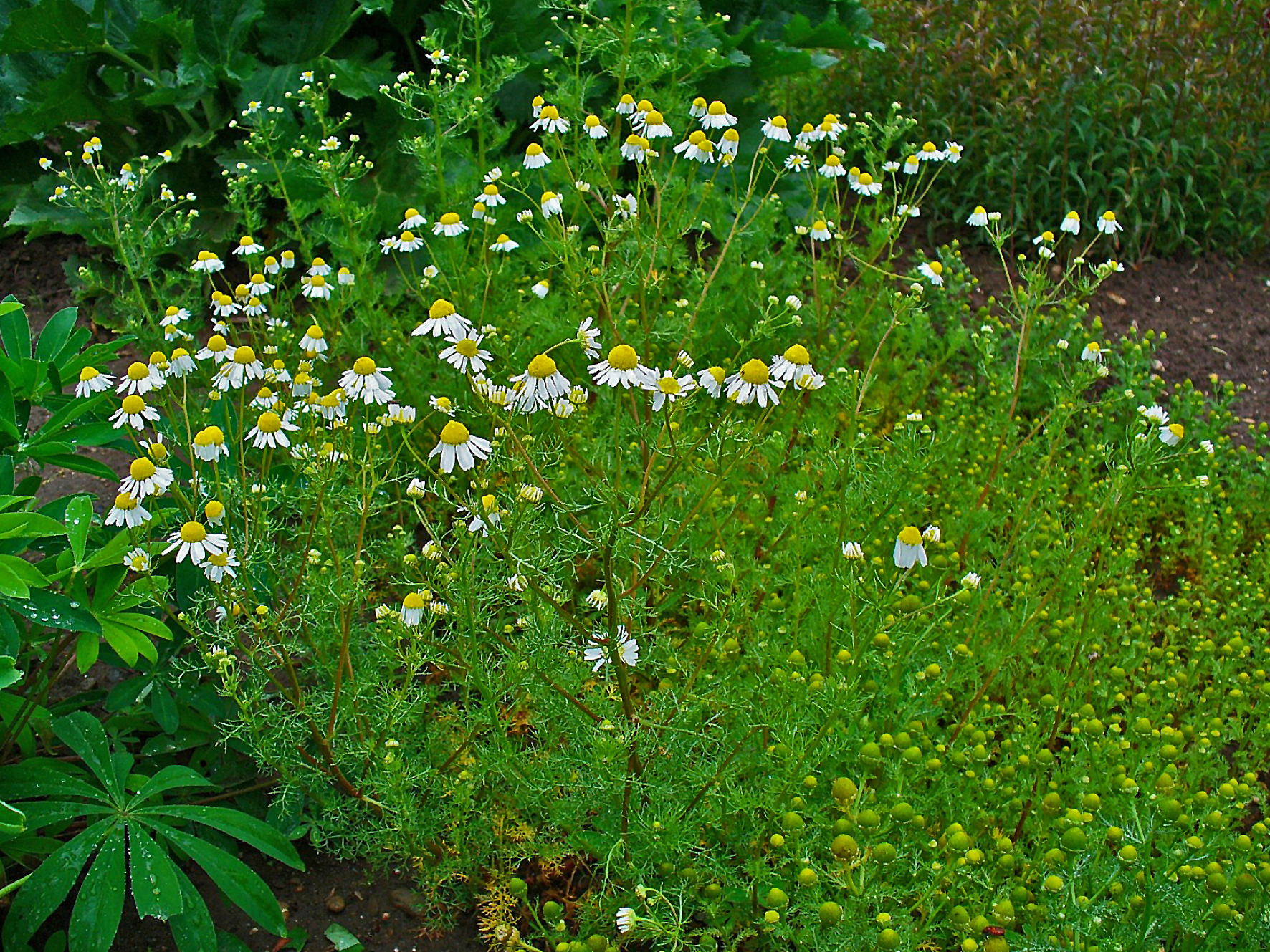
Photograph of Chamomile by H. Zell via Wikimedia Commons

CHAMOMILE - Infused as a tea for indigestion, gas, and stomachaches. Also used as a strewing herb and insect repellent.

COMFREY - Used as a poultice to heal wounds and reduce swelling.

CORIANDER. The seeds were chewed as a breath freshener.

ELECAMPANE - Used to treat skin diseases in sheep and horses; also as a diuretic and for coughs (for people!)

FEVERFEW - For "female hysteria," melancholia, headache, and constipation.

GERMANDER - For gout, rheumatism, fever, and melancholy.

HOREHOUND - Used to make a cough syrup, often in combination with honey and other herbs. Mixed with plantain for snakebites. Soaked in fresh milk to repel flies.

HYSSOP - Strewn on the floor to prevent the spread of infection; also used to treat respiratory illnesses.
Photograph of Lemon Balm by P. Wagner via Wikimedia

LAVENDER – The oil was rubbed into the temples for headache, strewn on the floor and also used as an insect repellent.

LEMON BALM - Infused as a tea for headaches, indigestion, nausea. Distilled as a treatment to clean and heal wounds.

LOVAGE - Used to treat kidney stones.

MARJORAM –Used  to cure insomnia, nasal congestion, and loss of appetite.

PARSLEY - Seeds used as a diuretic.
Photograph of Pennyroyal by H. Zell via Wikimedia Commons

PENNYROYAL - Strewing herb. Flea and mosquito repellent.

PEPPERMINT – The leaves were chewed to sweeten the breath and drunk in tea to aid digestion.

PLANTAIN - (The herb; not the banana-like fruit.) Used as a poultice to heal wounds, and the seeds to prevent miscarriage. 

QUEEN ANNE’S LACE - Used as a diuretic and for kidney stones; the seeds were used for birth control.

ROSE HIPS – Used to prevent scurvy. (Very high in Vitamin C.)

ROSEMARY - Oil used as a rub for sore muscles. Promotes liver functions.

RUE - Externally to cure warts, ringworm, and poisonous bites. Internally as a treatment for colic and epilepsy. Decocted for earaches. (Decoction is the boiling or heating of a plant to derive its concentrated essence.)

SAGE - Used in combination with other herbs for headaches. Decocted and as a mouthwash for sore throats and infected gums.
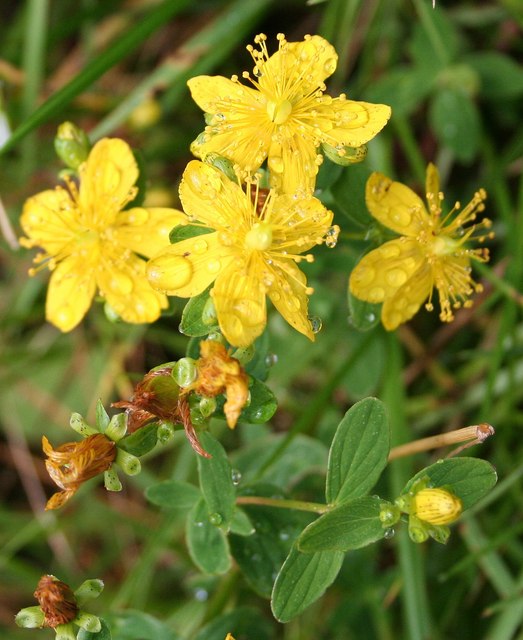
Photograph of St. John's Wort by Anne Burgess via Wikimedia Commons

SORREL – Used as a poultice for infected wounds. (And to remove stains from linen.)

SPEARMINT – Used as a breath freshener and for indigestion.

ST. JOHN’S WORT - Leaves used to treat burns and wounds. Flowers used as a tincture for melancholy.

STINGING NETTLES - A mixture of the seeds, bayberries, gunpowder, and honey was used for rheumatism.

TANSY - Its seed was used as a vermifuge (to kill internal parasites like roundworms) for children; the root was also used to treat gout.

THYME – Used as an antiseptic and for toothaches, gout, headaches, and to cure nightmares. Sprigs of thyme were placed on lard and butter to keep them from becoming rancid.


YARROW - Leaves were chewed for toothaches.

Have a good couple weeks, dear Reader. Thanks for stopping by...y'all come back now! 

Kate


Wednesday, July 23, 2014

Ducking the Witch...Grace Sherwood's trial by water

"Grace Sherwood, the Witch of Pungo"
Having spent my formative years in the City of Virginia Beach, Virginia, the words “witch duck” were ubiquitous and, pretty much, taken for granted: Witchduck Road, Witchduck Point, Witchduck Post Office, etc. You might wonder if Virginia Beach is the home of some kind of spell-casting duck or if it is a city where witches frequently duck in or are in danger of bumping their hats against low hanging branches. In fact, Virginia Beach was the scene of the eighteenth century witch trial of one Grace White Sherwood and a ducking into the river was part of the proceedings .

Grace White Sherwood was born in 1660, in what was then called Princess Anne County and is now called the Pungo area of Virginia Beach, to John and Susan White. When Grace married respectable, small-time farmer James Sherwood in 1680, Grace’s father gave them fifty acres of land and when he died a year later, the remainder of his one hundred forty-five acres. Grace became a widow in 1701 and never remarried. Contemporary accounts described Grace as tall, attractive, and with a good sense of humor. It was also noted she often wore men’s trousers when working on her farm. She was a mid-wife and a grower of medicinal herbs that she used in the healing of both people and animals.
"The Three Witches from Shakespeare's Macbeth, "1775, by Daniel Gardner


Such a combination of qualities, which sound quite benign and positive to our twenty-first
century eyes, may have been the core of jealousy and ill-will which assailed Mrs. Sherwood and sent her to court a dozen times between 1697 and 1706. Some of these court cases were for accusations of Grace’s witchcraft and others were her own suits for slander against her accusers. The cries of witchcraft blamed her for actions such as bewitching farm animals and crops to die and for bewitching a woman to miscarry her baby. One woman, Elizabeth Barnes, accused Grace of entering her bedroom one night in the form of a black cat, scratching and attacking her then departing through a keyhole. 

Although these varied accusations were dismissed or declared inconclusive, the courts of Virginia apparently grew tired of it all and considered Grace Sherwood a nuisance. In 1706 they allowed her to be tried for witchcraft by means of being examined by a jury of “ancient and wise women” to determine if she had marks on her body indicative of the Devil’s brand. These women, led by Elizabeth Barnes herself, did indeed decide Grace had two markings unlike any found on themselves or any other woman they knew. This opened the door for the final trial by water.

On July 10, 1706, Grace Sherwood was taken to 
Illustration from "A Popular History of the United States" by William Cullen Bryant
Lynnhaven Parish Church, set upon a stool, and ordered to ask forgiveness for her witchcraft. Her reply was, “I be not a witch, I be a healer.” The unrepentant “witch” was taken down a road (now called Witchduck Road) to the shores of the Lynnhaven River where five women searched her naked body for any devices she may have had to free herself, then covered her with a sack. Her right thumb was bound to her left big toe and her left thumb was bound to her right big toe. Thus bound, six justices rowed the bound woman out two-hundred yards into the river and threw her overboard. The idea was not to drown her but just to test her. The thought was, if she floated she was considered a witch and if she sank, she was innocent. Grace was apparently quite buoyant and floated on the surface. Then to give her the benefit of the doubt, the Sheriff of Princess Anne County tested her a second time by tying a thirteen-pound Bible around her neck and casting her overboard once more. This time she did sink but was able to free herself and swim to the surface. Aha! Proof-positive: Guilty!

Intersection of Witchduck RD and Sherwood LA
(Photo courtesy of WikiMedia Commons)
Grace was sentenced to about seven years in prison and served out her time in a jail adjacent to Lynnhaven Parish Church. In 1714, she paid back-taxes on her land which Lieutenant Governor Alexander Spotswood then helped her secure back from the County of Princess Anne. Grace Sherwood lived out the rest of her days in relative peace and quiet before dying at the age of eighty. 

Tales cropped up after her death including a story that the Devil came down the chimney and claimed Grace’s body before her sons could bury her. There were also claims of unnatural storms and lingering black cats. Soon, men were killing any cat they ran across in the county. This may have led to the
"Black cat (2901924188)" by mwanasimba from La RĂ©union (WikiMedia commons) 
infestation of rats and mice recorded in Princess Anne County in 1743. Grace’s body (assuming the Devil didn’t actually carry it away) is buried in an unmarked grave beneath a group of trees in a field near the intersection of present-day Pungo Ferry Road and Princess Anne Road. Local residents of present-day Virginia Beach say a strange moving light can be seen each July over the water where Grace was tried.

July 10, 2006, on the three-hundredth anniversary of Grace’s infamous trial by ducking,
Official Congressional Portrait of Tim Kaine
 (Governor, Senator, and Witch Pardoner)
Virginia Governor Tim Kaine granted her an official pardon. A statue of her holding a basket of rosemary and a raccoon by her side is visible from Independence Boulevard near the current Sentara Bayside Hospital and not too distant from her place of trial. This commemorative statue by sculptor Robert Cunningham was unveiled on April 21, 2007.

So…next time you happen to be in Virginia Beach, riding down Witchduck Road or visiting a friend living on Witchduck Point, give a nod to the lady who endured so much during one of Virginia’s less gracious moments.

Have a good week, dear Reader. Thanks for stopping by...Y'all come back now! 


Kate