Showing posts with label fashion. Show all posts

Wednesday, May 14, 2014

18th Century Maternity Fashions...what they wore while waiting

Sarah Churchill, 1700, after Sir Godfrey Knelle (is she, or isn't she?)
Over the years I have seen maternity styles change from those of my child-bearing years when we wore loose-fitting dresses or loose-fitting tops over skirts or pants with stretchy panels that we pulled over our bulging bellies, to those of my daughters' generation in which snug-fitting, stretchy dresses or snug-fitting, stretchy tops are worn over skirts or pants whose waistbands fit just below the bulging bellies. With Mother's Day, just passed, it made me ponder what our pregnant 18th century ancestresses wore while awaiting the big day.


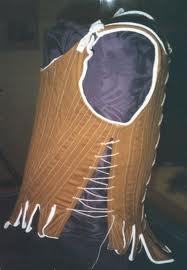
Replica of 18th century maternity corset (http://yeoldefashion.tumblr.com)
With the lack of modern methods of birth control as well as the need for birthing large numbers of babies to ensure enough survived to help out on the farm or even to carry on the family name or business, the 18th century woman often found herself in a state of pregnancy. You might consider some of these dear ladies, chronically pregnant (and, unfortunately, sometimes terminally pregnant with maternal death in childbirth not an uncommon occurrence.)  So, what did the well-dressed woman in the "family way" wear in an era of tight corsets? 


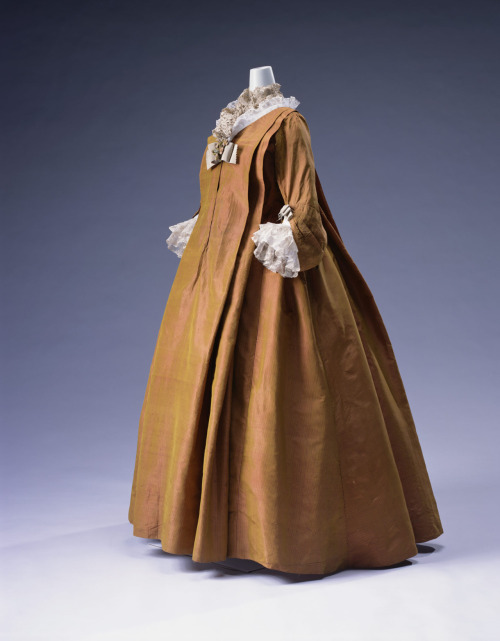
Robe Volante, 1720, Kyoto Costume Institute
Natalia Alexeievna, by Alexander Roslin, 1775
Until late in the 18th century, stiff corsets with equally stiff stays were the everyday wear of all women, whether high-born aristocrat or hard-working kitchen maid. Unlike those crazy folks of fashion in the later Victorian era who continued to wear tight bindings throughout pregnancy, 18th century women were free to at least loosen their corsets to accommodate their expanding waistlines and growing babies. There were corsets made especially for maternity wear that not only laced up in the back, as usual, but also up the front and both sides. Much clothing was pinned and tied together so the lady "in waiting" could adjust her gowns and bodices accordingly. Some fashions of the early 18th century provided convenient camouflage of the burgeoning baby-bellies. One of these was called robe volante, a loose fitting over-dress that was, at first, deemed appropriate as in-home or informal wear, but later worn in more formal settings among both pregnant and non-pregnant women. Some women customized their husbands' long waist-coats to wear over their gowns and petticoats. If the triangular-shaped fabric called a stomacher, which was pinned to the front of the bodice covering the corset, became too small for madam, she could drape long scarves in front to hide the corset.


I am certain many a lady breathed (literally) a sigh of relief when 1800 brought about the temporary end of the corseted stays and the fashion became loose, flowing empire-waisted gowns, a comfortable style for ladies no matter their state of maternity (or lack, thereof.) 


Have a good week, dear Reader. Thanks for stopping by...Y'all come back now! 

Kate
Portrait of María Luisa de Borbón y Vallabriga by  Francisco Goya, 1800


Wednesday, September 25, 2013

Undressing the 18th Century Woman, from shoes to shift

Mrs. Sharpe and Her Child by Joseph Highmore
Reading descriptions of women's clothing from the 18th century makes me very happy to be living in the relative simplicity of 21st century fashion! Getting dressed (or undressed) must have taken quite a bit of time out of a lady's day. Of course, they would be appalled at the t-shirt and jeans I slip into most every day. Probably have me arrested or sent off to an asylum until I came to my senses and dressed in a more seemly manner!

So, here we have the lady of the house after a busy day of tending to her family's needs, ready to get comfortable and lie down for a much deserved night of sleep:

First, off come the shoes made of leather, silk or worsted, fastened by buckles, clasps or ties. (If walking in the mud or rain, she may have overshoes, called patterns, to remove, as well. Patterns had a raised sole to lift her shoes above the muck.)

Second, with a pull of the ribbon garters poised just above the knee, off come the stockings made of wool, linen, or silk.

Third, off comes the cap, made of cotton, linen, or lace, worn alone or beneath a hat when outdoors. Caps were practical in that they protected the hair from dirt and dust and the viewer from unsightly, unwashed hair!

Fourth, off come the mitts, elbow-length fingerless gloves that keep her warm in winter and protect her skin from the sun in summer.

Fifth, off come the ruffles attached to the sleeves.

Sixth, off comes the stomacher, a triangular piece of cloth attached to the gown at the bodice to hold the front of the upper gown together.

Seventh, off comes the gown, a bodice sewn to a skirt which was open in the front to reveal the petticoat.

Eighth, off come the petticoats, an outer one was a skirt that filled in the gap left by the open-front gown and an underpetticoat was worn beneath it for extra warmth in the winter.

Ninth, off come the free-hanging pockets tied around the waist and accessed through pocket slits in the gown and petticoats.

Tenth, off come the stays (at last, whew!) Layers of linen encasing narrow strips of boning of whale bone, metal, wood, woodpaste or packthread were cone-shaped, extending from waist to just beneath the bosom and were meant to ensure upright posture. The most fashionable lady would wear one that pulled her shoulders back to the point of her shoulder blades nearly touching. Even children wore stays to create good posture!


Eleventh, off comes the long shirt-like garment called a shift...whoops, the shift stays on and doubles as a nightgown. And that, my Reader, is where it ends as there were no underpants of any kind worn at the time. I think we can all agree, however, that the dear lady was adequately protected and at least it made the use of the privy just a little easier!

Have a good week, dear Reader. Thanks for stopping by...Y'all come back now!

Kate