Showing posts with label Edenton. Show all posts

Tuesday, July 5, 2022

Sea Glass...Jewels From the Sea: NEWS FLASH!


Dear Readers,

Beginning with this post, I am moving my blog posts to a new home—my author website:


The blog page can be found at:


With this move, I will post on a monthly basis. PROMISE!

Thanks for stopping by. See ya'll in my new home!

Warmest Wishes,

Kate


Saturday, March 9, 2019

March Forth!...in shades of yellow

"Mama's Daffodil" photo by KLWood
If the month of March were a color, it would surely be yellow. Fresh new flowers burst forth in buttery lemon shades to encourage the golden sun on its journey toward the vernal equinox and beyond. Mirroring the sun are daffodils, dandelions, forsythia, and my personal favorite—buttercups.

"Buttercup Cottage" photo by KLWood

When we first found our home here in Edenton, North Carolina, it was in the month of March, with yellow swaths of gently gleaming buttercups swaying in the soft breezes of the Albemarle Sound. We were both smitten by the charm of this little, two-story Victorian-era cottage,
"Buttercups" by Manfred Richter- Pixabay  
surrounded by those diminutive botanical dancers, and promptly named it “Buttercup Cottage.”

Emily Dickinson welcomed March in her poem “Dear March—Come in." Here is the 
first stanza for your Spring reading pleasure:
How glad I am -
"Forsythia" by  KIMDAEJEUNG- Pixabay
I hoped for you before -
Put down your Hat -
You must have walked -
How out of Breath you are -
Dear March, how are you, and the Rest -
Did you leave Nature well -
Oh March, Come right upstairs with me -
I have so much to tell -

So, my dear reader, slip on your 
yellow sweater, don your yellow 
cap, or if there's rain, pull on 
"Dandelion" by Holi Ho- Pixabay
your yellow slicker, and 
March Forth to welcome 
the Sun-King of Spring
and his court of dancing yellow
blossoms!
Thanks for stopping by...
y’all come back, now!
Kate
"At Our Buttercup Cottage" photo by author's mother, Oleta Wood


Wednesday, June 20, 2018

Well Wishes...from our Wishing Well

I wish you all the joy you can wish.”
"Our Wishing Well" photo by KL Wood
--William Shakespeare

When my husband, Bill, sets his mind, heart, and creativity to a project, you can rest assured it will be well done. The latest project to catch his imagination has been the designing and building of a Wishing Well for our front yard, complete with water spilling from a tilted brass teapot. The Wishing Well actually serves two purposes: wishing, of course, which I will expound upon in the next paragraph, and the more practical purpose of covering the sump pump necessary to keep our little old cottage from floating away when rainwater pours down Edenton’s West Church Street.

To wish was to hope, and to hope was to expect.”
--Jane Austen

But, let’s talk about Wishes. Some say wishing is an empty and fruitless activity. I say,
Photo, Public Domain via Wikimedia Commons
there’s something innately important in the act of wishing. How many of us have, at that moment before wishing upon a star, a fountain, a Wishing Well, or a birthday candle, stopped to seriously consider what we truly wish for? The very act of wishing crystallizes our most immediate desires and, even believing it to be a silly superstition or ritual, we usually put real thought into it. Having to wish for something makes us think about our priorities in life and, for that fleeting moment, we wonder what it is we really wish were different, or really wish would remain the same. Because...what if that Wish came true? We’ve all heard the old adage, ”Be careful what you wish for.” I can say from my own decades of wishing, I’ve had a couple Wishes come true whose repercussions proved quite challenging.


A dream is a Wish your heart makes.”
--Cinderella
Undine by John William Waterhouse, 1872

And what about the tradition of throwing coins, along with our Wishes, into the water? Although Bill likes to tease that we plan to fund our retirement from the Wishes of our fellow Edentonians, and could even offer a drive-by “Easy Pass” plan, I’ve stopped to ponder why coins and Wishes often go hand-in-hand. Back in ancient times, people believed that certain fountains, springs, or wells, were inhabited by gods with the power to grant Wishes (or at least ensure the continuance of the flow of clear, life-giving water.) Throwing valuables into the water was meant to appease the deities and keep life flowing along in a positive direction. In other societies, a Wish was solidified by the making of a sacrifice. If it was important enough to wish for, it was important enough to sacrifice for. In other words, “Put your money where your mouth is,” if you want to see real change. So, today, when we toss in a coin with our Wish, I think the tiny financial expenditure is symbolic of the importance of the Wish we are making. Our first official Well Wisher was neighbor, Deems Cole, who tossed in coins with his Wishes and allowed me to photograph the moment for posterity.
"Our First Well Wisher" photo by KL Wood


As “Keepers of the Well,” we invite you to wish big and wish small, toss a coin or send a prayer. You’re not limited to the traditional three Wishes! Our Wishing Well at 215 West Church Street is always open to you. So...

Stop on by and wish a spell,
You’re Well-come to our Wishing Well.
Wishes really can come true,
And that’s our Wish for each of you.
Touch the bricks and close your eyes,
Make your Wish and realize,
A Wish is hope for better things,
A starting place to give it wings.”
--Kate Ahearn

Thanks for stopping by...y'all come back, now! (And if you don't live near Edenton, North Carolina, our Well takes long-distance Wishes, too!)
Kate


Monday, August 7, 2017

Haint Blue...how to repel evil spirits and spiders too

The next time you go out and sit on your porch, relaxing, rocking, bird and people watching, look up. I mean directly up at the porch ceiling. What color is it? If you live here, in Edenton, or any place in
Author's Front Porch Ceiling photo by KL Wood
the South, it is mostly likely a soft shade of greenish blue, especially if it’s an older home. Huh. Never thought about it, did you? Unless it’s time to repaint that outdoor ceiling, even those of us who grew up kicking our bare legs back and forth on a southern porch swing, often take that color for granted. I mean it’s pretty and it’s obviously what our ancestors preferred so it’s just traditional, right? But why?

The answer comes in the form of its regional name, “Haint Blue.” From the Gullah culture of coastal South Carolina, comes the word “haint,” referring to restless spirits of the not-so-dearly-departed who might bring evil into a home. This particular shade of blue was believed to keep the haints away and, thus, thwart their plans to spirit the residents off or influence them in some negative manner. Why would haints be repelled by such a lovely color? Because, apparently, they are easily fooled. Evil spirits are said to be unable to cross water and this shade of blue mimics the color of water. So since it’s not practical to include a moat around our homes, this paint does the trick. In some places, such as Charleston, SC and Savannah, GA, you will find not only porch ceilings painted Haint Blue, but shutters, trim work, and sometimes entire walls.

Haint Blue is thought to repel, not only evil spirits, but insects, as well. Some theorize that, like the haints, the pesky little critters are also fooled by the color. Not because they think it’s water, but because they think it’s the sky. As with much folklore, there is a kernel of truth there. The original Haint Blue paint was a mixture of indigo, milk and lime. It’s the lime that, most likely, kept the ceiling bug-free. Today’s modern versions of Haint Blue do not contain lime, so keep your fly swatter handy as you lounge beneath that lovely ceiling.

Whether, or not, Haint Blue repels evil spirits or insects, it remains a calming, cooling, peaceful color with which to greet our upward gaze. Coupled with its tie to our past, please consider it when sprucing up your porch. I’m squarely in the “can’t hurt, might help” camp. And besides, it’s so pretty!

Thanks for stopping by...y'all come back now.  
Kate


Wednesday, July 12, 2017

Crepe Myrtle...a most RevolutionaryTree

Backyard Crepe Myrtle Blossoms by KL Wood
When describing Edenton, I often refer to it as “dripping with history and crepe myrtles.” Whether you spell it, “Crape,” or “Crepe,” the Lagerstroemia indica is a gracious and beautifully ubiquitous member of our fair town. It’s a tree found only in warm climes (Hardiness Zones 7 to 9) so, although we tend to take it for granted, our more northern visitors are awestruck with its incredible beauty. Sometimes referred to as “The Four Season Tree,” we enjoy its bodaciously long-lived blossoms each summer, its flame-hued leaves in autumn, its smooth, polished bark and artistically twisting limbs in winter, and its fresh young leaves each spring.

From snowy white, to deepest fuchsia red, and all shades of pink and lavender in between, our exotic “Tree of a Hundred Days” (blooming for about 100 days each year,) is also uniquely appropriate to Edenton’s Revolutionary Spirit. Just as our ladies famously refused to purchase English tea in 1774, the Crepe Myrtle refused to thrive in the cooler English climes, when first imported there in 1759 from its native China. When Andre Michaux, botanist to France’s King Louis XVI, introduced the tree to Charleston, South Carolina around 1786, however, it breathed in the young nation’s warm air and burst into fragrant bloom! And the rest, as they say, is history.

Pardon me while I wax poetic, but such intoxicating beauty inspires me to toss out a few quick lines of verse.

Ode to Crepe Myrtles

Crinkly crinolines of Summer splendor,
they breathe in air and exhale flowers.
Autumn paints their leaves with flame,
while Winter bares their sculpted limbs.
Their delicate leaves of vernal Spring,
a prelude to their hundred-day reign.

In addition to their visual appeal, Crepe Myrtle flowers are a good food source for honey bees and other pollinators. Although they do not produce nectar (bee honey,) they do produce pollen (bee bread,) a necessary form of protein. As a matter of fact, Crepe Myrtles produce two different kinds of pollen. One for reproduction (the brown pad-like anthers,) and one just for the pollinators (the bright yellow anthers.) With the disturbing decline of honey bee populations, we can thank the Crepe Myrtle for doing its part to help keep this important plant pollinator alive.

Old Crepe Myrtle, Edenton by KL Wood
Oh, and one more thing--Please don’t be one of those well meaning but misinformed and misguided gardeners who commit “Crepe Murder” each year! The trend, started years ago, to annually chop off the lovely tree limbs to barren stubs, is unnecessary and just plain ugly. I’m gratified to see that most of Edenton’s trees are properly pruned and have been spared that particular botanical humiliation. If not convinced, please check out this link from an online Southern Living magazine article:

Now, won’t you join me as I go outside to sip a glass of lemonade beneath the inviting shade of the nearest Crepe Myrtle? We won’t have to go far!

Thanks for stopping by...y'all come back now.  
Kate


Wednesday, December 31, 2014

In the Twelfth Month of Blogging...highlights from the past year


"Portrait of a Gentleman" by Nicolas de Largillierre.(early 1700's)
Looking back over my blog posts of 2014, I have pulled out some of my favorite discoveriesone for each monthand listed them below for your edification and enjoyment. Maybe one of these will help you win on Jeopardy someday!

Jan 8- Regarding 18th century wigs: “The powder was made of starch and was such a messy affair some wealthier homes had rooms set aside for the process (‘Powder Rooms!’)
Feb 19- Regarding 18th century love and marriage: “One of the more prevalent means was ‘handfasting’ or ‘spousal’ in which the young couple, with or without witnesses, simply held hands and promised love and loyalty, declaring themselves married. These personal ceremonies were held anywhere the couple chose and in Colonial America were often performed over an anvil in a blacksmith’s shop, symbolizing the strength of their bond.”
Portrait of an Unknown Lady of South Carolina, 1708-1709,
 by Henrietta Johnston
March 12- Regarding John Lawson’s early 18th century description of the ladies of Carolina: “ ‘As for those Women, that do not expose themselves to the Weather, they are often very fair, and generally as well featurd, as you will see any where, and have very brisk charming Eyes, which sets them off to Advantage.’ ”
April 23-  Regarding the real life “Robinson Crusoe” for which Daniel Defoe based his famous character: “As a landing boat rowed ashore, a wild-looking man clothed in goatskin, waving a white flag and yelling in excited English, came running to the shoreline. This solitary man, Alexander Selkirk, had been living alone for the previous four and half years with only the company of wild goats, rats and feral cats, the legacy left by early Spanish colonization attempts.” 
May 7- Regarding the curse Rev.George Whitefield laid upon Bath, North Carolina: “At one point, Whitefield gave up and upon leaving the town for the last time proclaimed: ‘There’s a place in the Bible that says if a place won’t listen to The Word, you shake the dust of the town off your feet, and the town
Bath, NC (KLWood, 2014)
shall be cursed. I have put a curse on this town for a hundred years.’ ”
June 4- Regarding the female pirate, Anne Bonny: “On November 18, 1720, the day Calico Jack was to be hanged from the gallows, it is reported Anne Bonny was allowed to see him one last time. Her words? ‘I’m sorry to see you here, but if you had fought like a man you need not have hanged like a dog.’ "
July 2- Regarding 18th century sea bathing machines: “The machine was basically a dressing room on wheels that was pulled into the ocean by a horse. Although there were variations, most followed this basic routine: individuals entered the beached machines, fully dressed, by climbing a set of steps and disappearing into the privacy of the wooden box.” 
Captain Lord George Graham in his Cabin, 1745, by William Hogarth
Aug 27- Regarding common expressions with nautical origins: “Pipe down - A signal on the bosun's pipe to signal the end of the day, requiring lights (and smoking pipes) to be extinguished and silence from the crew
Sept 24- Regarding the secret code of flowers:
Camellia: My destiny is in your hands 
Carnation (Pink): I’ll never forget you
Carnation (Yellow): Disdain
Dahlia (Red): Dignity and elegance
Daisy: Innocence”
Edenton's 1767 Courthouse (photo by K.L. Wood)
Oct 22- Regarding Edenton townspeople’s grisly view of justice: “Disappointed at not being able to bring the man to justice, they took his corpse to the old Courthouse, sat it up for ‘trial,’ accused and sentenced him to ‘death,’ and then carried his body back to Beverly Hall where they strung him up in a tall tree in the backyard.”
Nov 5- Regarding 18th century chocolate: “Although drinking chocolate had been the
delicious norm for centuries, did you know that, other than chocolate used to flavor baked goods, there was no form of solid “eating” chocolate prior to 1830?”
Dec 3-Regarding the years when England cancelled Christmas: “Anything smacking of
revelry was denounced and soldiers were even ordered to roam the streets sniffing out any illegal substances, ie: mincemeat pies and Christmas puddings.”
The Examination and Tryal of Father Christmas,1686, Josiah King

It’s been a fascinating year, filled with wonderful discoveries from our past. I hope your New Year is filled with joy and all that makes for a fulfilling life for you and yours.

Have a good couple weeks, dear Reader. Thanks for stopping by...Y'all come back next year now! 
Kate


Wednesday, November 5, 2014

What to Drink After Colonial Tea Parties?...revolutionary thirst quenchers

The Destruction of Tea at Boston Harbor, 1846 by Nathaniel Currier
Here, in Edenton, North Carolina, the month of October, 2014, was set aside to commemorate one of the first organized political actions by a group of American women: the Edenton Tea Party. On October 25, 1774 (ten months after the famous Boston Tea Party in which male colonists disguised themselves as Mohawk Indians and dumped shiploads of tea into Boston Harbor,) Edenton's Penelope Barker organized a tea party of 51 ladies who signed a petition addressed to King George, pledging a boycott against the purchasing
Penelope Barker, 18th cent, artist unknown
of tea and cloth imported from England. The protests were spurred by The Tea Act in which England imposed a tax on tea bought by the colonists. Although the tax placed upon the tea was actually lower than it had been in the past, it was the notion of “taxation without representation” that fueled the patriotic protests.

Penelope Barker is a fascinating subject and I will dedicate a post to her at some time in the near future. But for now, I’ve been pondering what took the place of tea in America once its consumption was deemed unpatriotic.
In 1773, Susannah Clarke penned the following:

We’ll lay hold of card and wheel,
And join our hands to turn and reel;
We’ll turn the tea all in the sea,
And all to keep our liberty.
We’ll put on our homespun garbs
And make tea of our garden herbs,
When we are dry, we’ll drink small beer
And freedom shall our spirits cheer.

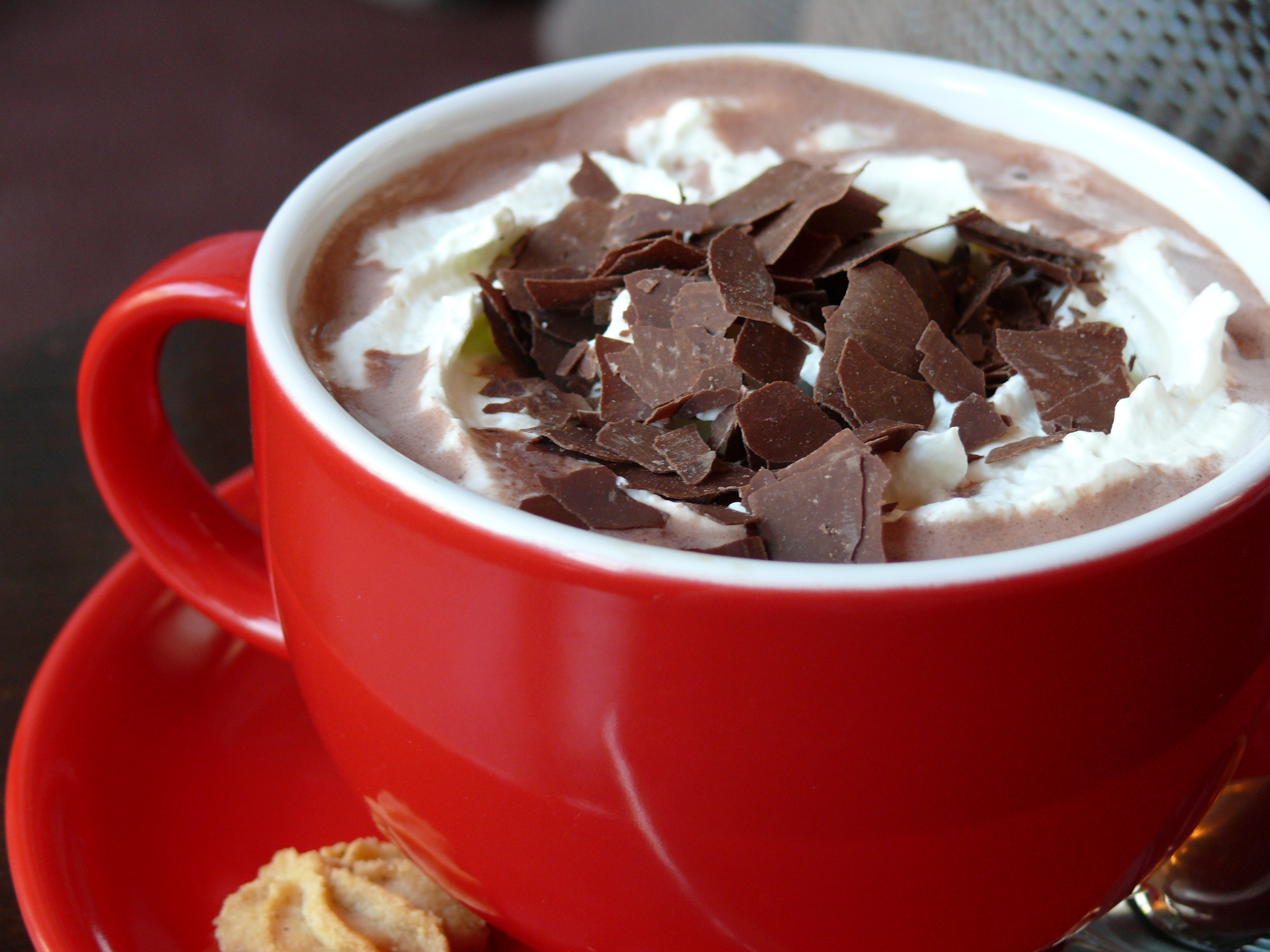
Schokolode by By Itisdacurlz via Wikimedia Commons
As alluded to in Mrs. Clarke’s poem, herbal teas brewed from native American roots and plants, and small beer (the Colonial version, made with very low alcohol content) were two beverages of choice. In addition, coffee gained great popularity (to this day, still ranking higher than tea consumption on the western side of “The Pond,”) and my personal favorite, chocolate, maintained its place at Colonial American tables. (***Interesting Chocolate Factoid!*** Although drinking chocolate had been the delicious norm for centuries, did you know that, other than chocolate used to flavor baked goods, there was no form of solid “eating” chocolate prior to 1830? A big “Thank You” to England’s Joseph Fry and Sons for all the leftover chocolate Halloween candy taking space in my cupboard! Of course, it won’t be there for long.)

Mint Tea By Onderwijsgek via Wikimedia Commons
The non-tea “teas” brewed in the Revolutionary era, were often made by steeping the leaves of strawberry, rhubarb, blackberry, or goldenrod plants. One favorite was called “Balsamic Hyperion” brewed from dried raspberry leaves and another called “Liberty Tea,” was made from the leaves of a plant aptly named loosestrife.

Well, time for a cup of tea, I think…or coffee…or maybe small beer…or hot chocolate. Yeah, definitely chocolate! (Just for research purposes, of course…) 


Have a good couple weeks, dear Reader. Thanks for stopping by...Y'all come back now!
Kate

Wednesday, October 22, 2014

300 Years of Haunted Edenton...taking the Ghost Walk in my hometown

Edenton's 1767 Courthouse (photo by K.L. Wood)
When you live in a town which is over 300 years old with many homes continuously occupied since the 1700s you have to expect there to be a few hauntings…or at least stories of haunted houses and spectral visitations. This year, my family and I went on the town's annual October evening walking tour: the Edenton Ghost Walk.

Young women from John A. Holmes High School carried candlelit lanterns to help illumine our path along the uneven, often brick, walkways in the dark of night. But what a perfectly beautiful night it was! Cool and crisp with bright stars above us, quiet enough to hear the water lapping gently against the town docks.  Our tour guide led us by several homes and buildings and shared their stories...historical and suitably creepy. Come close, dear Reader, and I will tell you some tales…but keep in mind these are just a few of what we heard and these are limited to the area in which we walked. Edenton is full of many more homes filled to the brim with lore and legend.

Standing outside the 1767 Edenton Courthouse, our guide told us of an eighteenth century man who committed several crimes and was tried and convicted in the historic building. Once sentenced to a lengthy imprisonment, he bolted to the front door and tried to escape. The exit was locked from the outside and he beat futilely on the heavy wooden door hoping someone would unlock it and let him out. The man ultimately died in prison. People walking by the old courthouse, late at night, sometimes hear the sound of banging as they pass the door.

Beverly Hall is a beautiful and stately mansion, built as part bank, part residence in 1810. It
Beverly Hall, photographed in 1936 by Frances Johnston
is home to a particularly grisly tale. It seems there was a clerk working in the bank who was discovered to have been swindling the townspeople out of their hard earned money. One night, the clerk saw a crowd of disgruntled people coming toward the Hall carrying torches and all manner of weaponry. He decided to shoot himself before the angry mob reached him. Disappointed at not being able to bring the man to justice, they took his corpse to the old Courthouse, sat it up for “trial,” accused and sentenced him to “death,” and then carried his body back to Beverly Hall where they strung him up in a tall tree in the backyard. There they left him for crows to pick his corpse apart. Today there appears to be an unusual amount of crows that hang out on Beverly Halls lovely grounds…looking for more, perhaps?

Built in 1850, elegant Pembroke Hall is popular today as a gorgeous wedding venue. Every weekend from spring through fall, festive white tents pop up on its generous grounds for happy couples to exchange their vows and celebrate their union. One hopes the brides do not encounter the spirit of a man who has been seen there, wearing a Confederate uniform and bearing horrific facial wounds from a Civil War battle in which he lost his life.
Pembroke Hall, Edenton (photo from visitedenton.com) 

Speaking of bridesanother lovely home is the source of a sad tale of a happy eighteenth century bride who decided it would be fun to play hide and seek with members of the wedding party on the day of the nuptials. During the game, the bride went missing and although the guests searched thoroughly and called her name repeatedly, she was never found. With a number of pirates wandering the streets, it was feared and assumed she must have been kidnapped by some dastardly piratical crew. Generations later, after the house had changed ownership a few times, a woman went into the attic and witnessed a filmy form sweep past her and hid for a far corner. The woman peered into the far recesses of the attic and found a beautiful wooden chest she thought might make a lovely coffee table. When the chest was brought down and opened, the body of long dead woman in a wedding dress lay within. Apparently the unfortunate bride hid in the chest during the game and it locked on her, sealing her in and sealing her fate.

Another story involves the restoration of the Roanoke River Lighthouse, in active
Roanoke River Lighthouse, Edenton (photo by K. L .Wood) 
commission from 1886 to 1941. This is the original lighthouse that marked the entrance of the Roanoke River into Albemarle Sound. In recent years it was moved from its working site to Edenton’s harbor where it has undergone extensive renovation and is now open for tours. Part of the restoration involved removing some sad, old carpeting. One of the workmen was bending over and pulling up a section of the carpet when he felt a hard and distinct kick on his backside. Looking around he expected to see he had bumped into something but there was nothing anywhere near him that could have caused the sensation. Evidently, one of the old keepers was indignant at the man’s removal of his beloved carpet!

As I have stated before, living in a 300 year old town is a wonderment and an inspiration. I hope you can come and visit our town someday…perhaps you will experience your own spirited encounter!

Have a good couple weeks, dear Reader. Thanks for stopping by...Y'all come back now! (And beware of things that go bump in the night!)


Kate

Wednesday, September 10, 2014

Moonstruck...Native American names for each full moon

"Bluemoon (1)" by Craig Deakin from Newcastle Upon Tyne, United Kingdom
 - Licensed under Creative Commons Attribution 2.0 via Wikimedia Commons - 
I’m back! Completed my first draft of Through the Hourglass and on to the editing phase. (Because of my intense writing schedule, I will be posting new blog posts every two weeks for the foreseeable future.)

We’ve just experienced our third and final Super Moon of 2014 this past Monday, September 8th. Granted, in my part of the world, rainy skies precluded viewing the Super Harvest Moon, however, there is some argument in the astronomical community over whether or not the full moon on October 8th could also be considered a Super Moon. If it were, it would be a Super Hunter’s Moon. (Also known as a Super Blood Moon and, this year, coincides with a full lunar eclipse as seen in North America!) Whew! A whole lot of lunar action going on. It’s a wonder we’re not all moonstruck lunatics! To learn more about the eclipse, see this website: 
"Supermoon" by Peter2006son - File:Supermoon - Howrah 2011-03-19 1881.JPG.
 Licensed under Creative Commons Attribution 3.0 via Wikimedia Commons - 
http://earthsky.org/tonight/total-lunar-eclipse-blood-moon-hunters-moon-october-7-8-2014#eclipse
A Super Moon is one in which it comes to its fullest phase on the same night it swings closest to the earth, at its perigee. (As opposed to when it’s at its most distant, apogee.)  All that’s fine scientific information to know but I’m in love with the names Native Americans gave each full moon, names adopted by our Colonial American ancestors. Each full moon was named to represent something important going on in the natural world, a world in which our ancestors (Native American and otherwise) lived in much more direct contact than do most of us today.
 So, here is a list of those full moon names, some of their alternatives, and an explanation of each (Thanks to the National Geographic website for this fascinating information.) 
January: Wolf Moon
Native Americans and medieval Europeans named January's full moon after the howling of hungry wolves lamenting the midwinter paucity of food. Other names for this month's full moon include old moon and ice moon.
"Blue Canyon Moon (5020077179)" by John Fowler from Placitas, NM, USA -
Licensed under Creative Commons Attribution 2.0 via Wikimedia Commons - 
February: Snow Moon
The typically cold, snowy weather of February in North America earned its full moon the name snow moon. Other common names include storm moon and hunger moon.
March: Worm Moon
Native Americans called this last full moon of winter the worm moon after the worm trails that would appear in the newly thawed ground. Other names include chaste moon, death moon, crust moon (a reference to snow that would become crusty as it thawed during the day and froze at night), and sap moon, after the tapping of the maple trees.
By Hahn Family Wines (Flickr: Harvest Moon8.JPG)
 (http://creativecommons.org/licenses/by/2.0)], via Wikimedia Commons
April: Pink Moon
Northern Native Americans call April's full moon the pink moon after a species of early blooming wildflower. In other cultures, this moon is called the sprouting grass moon, the egg moon, and the fish moon.
May: Flower Moon
May's abundant blooms give its full moon the name flower moon in many cultures. Other names include the hare moon, the corn planting moon, and the milk moon.
June: Strawberry Moon
In North America, the harvesting of strawberries in June gives that month's full moon its name. Europeans have dubbed it the rose moon, while other cultures named it the hot moon for the beginning of the summer heat.
July: Buck Moon
Male deer, which shed their antlers every year, begin to regrow them in July, hence the Native American name for July's full moon. Other names include thunder moon, for the month's many summer storms, and hay moon, after the July hay harvest.
"Harvest Moon" by Original uploader, Roadcrusher at en.wikipedia - 
August: Sturgeon Moon
North American fishing tribes called August's full moon the sturgeon moon since the species was abundant during this month. It's also been called the green corn moon, the grain moon, and the red moon for the reddish hue it often takes on in the summer haze.
September: Harvest Moon
The most familiar named moon, September's harvest moon refers to the time of year after the autumn equinox when crops are gathered. It also refers to the moon's particularly bright appearance and early rise, which lets farmers continue harvesting into the night. Other names include the corn moon and the barley moon.
October: Hunter's Moon
The first moon after the harvest moon is the hunter's moon, so named as the preferred month to hunt summer-fattened deer and fox unable to hide in now bare fields. Like the harvest moon, the hunter's moon is also particularly bright and long in the sky, giving hunters the opportunity to stalk prey at night. Other names include the travel moon and the dying grass moon.
"Hard to focus on! (4317424759)" by Bernal Saborio from Costa Rica
- licensed under Creative Commons Attribution-Share Alike
November: Beaver Moon
There is disagreement over the origin of November's beaver moon name. Some say it comes from Native Americans setting beaver traps during this month, while others say the name comes from the heavy activity of beavers building their winter dams. Another name is the frost moon.
December: Cold Moon
The coming of winter earned December's full moon the name cold moon. Other names include the long night moon and the oak moon.
The Blue Moon
Each year, the moon completes its final cycle about 11 days before the Earth finishes its orbit around the sun. These days add up, and every two and a half years or so, there is an extra full moon, called a blue moon. The origin of the term is uncertain, and its precise definition has changed over the years. The term is commonly used today to describe the second full moon of a calendar month, but it was originally the name given to the third full moon of a season containing four full moons.
From Amazon.com
*And on a less scientific but very romantic note dear Reader, in the 1920’s while on a trip from New York City to Miami, lyricist Benny Davis, pining for his sweetheart and seeing a beautiful moon reflected in the Perquimans River as he crossed the bridge in Hertford, North Carolina (just up the road from my Edenton,) penned the words to the famous song “Carolina Moon”. …Carolina Moon, keep shining, Shining on the one who waits for me…*
Have a good couple weeks dear Reader. Thanks for stopping by...Y'all come back now!

Kate