Showing posts with label Alaska. Show all posts

Wednesday, September 2, 2015

Following in Big Footsteps...Big Foot Legend and Lore

"Peyto Lake" photo by KLWood
When my husband and I spent several months wandering around in the wilds of the far north and west--Canada, Alaska, Washington, Oregon--it was easy to imagine all kinds of creatures prowling about unseen, watching us and our two little dogs. Usually we were on the lookout for mountain lions, wolves, moose, black bears and grizzly bears (all of which we encountered in the wild except for the mountain lions. We only saw mountain lion warning signs along a trail in Washington where one had recently been spotted.) We spent a fair share of our time alone on back trails singing at the
"Wrangel-St Elias Moose" photo by KL Wood
tops of our lungs so as not to surprise one of these lovely large beasts. The one critter of which we saw neither hide nor hair was Big Foot AKA Sasquatch. In my recent research I have discovered that Big Foot isn't just the product of overactive imaginations of backwoodsmen perhaps out on the trail a little too long. There is a long history and tradition of tales of big, hairy man-like creatures throughout the cultures of Native American and First Nation Peoples of the northwest. 
Native American tribes all over the continent have stories of wild, hairy people of the woods and plains but those outside the northwest tend to be the opposite in stature and known as Little People.


"Alaskan Grizzly" photo by KLWood
The Big Foot (Big Feet?) as described by natives of the northwest pretty much match the classical image we have of the creature--hairy, smelly, six to nine feet tall, strong, reclusive, elusive and night-foraging. The Athabaskan people of Alaska know of a creature called Wood Man/Woodsman. Wood Man is usually a solitary being who sneaks around quietly, remaining hidden from humans and does no real harm although he can be mischievous, stealing items from the villages. They have even been known to come to the aide of their stronger-brained but weaker-bodied human neighbors. In some tribes he is known to be more aggressive, stealing children and attempting to mate with humans. Depending on local tradition, he is either one immortal being, as believed by the Ahtna people, or is part of a larger community of male and female Wood Men. None are considered in any way sophisticated and communicate only with whistles, grunts, and sign-language. 


The Author and Big Foot (photo by the author's husband, Bill Ahearn)
The creatures are known by many different native-language names as well as Wood Man, Hairy Man, and the more violent varieties known as Bush Indians and Stick Indians.

Whatever you call them, I think you might not want to surprise or startle them anymore than you would a bear or a moose. So, I invite you to take a page from our backcountry hiking songbook and when you find yourself alone in the deep, dark northern wilderness fill your lungs with the fresh, wild air and SING! Our song of choice? "We All Live in a Yellow Submarine." Worked wonders.

Have a good couple weeks, dear Reader. Thanks for stopping by...y'all come back now! 

Kate


Wednesday, August 5, 2015

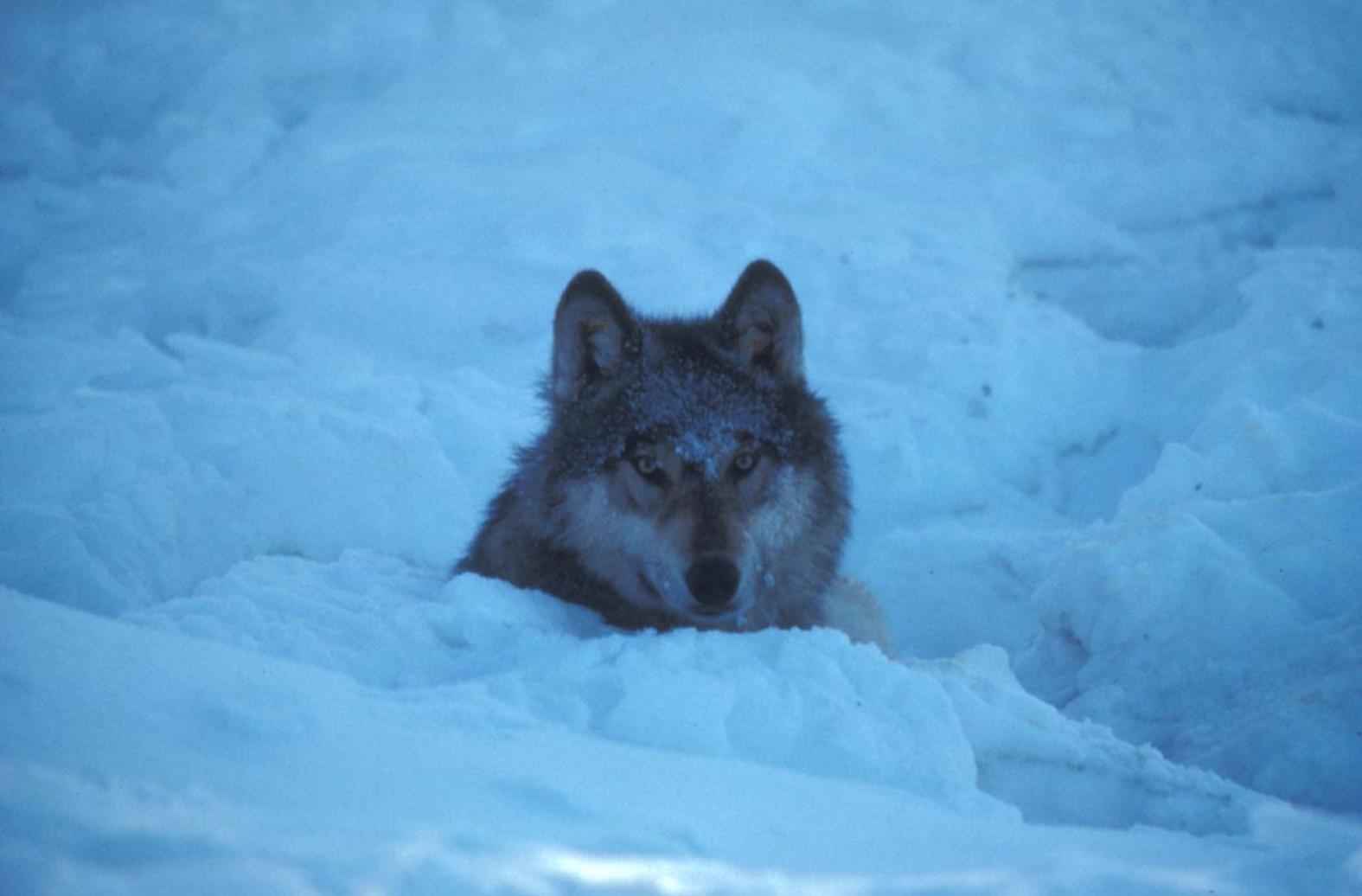
Close Encounters of the Wolfish Kind...Amarok of the North

By U.S. Fish and Wildlife Service [Public domain], via Wikimedia Commons
Ever since I stroked the thick, coarse hair of a wolf in "goodwill ambassador's clothing," I have had a fascination with wolves. Many years back in my college days at Old Dominion University in Norfolk, Virginia, a group of people dedicated to preserving and protecting wolves brought a pair to campus for a hands-on experience. They also showed us an informative and heartrending film about the plight of the wolf in the wild--how it was hunted down for its coat or for its undeserved reputation as a savage killer. I would like to think such actions are now a thing of the past but, having recently encountered a man in Alaska who bragged about how many wolf pelts he bagged on a regular basis, I am disheartened to know such exploitation still exists. OK. Now that I've gotten that particularly bitter pill out of my system, I will share the Inuit mythology of Amarok, the Wolf God. 

Amarok is a wolf-being of enormous stature, far larger than normal wolves. It is thought the
By Scott Flaherty [Public domain], via Wikimedia Commons
basis for Amarok may be in the real life interaction between the Inuit people and now-extinct animals, particularly the Dire Wolf, a formidable predator that prowled the northern landscape until the end of the Ice Age. It was about 25% heavier than the largest of modern wolves. Skeletal remains put them in at about five feet in length, from head to tail, and between 150 and 200 lbs. 


Unlike ordinary wolves, Amarok does not hunt in a pack but is the quintessential "Lone Wolf." It is said he is quick to kill anyone who is foolish enough to hunt alone in the dark of night. Perhaps he is just culling the herd as real-life wolves do when they kill the weak and sick, an action that increases the health and strength of the herding animals. Instead of pulling out the weak caribou, he is eliminating the weak-minded humans! (And, of course, I mean weak-minded in the sense of foolish--not mentally challenged.) 


By U.S. Fish and Wildlife Service [Public domain],
via Wikimedia Commons
Although Amarok is known as a fearsome deity, there is at least one story told of his kindness. There was a young Inuit boy who was chided and bullied by people of his village due to his stunted growth and subsequent frailty. In frustration he called out to the Lord of Strength to help him. Amarok appeared and wrestled the boy, easily pinning him down with his heavy tail. In the struggle, several small bones fell from the boy's body--bones which, Amarok explained, were prohibiting his growth. He told the boy to return each day and he would wrestle with him to build up his strength. The boy trained with Amarok until he was so strong he overcame three large bears with his own hands. That duly impressed the other villagers who then held him in highest regard.

Although I did not get to see a wolf, myself, on our journey through Alaska, my husband
Wolf Print by Copper River, Alaska by KL Wood (author)
encountered one at dusk while walking our two small dogs. We were the lone campers by the Copper River near Wrangell St. Elias National Park and I was busy inside our little travel trailer making us cups of tea. Bill burst through the door and practically threw the dogs in ahead of himself. He had seen what at first appeared to be a very large dog closely monitoring their progress but, when it disappeared into a ditch and then reappeared ghost-like much closer to them, he realized it was a wolf. Tawny and gray, with intent, intelligent eyes focused on our little, black shaggy pups. The next morning, I saw and photographed large canine-type paw prints just a few yards from our trailer. When the larger of our dogs, Betsy--weighing in at 25 lbs, stepped on the ground, she barely made any indentation at all. As you can see from my photo, the wolf's 4-inch long prints made a very visible impression. Wow.


Lessons learned? Don't go out hunting...or walking your dogs...alone at night (or at dusk) in the northern wilderness. Unless, of course, you are that wolf-killer I mentioned earlier, then...go ahead, make my day. All Hail Amarok! 

Have a good couple weeks, dear Reader. Thanks for stopping by...y'all come back now! 

Kate


Wednesday, July 22, 2015

The Real Tickle Monster...not so funny!

 "A-maze-ing Laughter" by Yue Minjun, Vancouver, British Columbia-
photographed  by Antony Stanley via Wikimedia Commons
As we swelter in the deadening heat of summer, my thoughts return again to the colder regions of the far north-- Canada and Alaska (although I hear it's been a long, relatively hot summer up there as well this year!) In researching Inuit legend and lore, I ran across a particularly diabolical creature aptly named "Mahaha."

Why aptly named? Well, because Mahaha tickles his prey to death. Literally! Any of us who have ever fallen victim to aggressive ticklers who were unrelenting, even when we gasped for breath and begged them to stop, can imagine the unique horror of being tickled into twitching oblivion. Gives me the shivers just thinking about it. Those murdered by malicious Mahaha are usually found with agonized, twisted smiles contorting their faces. 

So, as a public service announcement to those of you lucky enough to go wandering the cooler lands up North, this summer, I am posting this all points bulletin, below.

Perpetrator's Name: Mahaha
Perp's Warning Sound: Giggling (usually from behind the victim)
Perp's Build: Scrawny with long bony fingers and razor sharp nails
Perp's Skin: Blue and icy cold
Perp's Eye Color: White
Perp's Hair: Long and Stringy, hanging over his face
Perp's Clothing: Nearly none and always barefoot
Perp's Strength: Powerful muscles
Perp's Weakness: Easily tricked
Last seen: Being swept away downstream in a strong current after his intended victim invited him to lean over for a drink of water and then pushed him in. 
Author and Husband, Kenai Fjords, Alaska, 2011


Enjoy your respite from the heat, fortunate northern adventurer, but be on alert. That giggle you hear sneaking up behind you just may be the excited delirium of Mahaha, the real Tickle Monster! 

Have a good couple weeks, dear Reader. Thanks for stopping by...y'all come back now! 

Kate


Wednesday, July 8, 2015

Now You See Them, Now You Don't...Shadow People of the Inuit

"Shadow Person" photographic illustration by K.L. Wood
What was that? Did you just see something flicker beside you but when you turned your head…it was gone? Optical illusion? Ghostly apparition?

The native Inuit people of the far northern climes of Canada and Alaska might say it was one of the shadow people. Among their many legends is that of the tarriassuit, the shadow people, who live alongside the Inuit in a kind of parallel universe. The origin of the tarriassuit is said to be of Inuit who strayed too far north on hunting trips and found themselves in a strange land halfway between the living and the dead. They could not leave this odd plane of existence and became beings with one foot in the visible and one foot in the invisible world.

The tarriassuit cannot usually be seen by humans but can sometimes be glimpsed from the corner of one’s eye. When they are, somehow, visible they are said to look and act just like contemporary Inuit…same clothing, hairstyles, hunting equipment and modes of
Map of Inuit Dialects per Wikimedia Commons
transportation. (That means snowmobiles in the 21st century.) Some Inuit say you can only see their shadows, hence the name shadow people, but can sometimes hear their footsteps and voices. There are Inuit legends that claim the amorphous creatures become visible when they die.

Although rare, it is said that sometimes humans can cross over into the land of the tarriassuit and even marry shadow people. There is the story of a woman who was wed to a shadow man but after some time she became frustrated with her inability to see her husband clearly. She grabbed a hunting knife and plunged it into the place she thought he stood. The shadow man fell dead to the ground, materializing into a handsome young man.
"Eskimo Figure, near Wrangell St. Elias Ntl Park, Alaska" photograph by Wm. Ahearn

The tarriassuit are thought of as kind, gentle, and helpful beings. The ending to the story of the murdered shadow husband is that, although the tarriassuit felt the need to seek revenge, they restrained themselves, believing it unfair to attack people who could not see them to fight back. This concept of benevolence is in sharp contrast to the tales of fear and horror associated with sightings of what current American ghost hunters call shadow people. I see the difference as how one society accepts and venerates that which is beyond our five senses versus another society (ours) that pushes other-worldly experiences into the realm of superstition and fear.

Have a good couple weeks, dear Reader. Thanks for stopping by...y'all come back now! 

Kate